Latin America's mega-prisons: Can El Salvador's model work?
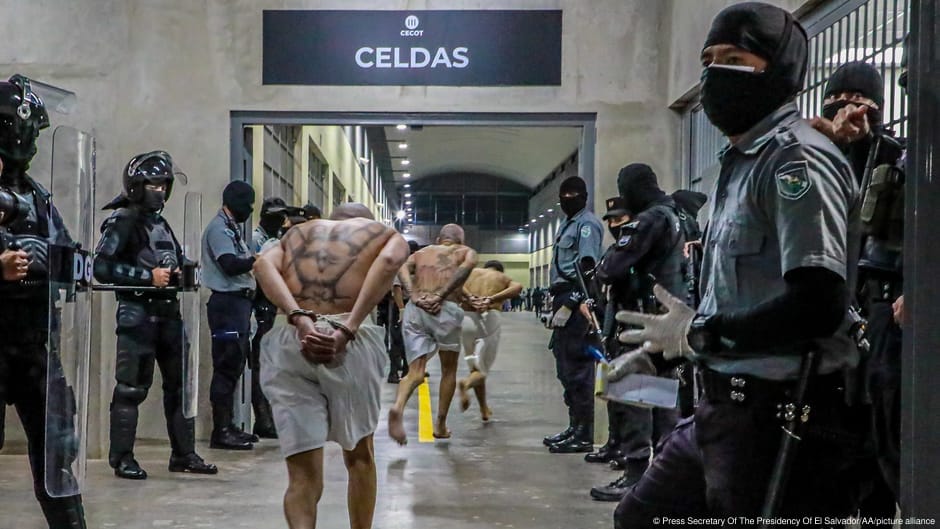
Inside El Salvador's Terrorism Confinement Center (CECOT). Image released by the El Salvador presidential press office following its inauguration in 2023Image: Press Secretary Of The Presidency Of El Salvador/AA/picture allianceAdvertisementAround 15,000 inmates and a capacity of up to 40,000, prison sentences of up to 1,000 years, strict security measures and an extreme isolation regime. Staged images show inmates with shaved heads and tattoos being subdued by heavily armed guards.
These are just some of the facts circulating about El Salvador's Terrorism Confinement Center (CECOT), a symbol of President Nayib Bukele's security policy and a possible model for other Latin American countries seeking to combat organized crime.
More than a dozen governments in the region have proposed building similar "mega-prisons," although most would have a far smaller capacity. A range of experts consulted by DW question the effectiveness and sustainability of these initiatives.
De facto mega-prisons — that is, overcrowded prisons with excessive inmate populations — existed in Latin America long before Bukele, says criminologist Jose Luis Perez Guadalupe, former president of the National Penitentiary Institute and former interior minister in Peru. Lurigancho Prison in Lima, for example, designed to hold 3,000 inmates, has housed nearly 11,000 for decades.
But ever since CECOT was launched in 2023, the concept of a "mega-prison" has been primarily linked to maximum-security facilities. For Olga Espinoza, an academic specializing in prison systems at the School of Government of the University of Chile, this association is problematic because it implies that the entire prison population requires "extremely severe" punishment.
According to Espinoza, placing the entire prison population in maximum-security facilities would amount to inefficient and extremely costly "over-intervention." These facilities require substantial investments in infrastructure, technology, specialized staff, anti-corruption measures and social reintegration programs.
It would also be ineffective because "international evidence indicates that when people with different profiles are placed in the same space, there is a high risk of the spread of criminal behavior," the Chilean expert adds.
Several criminal groups across the region even have their roots in overcrowded prisons: Tren de Aragua in Venezuela; Los Lobos, Los Choneros and Los Tiguerones in Ecuador; and Primeiro Comando da Capital (PCC) and Comando Vermelho (CV) in Brazil.
Even when the proposal involves simply building large-scale facilities, investing in a single structure may seem attractive given the difficulties of developing public infrastructure in Latin America.
However, "there is insufficient evidence to support the claim that building mega-prisons is more cost-effective," says Renato Rivera, a senior analyst at the Global Initiative Against Transnational Organized Crime (GI-TOC).
The United Nations Standard Minimum Rules for the Treatment of Prisoners, adopted in 1955, "the recommendation has been to build medium-sized prisons housing between 1,000 and 2,000 inmates rather than mega-prisons," explains Perez Guadalupe, a professor at the Universidad del Pacifico in Lima.
"Mega-prisons, apart from being impersonal, can become extremely dangerous," says Guadalupe. As an example, the GI-TOC's Rivera highlights the widely reported prison massacres in Ecuador in 2021 that took place in the country's largest and most populated facilities.
Experts acknowledge that mass incarceration has coincided with a dramatic decline in violence in El Salvador and has strengthened the public's perception of safety. Despite reports of arbitrary arrests, abuses and more than 500 deaths in state custody in the country, announcements of new mega-prisons project an image of a strong state confronting organized crime across the region.
However, they warn that this political and symbolic impact does not guarantee sustainable results. Achieving them would require a "clear commitment" to external oversight, human rights protections and social reintegration programs, which governments have yet to demonstrate, Espinoza says.
Perez Guadalupe is particularly critical of the Salvadoran model, describing it as "pure propaganda." He believes the images released from CECOT violate human dignity. He also argues that the state must demonstrate "moral superiority over those who break the law."
Although transnational organized crime represents a growing challenge across the region, the Peruvian criminologist considers El Salvador's case exceptional.
Following the mass arrests carried out under the state of emergency introduced by Bukele, the country has one of the highest incarceration rates in the world. CECOT was designed to permanently detain members of gangs such as MS-13 and Barrio 18, which are considered extremely dangerous.
However, the reality of other Latin American prison systems is different. The question is not where to lock people deprived of their liberty away forever, but rather "how we want them to leave: worse or better," Perez Guadalupe argues, pointing out that most will eventually return to society.
In theory, the official alternative is provided by the UN Nelson Mandela Rules for the treatment of prisoners, updated in 2015. They establish principles for modern prison management, including respect for human dignity, an absolute prohibition on torture and degrading treatment and social reintegration as a central goal of imprisonment.
In practice, Latin America has developed innovative approaches in this direction. These include the APAC model in Brazil, which operates facilities without guards, weapons or violence; Conflict Prevention and Resolution Committees in Argentina; and the Alternative Criminal Justice Center in the Mexican state of Sonora.
Experts also point to the need for maximum-security prisons for specific inmate profiles, but on a smaller scale and with more precise classification of the prison population.
Finally, they emphasize that prisons, including mega-prisons, primarily address the consequences of organized crime rather than its root causes. Poverty, social exclusion and a lack of opportunities require public policies focused on employment, education and social integration to reduce the conditions that enable crime to expand in one of the world's most unequal regions.
This article was originally published in Spanish.