
Lawmaker invigorates Lula campaign with social media push - Valor International
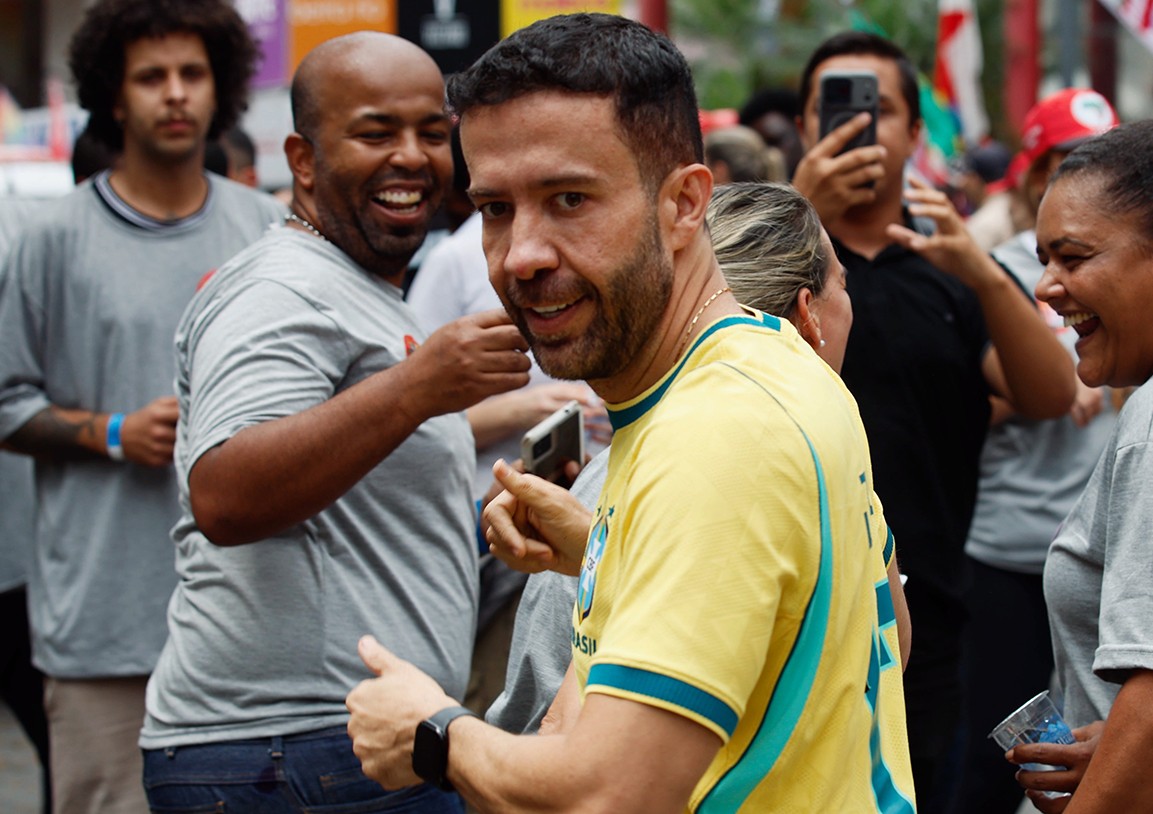
“Folks, urgent!” “The strategy I’m about to send you will decide the election once and for all.” “Blow it up [the sharing].” “Push the hashtag and share it on WhatsApp.” The orders to supporters of President Luiz Inácio Lula da Silva (Workers’ Party, PT) keep coming throughout the day, fired off by Federal Deputy André Janones (Sustainbility Network, REDE, Minas Gerais) to the “Exército do Lula” (Lula’s Army), a WhatsApp channel with more than 6.7 million followers. “It’s the challenge of your lives.”
Janones, or “General Janones,” as he has come to be called on social media, is one of the people chiefly responsible for the digital strategy of Lula’s runoff campaign against Senator Flávio Bolsonaro (Liberal Party, PL, Rio de Janeiro). The lawmaker helped turn around the PT candidate’s campaign against Flávio. With his orders and guidance, Janones has driven and mobilized pro-Lula demonstrations on X, Instagram, and Facebook, and in the streets.
On Friday (16), for example, he fueled a “panelaço” (pot-banging protest) against Flávio during the senator’s interview with TV Globo. The next day, he encouraged people to post photos of themselves wearing the colors of Brazil and making the “L” for Lula. “The far right will never again have hegemony on social media, because the knowledge I have, [about] the way the algorithm works, I’ve already passed on,” Janones says.
With Lula trailing at the ballot box in the first round, when he finished behind Flávio (47.03% for the senator to 45.15% for the PT candidate), the campaign sounded the alarm and deployed a “shock troop”—or rather, an “Exército do Lula”—to help with digital strategy. Since the start of the runoff, the channel has grown from 50,000 followers to more than 6.7 million.
The lawmaker understands the language of social media and in 2022 took on the same role to blunt some of Bolsonarismo’s strength in that arena. This time, he counts on newly elected colleagues with a digital presence, such as Ana Elisa (PT of Minas Gerais), Guilherme Cortez (Socialism and Liberty Party, PSOL, São Paulo), Jones Manoel (PSOL of Pernambuco), and Erika Hilton (PSOL of São Paulo). “In 2026, I started to be listened to more. What I know, I started learning 10 years ago, and I learned by observing. I wasn’t listened to as much as I am today,” he says.
In recent weeks, the lawmaker says, he has endured “sleep deprivation” and neglected his eating and hydration to devote himself to the campaign. In the early hours of Monday, after the TV Band debate, he was admitted to the ICU of a São Paulo hospital with a cardiac arrhythmia. He was discharged Tuesday and greeted by an “army” of supporters.
“Cultural Janonism,” as the lawmaker’s approach is known, shares space in the campaign with a younger profile. The group’s ideas and suggestions were adopted by Lula, who began making videos seen as more relaxed and less institutional in tone. “We ran over the far right on social media. By bringing together a people who truly believe in democracy,” he says.
Janones is at the center of a dispute with the Superior Electoral Court (TSE). The channel he runs was taken offline at least twice at the request of Flávio’s campaign, which alleged the use of “fake news” on it. The situation caused unease within the court. TSE President Kassio Nunes Marques clashed in a back-and-forth of conflicting rulings with the court’s electoral inspector-general, Ricardo Villas-Bôas Cueva. As a result, the channel was offline for about 24 hours on the 14th. Nunes Marques argued that the channel was not registered as an official Lula campaign medium. The “Tropa do Flávio” channel, linked to the senator, was also not registered with the TSE but faced no penalties.
The lawmaker caught Bolsonarists’ attention in 2022 when he posted a text referring to a video of then-president Jair Bolsonaro speaking at a Masonic lodge. “Urgent: atheist Satanists of Freemasonry ask that Bolsonaro be elected to represent them,” the message read. The episode embarrassed the Bolsonaro campaign with evangelicals. He detailed these stories and tactics from the 2022 campaign in the 2023 book “Janonismo Cultural: O uso das redes sociais e a batalha pela democracia no Brasil” (Cultural Janonism: The use of social media and the battle for democracy in Brazil).
According to the lawmaker, the clashes follow no previously worked-out strategy and proceed from the premise that the election period is a matter of urgency. He says he monitors what is shared on social media and on pages aimed at voters, filtering for the topics that may be most pertinent. “There’s no point in showing more scandals from the opponent; nothing will have an effect on his most loyal bubble. We will win with arguments.”
Agnaldo Montesso, a researcher at the University of São Paulo’s Institute of Advanced Studies, analyzes the tactics used by the lawmaker and described in the book. He says that in 2022 Lula’s campaign criticized the way the lawmaker handled communications, but that Janones is now the one filling the space, since the traditional approach is not proving effective.
Montesso likens the strategy to guerrilla tactics, with Janones as the army’s commander, but questions its effectiveness. “It brings engagement, but at what point has it convinced undecided voters, or those who voted for other candidates, to trust Lula? He is right to adopt this tone of urgency because the election is now and the campaign has no time to lose,” he says. One strategy that stands out is the mass distribution of information through WhatsApp “status” updates, which, according to the researcher, are not subject to the algorithm.
Leticia Cesarino, an anthropologist and professor at the Federal University of Santa Catarina (UFSC), assesses the landscape: “With the first-round result, there was an awakening, and that was a window of opportunity for the people who have always advocated using social media to gain ground.”
Even so, the anthropologist sees the movement as arriving late. Cesarino stresses that, regardless of the election period, the strategy is causing political leaders to reposition themselves on social media. “It’s not about using the enemy’s same tactics, but about speaking in the same terms. Alongside all of this is people’s digital literacy and an understanding of how to use the algorithm.”
This article was translated from Valor Econômico using an artificial intelligence tool under the supervision of the Valor International editorial team to ensure accuracy, clarity, and adherence to our editorial standards. Read our Editorial Principles.
