Learnt Hindi from Bachchan, now Afghanistan's Sharafuddin is commentating in India
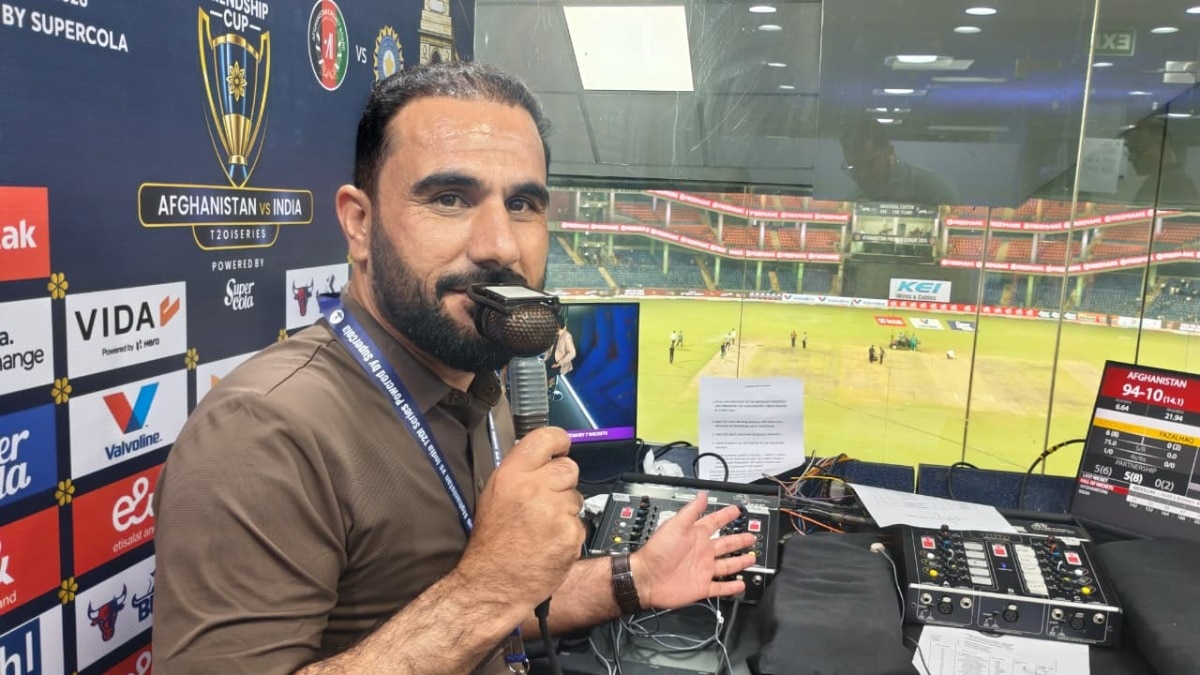
Sharafuddin Shakir had begun his Hindi commentary on Sony Sports, the official broadcaster of Afghanistan’s ‘home series’ against India, aware that the voice coming out of the microphone was being heard by an audience far larger than the one he was used to back home in Afghanistan. The legendary Gavaskar, seated next to him in the commentary box at Arun Jaitley Stadium, was observing him closely.
It was a small gesture, but Shakir noticed it.
“He gave me a thumbs-up gesture, signaling 'You speak Hindi so well!' You could see the appreciation on his face,” Shakir recalled in his chat with IndiaToday.in.
There is something almost circular about the moment. Shakir grew up in Afghanistan watching Indian cricket on television. Now, sitting in an Indian commentary box, he was speaking the language he had picked up largely from watching Indian films as a boy, while Gavaskar listened.
For an Afghan commentator, it was quite a journey to make.
If you heard an unfamiliar voice on the Hindi commentary during the Afghanistan-India Friendship Cup in Delhi, it belonged to Shakir, who travelled to India for the series. He has been commentating in Pashto for around 15 years, but this assignment offered something he had long wanted to experience: doing Hindi commentary in India, for Indian viewers.
He was making his second trip to the country. His first came in 2017, when he worked on Hindi commentary for Afghanistan's series against Ireland for Doordarshan.
This time, the setting was different. So were the names around him.
Sanjay Manjrekar, Sunil Gavaskar and Ajay Jadeja were among those sharing the commentary box.
“I was in the commentary box with Jadeja as well,” Shakir said.
“I told him that there was a time when we only wished to see you. But today God brought the day where I am sitting with you, seeing you, and doing commentary alongside you.”
Shakir is not someone who arrived at commentary through a conventional broadcasting route. He played cricket in Afghanistan at domestic level, though never First-Class cricket. He studied Political Science at Avicenna University in Kabul and later joined the Afghanistan Cricket Board, where his career took him through several roles: from the head of the CEO's office to HR, media, deputy spokesman, game development and the domestic department.
He also completed Level 1 coaching through the Emirates Cricket Board, with ICC-certified instructors.
All of that has found its way into his commentary.LEARNING HINDI FROM BOLLYWOOD India Today Photo
But if cricket gave Shakir his profession, Bollywood helped give him his Hindi. He has been watching Hindi films since childhood. In Afghanistan, Indian cinema was not some distant cultural curiosity. It was part of growing up.
Ask him how he learnt to speak Hindi so comfortably and he goes back to the films.
“People don't just watch cricket; Hindi films are also watched with great fondness,” he said.
One film, in particular, stayed with him: Khuda Gawah, the 1992 Amitabh Bachchan-starrer that was filmed partly in Afghanistan.
Bachchan's presence in Kabul and the film's portrayal of Afghanistan left an impression on Shakir and many others. He remembers the film almost as a cultural bridge, one of the things that helped make India familiar to Afghans long before he ever sat in an Indian commentary box.
It is why his love for Bachchan is not simply that of a Bollywood fan admiring a famous actor.
“He came to Kabul as well,” Shakir said, referring to Bachchan. “Shooting took place there, as well as in Kunduz province, Baghlan, and other provinces.”!From Amitabh Bachchan’s films to calling T20 matches in Hindi, Sharafuddin Shakir shares the story behind his journey into Hindi and Pashto commentary!Catch #AFGvIND 3rd T20I LIVE NOW on Sony pic.twitter.com/ESI4zGazgW— Sony Sports Network (@SonySportsNetwk) September 17, 2026
Now Shakir was in India himself, carrying that connection in a different direction.
“A Pathan from Kabul is doing Hindi commentary on Indian soil,” he said, with evident pride.
Shakir first picked up a microphone for Pashto radio commentary after a friend insisted that he had the voice and cricket knowledge for it. What began as encouragement from a friend eventually became a career spanning roughly 15 years.He has also become a podcast host in Afghanistan, adding another layer to his media work.GROWING UP WITH INDIAN CRICKET
But the love for cricket came before all of that.
As a boy, Shakir watched India play at a time when Afghanistan did not yet have a team capable of competing on the international stage. Indian cricket became something Afghan fans could follow closely.
“Before that, we used to watch India's matches and support the Indian team,” he said.
Sachin Tendulkar was among his heroes. Rahul Dravid belonged to the generation he grew up watching. And some of the players he once saw on television eventually became colleagues in the commentary box.
That transition is still something he seems to marvel at.
“In English, it's Ravi Shastri and Sanjay Manjrekar. In Hindi, Navjot Singh Sidhu — when he speaks, it's enjoyable,” Shakir said when asked about his favourite commentators.
Sidhu, in fact, became something of a teacher without ever knowing it. Shakir listened to him so closely that some of Sidhu's colourful expressions eventually found their way into his Pashto commentary.
There is another side to Shakir's cricket story that makes his current role more meaningful. He has seen Afghanistan's cricketing rise from inside the administration.
He has worked across departments at the Afghanistan Cricket Board and remains close to its chief executive, Naseeb Khan. He has watched the sport evolve from something Afghans followed on television into one of the strongest threads of sporting identity in the country.
“Cricket played a vital role in Afghanistan for peace, unity, and bringing people together,” Shakir said.
“Anywhere in the world, if you mention Afghanistan, people name Rashid Khan. Cricket and Afghanistan are now inseparable.”
Shakir has watched that transformation from close quarters. He has also watched the emergence of a new generation through Afghanistan's domestic system, which he describes as robust, with around 15 events a year across different age groups and formats, including First-Class, List A, National T20 and the Shpageeza League.
That is the administrator and cricket insider speaking.
But in Delhi, he was something else. He was the Afghan voice trying to win over an Indian audience.
Afghan cricketers have already done that in their own ways. Rashid Khan became a familiar IPL figure. Mohammad Nabi has been a popular presence in Indian cricket. Noor Ahmad has added another young Afghan name to that list.
Shakir arrived without a bat or ball to offer Indian fans. He had only his voice. And he brought it in a language he had learnt thousands of kilometres away, from television screens showing Amitabh Bachchan, Hindi films and Indian cricket.His first big Hindi commentary assignment in India may have been a professional opportunity, but it carried something more personal. He had spent his childhood watching Indian cricket from Kabul. Now, in Delhi, the cameras were pointed at him.
And somewhere inside the commentary box, when he began speaking, Gavaskar gave him the thumbs-up.- EndsPublished By: Akshay RameshPublished On: Sep 18, 2026 09:20 IST