Live: Trump, Putin, Xi unite in China's Shenzhen ahead of historic trilateral meet
The Chinese President stressed the need to strengthen capacity-building and promote regional energy and food security. He also called for a deeper fight against corruption, coordinated development of resources, the environment and population, and expanded cooperation in green and low-carbon development.
China's Xi Jinping called for greater digitisation of trade and investment, the promotion of smart customs and improved regional data governance. He also urged countries to build new pillars of cooperation driven by digital technology and artificial intelligence, while promoting regional economic agreements.
Chinese President Xi Jinping, addressing the 33rd APEC Summit, called for free and open trade, stronger regional economic cooperation and greater integration among Asia-Pacific economies. He stressed the need to uphold open regionalism, create a fair and non-discriminatory business environment and remove barriers to economic growth in the region.
#WATCH | Shenzhen, China: Russian President Vladimir Putin meets Chinese President Xi Jinping at the 33rd APEC Economic Leaders' Summit. (Source: Russian Pool via Reuters) https://t.co/PNWBE272ex
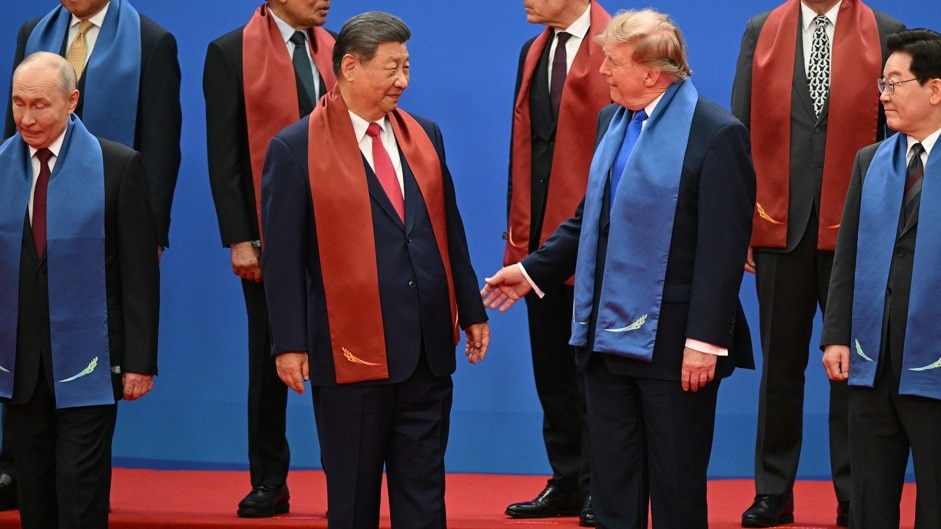
#WATCH | Shenzhen, China: World leaders, including US President Donald Trump, Russian President Vladimir Putin, and Chinese President Xi Jinping, pose for a family photo at the 33rd APEC Economic Leaders' Summit. (Source: Russian Pool via Reuters) https://t.co/Sko5L1M6P1
In a striking departure from diplomatic protocol, Xi Jinping personally received Donald Trump at the airport on Wednesday, welcoming him with a hug in a rare display of physical affection by the Chinese leader.
President Donald J. Trump arrives in Shenzhen, China, where he'll participate in the APEC Summit and historic meetings with world leaders. 🇺🇸 https://t.co/al4Exu09XD
The reception was particularly significant as it marked the first time a Chinese leader had personally welcomed a visiting head of state at the airport since Mao Zedong greeted Soviet leader Nikita Khrushchev nearly seven decades ago.
Xi's gesture was also seen as reciprocal to the reception Trump and the US presidential couple extended to the Chinese leader during his state visit to Washington in September.
The two leaders spent around 20 minutes exchanging pleasantries and watching formations of Chinese J-10C fighter jets put on a welcome display for Trump.
President Donald J. Trump greets Chinese President Xi Jinping as he arrives at the APEC Summit in Shenzhen. https://t.co/En2EK0FX7s
The Ukraine conflict and the Iran war are among the major geopolitical issues expected to feature in the trilateral discussions.
Nuclear arms reduction is also likely to be a key subject, particularly amid concerns over the future of global arms control following the expiry of the New START treaty between Washington and Moscow in February.
The White House has said Trump intends to discuss reducing nuclear weapons. However, Beijing has shown little enthusiasm for trilateral nuclear arms control, pointing to its significantly smaller nuclear arsenal compared with those of the US and Russia.
China has also repeatedly rejected the idea of a model of great-power co-governance in global affairs.
The discussions could additionally explore possible commitments on regulating the use of artificial intelligence in nuclear arsenals as part of a broader global governance agenda.
Chinese Foreign Ministry spokesperson Mao Ning said on Monday that the three presidents would exchange views in depth on safeguarding world peace and enabling strategic stability in relations between major powers. She described the summit as having groundbreaking significance.
Meanwhile, Kremlin spokesman Dmitry Peskov said Putin had been invited to the G20 summit in Miami next month, and the invitation could also come up during his conversation with Trump in Shenzhen, TASS reported.
Although the three countries have held weeks of discussions to finalise the agenda and protocol, observers believe the first-ever trilateral engagement could be more symbolic than substantive in terms of concrete outcomes.