Living beyond the kitchen sink: the battle for identity - IOL
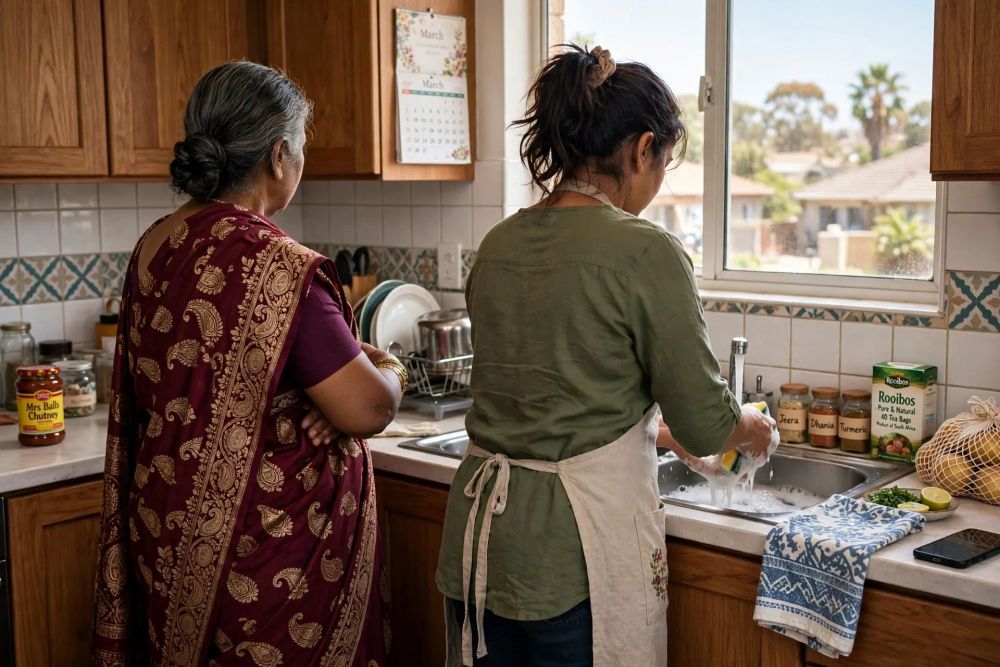
The writer says a kitchen sink is not a measure of a woman's character.
I RECENTLY came across a Facebook post in which an Indian mother-in-law praised her daughter-in-law and, among her compliments, celebrated her ability to take over the “household chores”. Something in me snapped. This is one of the most deeply entrenched problems in our Indian community: the conditioning of women to believe that their worth can be measured by how efficiently they run a household. What makes it even more disturbing is that women are often the ones perpetuating it.
We call this culture. From childhood, girls are often taught that domestic competence is not merely a useful life skill. It measures their character. A girl who cooks is “well brought up.” A girl who keeps a spotless home is “a good wife.” A daughter-in-law who anticipates everyone's needs is “a blessing”. But a woman who says, “I don't want to spend my life doing this” is sometimes labelled selfish, lazy, arrogant, or incapable of looking after a family.
Think about the absurdity of that. We take something that should be a shared human responsibility and turn it into a test of female virtue. And then we make women compete against one another for approval. Mother-in-laws judge daughters-in-law. Daughters-in-law compare themselves with other daughters-in-law. Women compare kitchens, children, clothes, careers, marriages, and cooking skills.
And somewhere in the middle of this exhausting Olympics of domestic perfection, nobody asks the most important question: Is she happy? Does she have dreams? Does she even know who she is outside her role as someone's wife, someone's daughter, someone's daughter-in-law, someone's mother?
We have become remarkably comfortable celebrating a woman's ability to disappear into service. The more she sacrifices, the more virtuous she becomes. The more exhausted she is, the more we praise her.
But perhaps we should stop romanticising exhaustion. Perhaps “she does everything” should not be a compliment. Perhaps it should make us ask why everyone else isn't doing something. A woman should not receive a medal because she managed to cook dinner while working a full-time job, raising children, caring for elderly relatives and maintaining an immaculate house.
She should receive the freedom to say, “Today I don't feel like cooking.” And the world should continue turning. We also need to stop pretending that domestic perfection is some sacred inheritance that must be passed from one generation of women to another. Your grandmother survived without a dishwasher. Your mother cooked for ten people. Wonderful.
But that doesn't mean your daughter has to repeat the same performance to prove she is worthy. Progress means the next generation gets to live differently. If technology can make life easier, use it. If a husband can cook, let him cook. If the children are old enough to clean, let them clean. If the family can afford help, employ someone.
And if a woman would rather spend Saturday morning writing a novel, painting, studying, exercising, sleeping, travelling, or simply doing absolutely nothing, let her. Her life does not become less meaningful because the kitchen floor has a footprint on it. And perhaps we need to ask why women are so often judged more harshly for an untidy home than men are.
A man can come home from work and be praised for being tired. A woman can come home from work and be criticised because supper isn't ready. A man who cannot cook is often regarded as amusing. A woman who cannot cook is sometimes regarded as deficient. That isn't tradition. That is a double standard. And we should be brave enough to call it what it is.
I don't want our daughters growing up believing that the ultimate achievement is becoming a woman who can do everything for everyone else. I want them to know that their lives belong to them. I want them to pursue education without being told that degrees are unnecessary because “what’s the point, because you are still going to wash pots and pans”.
And yes, if they enjoy cooking, let them cook. But let it be because they love cooking, not because they are terrified of being judged as a bad woman if they don't. Teach our daughters how to make a meal. But also teach them how to make money. Teach them how to keep a home. But also teach them how to build a career.
Teach them how to care for others. But also teach them how to care for themselves. Teach them how to serve food. But also teach them that they don't exist to serve everyone. And most importantly, teach our sons that a household is not a woman's unpaid workplace. Because until men are taught that domestic responsibility belongs to everyone, women will continue competing with one another over who can carry the heaviest load.
I don't want the next generation of Indian women competing over who can sacrifice the most. I want them competing over who can dream the biggest. Who can walk into a room without wondering whether someone has judged the state of her kitchen. The kitchen sink is not a measure of a woman's character. A spotless house is not evidence of a good marriage. A perfectly cooked meal is not proof of good motherhood. And exhaustion is not a personality trait. A woman is not here to win the Domestic Goddess Championship.
I want them to build businesses, write books, make art, travel, study. She is here to live. To think. To create. To discover. To become. And perhaps the most radical thing we can teach our daughters is this: You do not have to earn your worth by making yourself useful to everyone else. Your life can be about more than the people you serve. There is a whole world beyond the kitchen sink. Go and live in it.
Dr Shamila Ramsookbhai is a former art teacher and academic. She has authored two books. In between writing, she runs a pottery studio: www.theeatplayclayclub.co.za
** The views expressed do not necessarily reflect the views of IOL or post.co.za