
Living in the shadow of LA's hidden oil wells
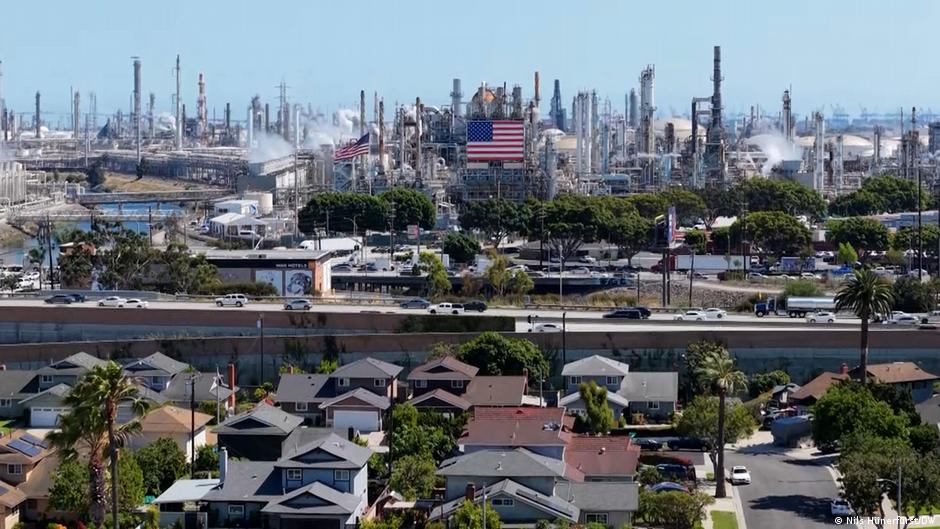
Homes back directly onto the Marathon refinery, the largest on the West Coast, illustrating how closely LA neighborhoods sit beside oil infrastructureImage: Nils Hünerfürst/DWAdvertisementFor most, Los Angeles conjures images of a city of beaches, palm trees, and movie stars. Few realize LA County is also one of the largest oil-producing regions in the United States. But it is.
Oil wells are strewn everywhere across Los Angeles. Including on Pico Boulevard, next to the affluent neighborhood of Beverly Hills, where two fake buildings house and hide active oil wells. From the street, it's nearly impossible to tell what is inside.
Artificial islands off the coast of Long Beach disguise further drilling sites. And the disguise is so good that tourists who assume they are hotels often ask the city how they can book a night's stay there.
Other sites, such as the Inglewood Oil Field, are out in the open. The largest urban oil field in the US, it is right next to Kenneth Hahn State Park, where there is a fishing pond, hiking trails, and playgrounds. The pumpjacks are visible from inside the park.
Elsewhere there are yet more wells that have been built over, making them invisible to unknowing residents who pass them every day. A map created by CalGem, the state agency that manages oil and gas, shows them lurking beneath neighborhoods, schools, and playgrounds.
And that is a big issue, as they are potential sources of pollution linked to respiratory disease, cancer, cardiovascular problems, reproductive harm, and other serious health issues.
For people living near oil wells, one of the most immediate concerns is air quality. Oil wells can release a range of pollutants, including volatile organic compounds such as benzene, as well as hydrogen sulfide and methane. Research has found that people living near oil and gas operations may experience reduced lung function and elevated rates of respiratory illness.
Residents who do live close to oil fields often describe odors and report physical impacts including headaches, nausea, eye irritation, coughing and breathing difficulties.
Community advocates in LA says such symptoms have impacted generations of families living close to oil and gas drilling infrastructure. Regina Martin, who grew up near the Inglewood Oil Field, recalls days when pollution was visibly present in the air.
"We used to be able to see the air that we were breathing," she says, adding that it was so bad that playing outside was not possible. "We had to stay in for recess. I used to deal with the nosebleeds, the headaches, the upset stomach, and the red eyes.”
Though the air has become clearer since Martin was a child, the oil field is still operational. She canvases with Black Women for Wellness to talk about issues affecting LA residents and says many local families do not know about the health impacts of living near oil extraction. She herself wasn't aware until she started doing community advocacy work.
"I always felt that everybody lived near an oil field,” she says. "So it was just really, really normalized for me.”
Studies have linked proximity to oil and gas extraction with an increased risk of cardiovascular disease, adverse birth outcomes, certain cancers, as well as reproductive health complications. Some studies have also explored associations between exposure to oil field pollutants and autoimmune conditions.
For Rosalinda Morales and Brenda Valdivia, the connection between oil drilling and health issues are all too familiar. The two women grew up in Vista Hermosa, a neighborhood scattered with oil well.
Some, as Morales explains, are located close to schools and early childhood education centers. "To the right of us there's another school," she says.
"And down the block is a county preschool,” adds Valdivia.
The two are standing on the sidewalk next to a non-descript fence, which is impossible to see through or over from street level. But the smell is a giveaway. And behind the fence is a tank for storing oil as well as moving pumpjacks.
"This is mild today," Morales says, adding that the smell get very strong. "You know, this is what we've grown up with."
While she struggles with respiratory problems, Valdivia has lupus, an autoimmune disease that contributed to multiple strokes.
Although proving that any individual illness was directly caused by nearby drilling is difficult, both women believe years of exposure to pollution from oil extraction played a role.
The health burden of urban oil extraction is not spread evenly across Los Angeles. Many of the city's most heavily drilled areas are predominantly Black and Latino neighborhoods, in South and East LA. In West LA, the neighborhoods close to the ocean, most of the oil wells have been plugged and sealed for decades.
Tianna Wakeman, who also does canvassing work with Regina Martin, argues that these communities have historically been forced to live with environmental hazards that wealthier neighborhoods were able to remove.
"There are protections that communities in South Los Angeles have been fighting for for decades, that whiter wealthy communities in West LA, have already received," she says, adding that there is very clear environmental racism at play.
"Black and brown people saying, I want clean air, I want clean water, I want clean soil for my kids to play in, is not received in the same way as when white, wealthy folks say the same thing."
One frequently cited example is how residents successfully pushed for the closure and plugging of oil wells located on the grounds of one of LA's most affluent schools, Beverly Hills High. Morales and Valdivia, meanwhile, say they have been trying to find out the owner of oil wells in their neighborhood for years. So far, with no luck.
Morales, Valdivia, and others are advocating for the closure of the LA's urban oil fields, and phasing out of drilling entirely in LA County.
Los Angeles is currently debating both banning oil extraction and how to manage thousands of aging wells.


