
Looking for Neem Karoli Baba: How a 20th century guru found a new generation - The Indian Express
A little before 6 pm, hundreds wait in the slow drizzle for the aarti to begin. Somewhere in the middle, a woman stands with her palms folded in prayer, her tear-streaked face lit up by the aarti fire. Just then, the bells toll, and she joins the crowd to chant a guttural “Sitaram, Sitaram”.
Here at the Kainchi Dham, a shrine and ashram in the Kumaon hills dedicated to Neem Karoli Baba, faith and devotion, and the steady stream of worshippers, crowd out any stray questions one may have about the pull and relevance of a long-departed spiritual guru in these times.
A recent film, Hanuman Ansh, a biopic on the Baba who died in 1973, has turned into one of the biggest hits of the year. Made on a modest budget of Rs 2 crore, it has already grossed Rs 300 crore worldwide and forced Bollywood to take note. With that, the traffic on the winding hill roads leading up to the ashram, 20 km from Nainital, have only thickened — bus loads of travellers from across the state and outside, private vehicles cramped with families, and young Instagrammers wanting to cash in on the latest trend.
One of the most influential Indian spiritual gurus of the 20th century, the height of Neem Karoli Baba’s fame coincided with the Western spiritual counterculture movement of the 1960s and 1970s. Like his contemporary Mahesh Yogi, whose ashram in Rishikesh famously hosted the Beatles in 1968, Neem Karoli Baba’s influence spread globally through his prominent American disciples. Among them, Richard Alpert, the Harvard psychologist who became Ram Dass and whose Be Here Now is considered a landmark text for spiritual seekers, American rock singer-turned-kirtan singer Krishna Das (born Jeffrey Kagel), and Dr Larry Brilliant, the American epidemiologist who is globally renowned for his role in eradicating smallpox.
But modern interest around the Baba was piqued possibly around 2015, when Prime Minister Narendra Modi visited the Facebook headquarters in California, where Mark Zuckerberg spoke about a “difficult period” in his life when Apple founder Steve Jobs is said to have advised him to visit the Kainchi Dham shrine in India that Jobs had himself visited.
Since then, in a country that’s in a constant search for cultural anchors, the crowds haven’t stopped coming to Kainchi Dham.
According to the district administration, 24.34 lakh people visited Kainchi Dham in the first six months of 2026, compared with around eight lakh visitors a year in the previous years.
But it’s one visit that everyone in Kainchi Dham and the surrounding Kainchi village talks about. In 2022, power couple Virat Kohli and Anushka Sharma, along with their daughter, visited the Baba’s ashrams in Kainchi Dham and Vrindavan.
“The Kainchi we grew up in was a lot quieter, but after Virat Kohli and Anushka visited the shrine, the crowds wouldn’t stop coming. Since I was a child, June 15, the day Maharaj ji established the ashram here, has been celebrated as a festival. But now, Kainchi looks like there is a festival everyday,” Dheeraj Tiwari, 27, says.
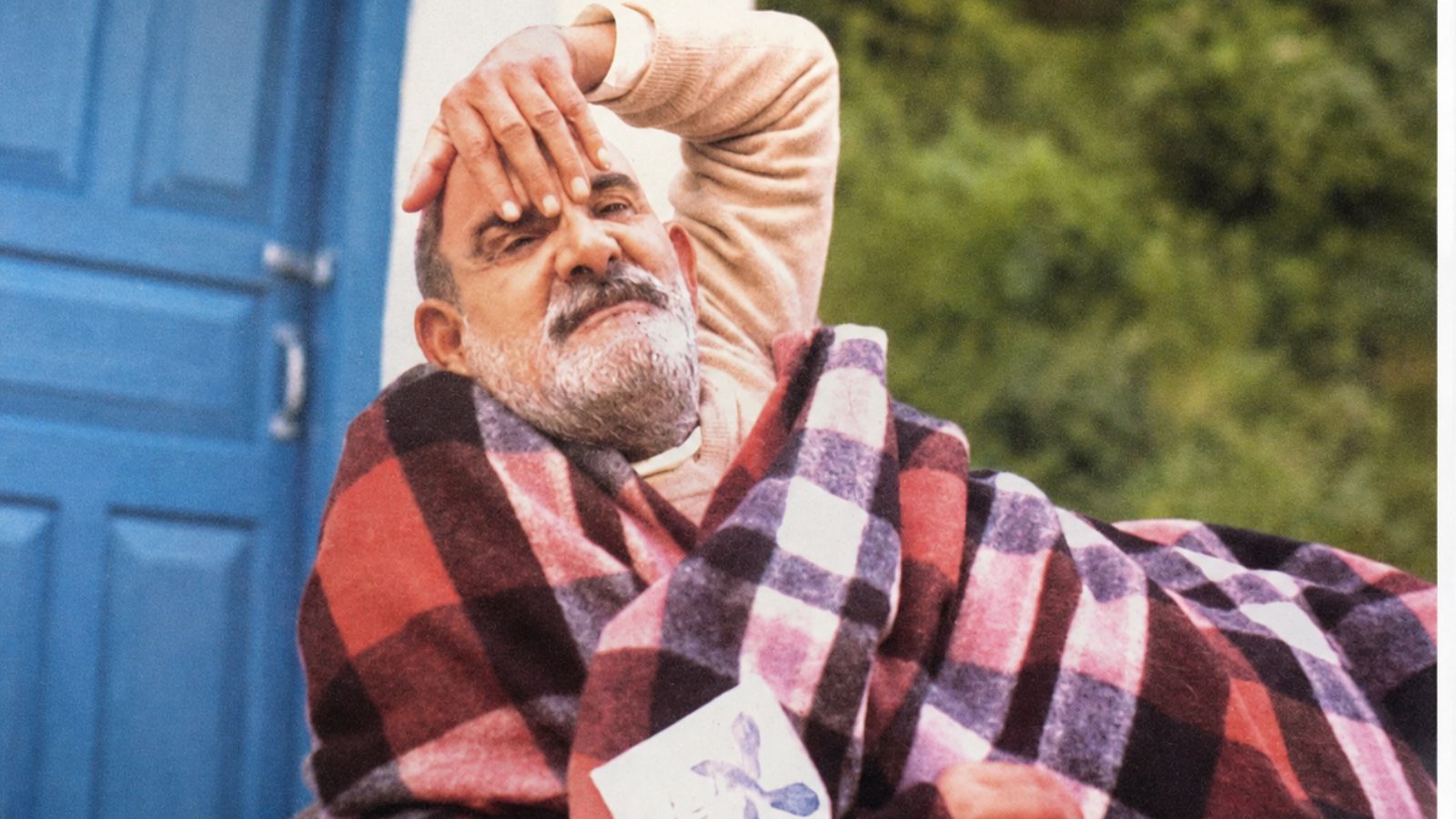
He isn’t complaining, though. Tiwari runs a shop beside the Kainchi Dham ashram, where he sells boxes of peda and “Baba Kambal”, the kind of plaid woollen blankets that Neem Karoli Baba is seen wearing in all his photographs. Similar checked blankets are given as offerings at the shrine, with devotees referring to the Baba’s iconic blanket-wrapped reclining pose as the “Kambal Mudra” and associating it with Lord Hanuman’s posture when he blocked Bhima’s path. Some of his followers even consider him a reincarnation of Lord Hanuman.
“Only Raymond blankets are given to the Baba as offering,” says Tiwari, going on to talk about his tryst with the Baba’s “chamatkaar”.
A few years ago, he says, when he decided to set up his blanket shop, he needed a distributor for Raymond blankets. “I had no idea where to find one. But then, that very day, a Raymond agent arrived in Kainchi. My family has been running a restaurant here since the 1990s, now we run this business, too. Sab Babaji ki kripa…my life is a gift that Baba ji has given me,” he says, folding his hands and slipping into a few moments of reverence.
Much of what is known about the Baba is through devotional biographies, accounts of those who lived around the same time as him, and now, the movie. According to these accounts, the Baba was born around 1900 into a wealthy Brahmin family in Akbarpur, in Uttar Pradesh’s Firozabad district, as Lakshman Narayan Sharma. Married as a child, he is said to have left home at 12, with the subsequent years marked by long periods of wandering across Rajasthan, Gujarat and later, Uttar Pradesh. There are accounts of how he went back to his village at one point, only to wander again. In Uttar Pradesh, he travelled to Neeb Karori village in Farrukhabad district and meditated here, an association that stayed in his name.
By the early 1950s, the wandering ascetic had begun creating places of worship. His first temple was Hanuman Garhi, built on the Manora hillside in Nainital. Over the next two decades, temples and in some places ashrams followed — at Bhumiyadhar, Kainchi and Kakrighat in Uttarakhand, Vrindavan, Kanpur and Lucknow in UP, and Shimla and Delhi, among other places.
Kainchi Dham, whose Hanuman temple was consecrated on June 15, 1964, eventually became the principal ashram of his later years.
A little after 6 pm, the crowd moves towards the Kainchi shrine barefoot. Devotees leave their footwear outside and step onto the cold stone floor, moving through steel railings and barricades that guide them towards the sanctum. There are no separate queues for VIPs. A little ahead is a white marble statue of the Baba, complete with the blanket in marble.
The Shipra River runs by the ashram, the sound of its rushing waters a constant soundtrack that’s audible above the bells and the bhajan of devotees.
This weekend, the packed road outside the shrine, wet after a sudden shower, glistens with lights from the shops on either side. Kainchi’s local economy runs entirely on Baba’s name — “his blessings”, is how the traders say that — with shops selling his photographs, trinkets, blankets and prasad.
Metres away, Vishesh Kaushik, 26, an IIT Kanpur graduate from Gurgaon, waits outside Hotel Monal for his room to be handed over. He says he decided to come to Kainchi after watching Hanuman Ansh. “I am usually not impulsive,” he says. “But after watching the movie, I opened the RedBus app, booked a ticket and came here.”
Kaushik, who recently lost two members of his family, says the film affected him more deeply than he expected. “I cried several times while watching it,” he says. “But here, I feel a sense of peace.”
Talking of the film, he says he was particularly struck by a scene in which Baba is shown eating seeds and producing plants from his mouth.
To Kaushik, the moment represented something larger than a cinematic miracle. “That is the power to create life,” he says.
At 7 pm, the temple closes. Red curtains are drawn across the rooms where the deities sit, and the gates are shut. Devotees who have failed to make it inside stand outside, pleading with the authorities to let them in. Some cry, others wait in the hope that the doors might reopen.
Then, Kainchi changes almost immediately. The shops begin to close and the crowd thins out.
Vineeta Rawat, 27, who grew up in Bhowali, a town 10 km from Kainchi village, and who now works at Hotel Monal, says, “Once the mandir shuts down, it feels like Kainchi has gone to bed.”
On a Friday night in state capital Dehradun, the 8 pm show of Hanuman Ansh at the city’s Pacific Mall is packed. Families with children and the elderly, and young people in groups, all watching the story of a guru.
As the young Shobhinaw Satya, who plays the Baba, appears on screen, there’s none of the hooting and whistling that usually accompany the hero’s entry; only a reverential silence.
One of the scenes has a group of children teasing the Baba as he meditates in a lake. He then miraculously pulls out laddoos from the water and gives it to each of the children. In the movie hall, a young girl turns to her sister and asks, “Aise sach mein hota hai kya? (Does this really happen?)”
Later, as a man lost in the forests around Kainchi begins reciting the Hanuman Chalisa, the audience joins in.
When the lights come on, people linger to take photographs, some make reels with photos of the Baba that appear on the screen along with the rolling credits, and others continue sitting, wiping their eyes.
Anupriya Nagar, 21, one of the three producers of the film, says she was doing her Bachelor’s in Economics at the University of Bath, UK, when she came across the story of how Steve Jobs met Neem Karoli.
The daughter of an art collector, Nagar had already secured a job at an art company in Zurich and had hoped to graduate and leave for Switzerland. Instead, she found herself drawn to the story of the Indian spiritual guru.
Back in India, Ragini Sona, a family friend, introduced her to the team making Hanuman Ansh. Nagar, who read 120 pages of the script, recalls “getting goosebumps”. She offered to pitch in with the production, along with Sona and Namrata Singh, leading to an all-woman team of producers. “The movie should have been made long ago. I believe spirituality is in every one of us; we need to find a way to access it.”
Over 400 km from the Kainchi Ashram is Akbarpur, a village in Firozabad district that’s the birthplace of the Baba.
Though the village has a temple that came up in 2001, where his stone statue shares space with those of Lord Hanuman, Lord Vishnu and Goddess Lakshmi, Akbarpur isn’t awash in the kind of devotion that keeps Kainchi going. When they talk of him here, it is as “Lakshman Das ji”, a mortal among mortals, the father of two sons and a daughter, a man who left his family behind and found fame elsewhere.
It doesn’t help that a property tussle has been playing out in Akbarpur between the Baba’s granddaughters and a Trust, which manages the temple and the family property. Six daughters of the Baba’s younger son, Dharam Narayan Sharma, have written to the District Magistrate seeking action against the illegal occupation of their ancestral house in Akbarpur.
Shyam Upadhyay, a farmer, says that as long as Lakshman Das walked through these lanes, he was not “Baba”, just an ordinary householder with a family.
In her brick house behind the temple, Shanti Jatav, who says she is around 85 years old, claims to have met Lakshman Das ji. “On the day Lakshman Das set out on his journey, his wife Rambeti did not even weep,” she says.
But now, Akbarpur is hoping the Baba’s popularity will help the villagers’ cause.
There’s a quiet excitement about a new ring road or a parikrama path that’s being built around the village. People also hope that the other roads in the village will finally be fixed, and that dirty water won’t pool in the lanes anymore.
On a platform just outside the family’s dak bungalow are two pairs of charan paduka (footprint-shaped markers) commemorating the Baba’s two sons, Aneg Singh Sharma and Dharam Narayan Sharma, who died during the Covid wave. People come, quietly bow their heads, and leave.
The government has now announced that the region will be part of a larger tourist circuit. The village hopes all of this will add up to something.
A labourer on the outskirts of the village says, “The cremation ground is without a roof and it’s difficult to cremate bodies in the rain. Maybe now, they’ll build a roof?”
As the day winds down, we find ourselves at a doorway. Inside, a framed photograph of Ambedkar hangs tilted on the exposed brick wall. On a shelf below it are framed pictures of Gods, and one of the Baba. The young man who lives here sees no contradiction in an iconoclast sharing space with Gods and godmen. “We believe in all. Whatever we are today, we owe to Ambedkar ji, but Neem Karoli Baba is our village’s pride, so we worship him too.”
An Award-winning journalist covering the state of Uttarakhand, Vidheesha Kuntamalla... Read More
