Los Angeles Is on the Cusp of Its Mamdani Moment - Newsweek
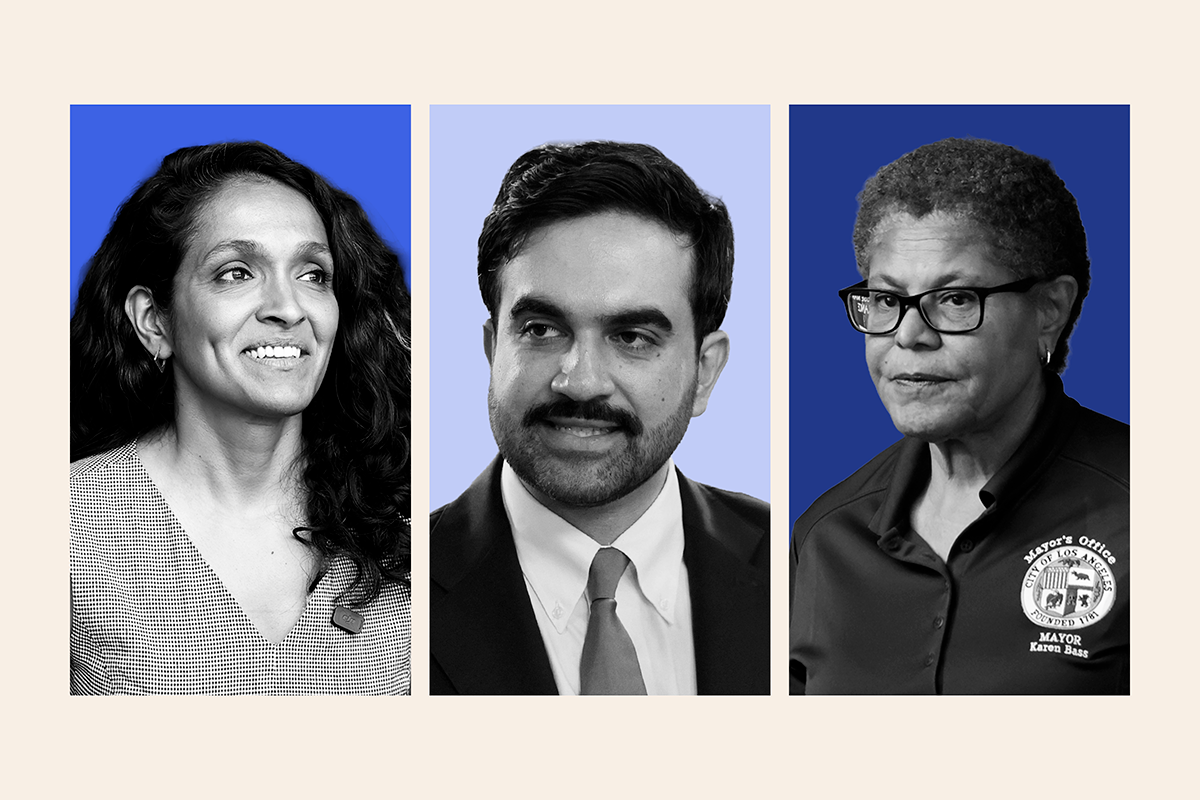
Los Angeles Councilmember Nithya Raman has moved ahead of Mayor Karen Bass in both a major new poll and two prediction markets, raising a question that extends well beyond California: Is the political coalition that carried Zohran Mamdani to New York City Hall beginning to reproduce itself on the other side of the country?
A UC Berkeley Institute of Governmental Studies poll, co-sponsored by the Los Angeles Times, put Raman at 39 percent among likely voters and Bass at 28 percent, although a substantial 33 percent remained undecided. Raman had finished behind Bass in June’s primary, 29 percent to 34 percent, according to official results.
Traders have noticed the shift. As of Friday, Kalshi priced Raman at roughly 57 percent to win the November 3 runoff, against 42 percent for Bass, while Polymarket put Raman at about 58 percent. To be clear, though, prediction markets measure what traders are willing to wager rather than what voters will necessarily do, and with a third of likely voters undecided, the race remains unsettled.
Still, Raman’s rise makes Los Angeles a good test of how Mamdani changed urban politics across America.
Mamdani’s breakthrough in New York was a triumph of democratic socialism. His campaign, however, organized that politics around an intensely practical subject: the cost of living. He ran on freezing rents for rent-stabilized tenants, fare-free buses, universal child care and city-owned grocery stores. His 2025 Democratic primary victory was powered heavily by younger and middle-class voters, renters and a coalition that cut across some of New York’s traditional political divisions.
Raman is running on terrain that rhymes with Mamdani’s without copying his program. Her campaign puts affordability at the center, promising substantially more housing, stronger protections for renters and a city government that works better on basic services. She is also a Democratic Socialists of America member, and DSA-LA endorsed her this month after more than 60 percent of participating members voted to do so.
John Mollenkopf, distinguished professor at the CUNY Graduate Center and an expert on urban politics, told Newsweek that Mamdani’s success combined dissatisfaction with establishment politics with changes in the electorate, including immigration and “the rise of a new generation of knowledge workers facing uncertain career prospects.”
“This is not a combination unique to New York," he said. "It extends to many other strong market, ‘no majority’ cities like Los Angeles.”
That may be the more useful way to understand an L.A. “Mamdani moment.” Perhaps, it's not about voters suddenly embracing an ideological label but about expensive, diverse cities producing similar political coalitions around affordability and dissatisfaction with established leadership.
Los Angeles certainly checks the boxes. Nearly two-thirds of Angelenos rent, according to Raman’s campaign, while Census data puts the city’s homeownership rate at just 36 percent and median gross rent at $1,933. No single racial group constitutes a majority: Census estimates put Los Angeles at 47 percent Hispanic or Latino, 28 percent non-Hispanic white, 12 percent Asian and 8 percent Black.
Mollenkopf argues that such cities reward candidates who can assemble coalitions across those lines. Mamdani proved effective at doing so, and we have the proof in his election. Whether Raman can reproduce that feat is still a question.
The analogy becomes weaker once campaigning gives way to governing.
Mollenkopf points to significant demographic differences, including New York’s larger Black population and different white ethnic composition. More important may be the institutional gap.
“New York is much more heavily political and partisan, with a bigger city budget per capita, compared to the less partisan and thinner government in Los Angeles,” Mollenkopf said.
Here are the numbers: New York adopted a $125.8 billion budget for fiscal 2027; Los Angeles’ 2026-27 budget is roughly $14.8 billion.
Keep in mind, though, that the cities divide responsibilities differently, which may also affect the potential "Mamdaniness" of Los Angeles.
Los Angeles’ mayor does not control its school district; LAUSD’s elected Board of Education controls and manages the public schools, and Bass herself has acknowledged that City Hall has “no jurisdiction over the school district.” Homelessness also crosses city and county bureaucracies. Los Angeles County created a Department of Homeless Services and Housing this year to coordinate housing, health and social services across the county and its 88 cities.
Mollenkopf put the distinction plainly. “Social services in Los Angeles are largely run by the county, not the city. The Los Angeles mayor does not control the public school system as the mayor of New York does. Land use and policing, however, are municipal responsibilities in both cities.”
That leaves housing, homelessness and land use as some of the clearest arenas in which a Raman administration could try to translate electoral change into policy.
There is also a strong case against reading too much national meaning into Raman’s surge. Bass enters the final weeks with serious political liabilities of her own. The Berkeley poll found 63 percent of likely voters viewed her unfavorably, while 40 percent viewed Raman favorably and 39 percent unfavorably. Bass’ campaign has argued that the survey is one poll in a fluid race and many former Spencer Pratt voters remain undecided.
Bass can also point to a governing record rather than simply an ideological contrast. Her administration said this week that more than 10,000 affordable housing units have been completed during her tenure, while her campaign is emphasizing reductions in homelessness, housing construction and public safety.
Mollenkopf offers another reason for caution. “The forces that Mamdani has propelled exist in many other cities, but few of them have candidates who are as exceptionally talented as political communicators as Mamdani,” he said.
That may be the real significance of Raman’s rise. The test is not whether Los Angeles can produce another Mamdani, but whether the political conditions that produced him can survive without him: punishing housing costs, frustrated renters, younger voters locked out of old promises and an electorate increasingly willing to gamble on candidates outside the urban establishment. If Raman wins, the message will travel far beyond Los Angeles, and the Mamdani moment may turn out not to belong to Mamdani at all.