Love, lies and R100 million: Six alleged Black Axe members extradited to US - IOL
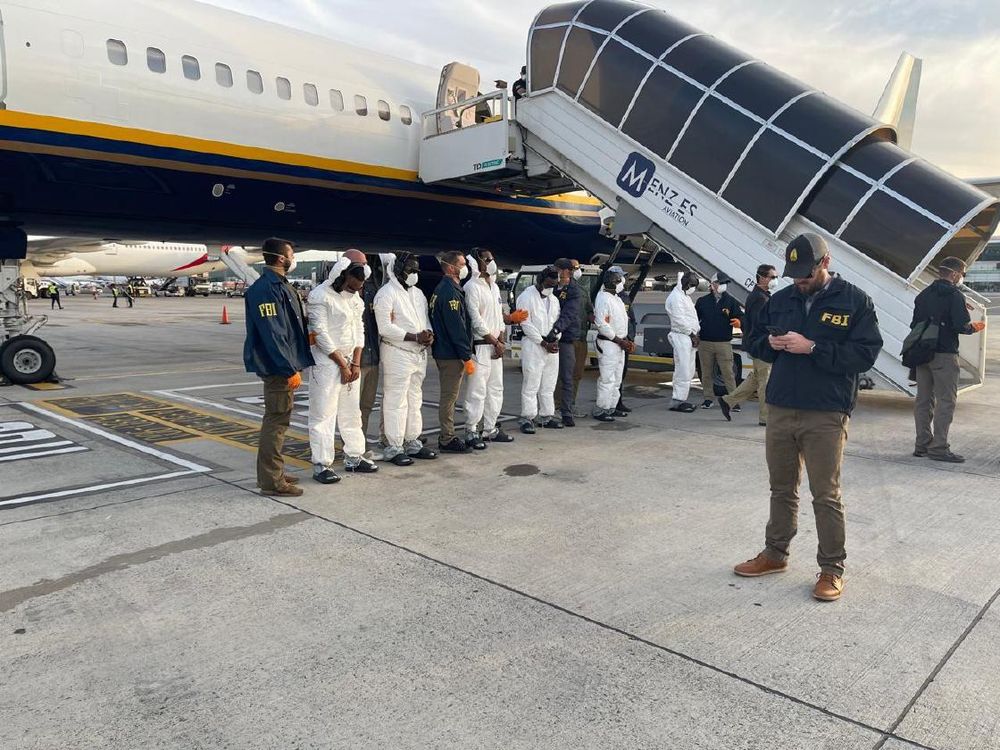
Six Nigerian nationals (in white) were extradited to the US on Friday for their alleged involvement in romance scams targeting more than 100 US women. The process was facilitated by the Hawks and INTERPOL South Africa.
Six alleged members of the Black Axe organised criminal network arrested in South Africa in 2021 will be extradited to the US to face wire fraud and money laundering charges.
They allegedly promised love, then built relationships and thus gained the trust of their victims.
Then, investigators allege, the money started flowing.
Romance scams work, say police, because the fraud is built on trust before money.
Now six Nigerian nationals arrested in Cape Town in 2021 were extradited to the United States, where they face allegations of wire fraud and money laundering linked to an international romance-scam operation that allegedly targeted more than 100 American women and stole more than R100 million.
The six men are alleged to be members of the Black Axe organised criminal network and are wanted by US authorities over their alleged involvement in sophisticated online “love scams”, according to the Directorate for Priority Crime Investigation, commonly known as the Hawks.
Among the alleged victims were pensioners and businesspeople who were reportedly drawn into relationships online before being persuaded to hand over their money.
On Friday, the men were transported from a correctional facility in Cape Town to Cape Town International Airport, where they were handed over to officials from the Federal Bureau of Investigation and the US Secret Service.
The extradition was being facilitated by the Hawks in cooperation with INTERPOL South Africa.
Hawks spokesperson Colonel Katlego Mogale said the six suspects were arrested in South Africa in 2021 following a major takedown operation.
The case has taken almost five years to reach the point of extradition.
“The six men are alleged to be members of the Black Axe organised criminal network and are wanted by the US authorities in connection with charges of wire fraud and money laundering,” Mogale said.
She said the alleged victims had been targeted through sophisticated online relationships.
The allegations reveal how a romance scam can begin with something that appears entirely ordinary - a conversation online - before developing into an elaborate fraud.
US prosecutors have previously detailed the alleged methods used by the Cape Town-based Black Axe network.
According to the US Department of Justice, members allegedly used social media, online dating sites, and internet-based telephone numbers to find and communicate with victims in the United States.
They allegedly operated under false names and identities while presenting themselves as potential romantic partners.
One recurring story allegedly involved a supposed love interest travelling to Cape Town to work on a construction project.
The victim would then be told that the man had been robbed and needed phones, tablets, or computers sent to South Africa.
In other cases, according to US prosecutors, the supposed romantic partner needed money to repair a faulty crane, pay legal costs following an accident at a construction site or settle foreign taxes before receiving a larger amount of money.
The requests were allegedly designed to make the victim believe that the person they had fallen in love with was facing a genuine emergency.
And because the relationship had already been built on trust, the request for money could appear to be an act of helping someone they loved rather than a financial transaction with a stranger.
US prosecutors have also alleged that some victims faced further manipulation when they became reluctant to send money, including threats involving personally sensitive photographs.
The alleged operation did not end with the money being received.
US authorities say members of the network also used bank accounts and business entities to move and conceal proceeds from the alleged fraud. The Cape Town group was also accused of alleged involvement in advance-fee schemes and business-email compromise fraud.
The scale and sophistication of the alleged operation have placed Cape Town at the centre of an international investigation into Black Axe.
The US Department of Justice has previously described the Cape Town group as a zone of the Neo Black Movement of Africa, also known as Black Axe, and said the alleged criminal activity stretched over years.
In a previous case, US prosecutors alleged that Black Axe members operating from Cape Town had been involved in widespread internet fraud from at least 2011 to 2021.
The US authorities have also previously prosecuted a senior alleged Cape Town Black Axe member over internet scams and money laundering, describing romance scams as one part of the group's alleged criminal activity.
The six suspects extradited have been fighting the extradition process in South Africa since their arrests.
The Cape Town Magistrate’s Court found in 2024 that there was sufficient evidence for the extradition proceedings to continue.
The Western Cape High Court subsequently dismissed an appeal by the accused in April, paving the way for the extradition.
The latest move brings the long-running South African proceedings to an end as the men were handed over to US authorities to face the charges there.
The case also highlights the growing international reach of cyber-enabled organised crime.
INTERPOL has identified Black Axe and related West African criminal networks as being involved in transnational financial crimes, including romance scams, as well as cryptocurrency and investment scams.
AP reported that the organisation is regarded by INTERPOL as part of a wider network responsible for a significant share of cyber-enabled financial fraud.
For South African investigators, the case demonstrates the importance of international cooperation when criminal networks operate across borders.
For the alleged victims, however, the crime was much more personal.
They were not simply targeted as bank-account numbers.
They were allegedly courted, deceived, and manipulated by people pretending to be romantic partners.
A message, a phone call, or a photograph could be the beginning of a relationship that appeared genuine. Behind the screen, investigators allege, was a criminal operation designed to turn emotional trust into financial gain.
Now, after years of arrests, court proceedings, and extradition battles, the six men will face the US justice system. They remain accused of the crimes and are presumed innocent unless proven guilty in court.
The Institute for Security Studies (ISS) has reported that South Africa has the highest number of identified Black Axe zones in Africa.
In its report, The Black Axe Puzzle in South Africa: Layers of Criminal Culpability, the ISS identified six zones in Cape Town, Durban, Ekurhuleni, western and northern Gauteng, Johannesburg, and Pretoria.
The report said members were predominantly Nigerian, with some having lived in South Africa for between five and 30 years. It also noted that information about the recruitment of non-Nigerians remained unconfirmed.
According to the ISS, Black Axe’s expansion has been linked to social and economic pressures, migration, and the strategies of organised-crime networks.
The report said formal zonal structures began emerging in South Africa in the early 2000s as the Nigerian diaspora grew. One of the earliest zones, the South Africa Zone, was reportedly established around 2003.
The US Department of Justice has previously linked alleged Black Axe members operating from Cape Town to romance scams, advance-fee schemes, business email compromise, and money laundering.
Romance scams work because the fraud is built on trust before money.
Research shows that scammers often groom victims over time, using frequent communication, emotional intimacy, flattery, and promises of a future together to create a sense of genuine attachment.
A 2026 review of 87 studies found that scammers exploit people's basic needs for connection, trust and authentic communication, gradually turning emotional trust into financial leverage.
Once a victim believes the relationship is real, requests for money can feel like helping a loved one rather than handing money to a stranger.
Researchers also describe a “double hit”: victims can lose both their money and a relationship they genuinely believed existed, which can lead to shame, grief and difficulty accepting that they have been deceived.
South African Police Service (SAPS) advice includes reporting suspected cybercrime, identity theft, and commercial scams to your local police station. If you have lost money, contact your bank or financial institution immediately and report the matter to police.