Lula or Bolsonaro as president? Brazil gears up to vote
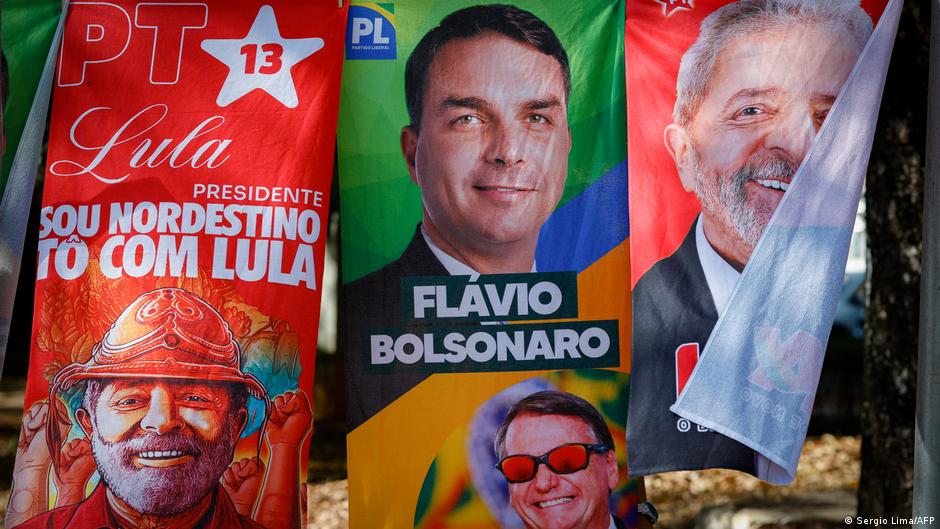
Luiz Inacio Lula da Silva (seen at left and right) is facing off with Flavio Bolsonaro (center)Image: Sergio Lima/AFPAdvertisementLuiz Inacio Lula da Silva spoke in no uncertain terms at the opening of the UN General Assembly on Tuesday in New York: "Brazil does not belong in anyone's backyard," the Brazilian president said. His comment was directed at his US counterpart Donald Trump, despite Trump not being in attendance.
The US president has repeatedly interfered with Brazilian domestic politics, siding with former President Jair Messias Bolsonaro and the far-right opposition. In July, Trump imposed sanctions on a judge who found Bolsonaro guilty of attempting a coup and sentenced him to 27 years in jail. Washington only lifted the sanctions after negotiating with Lula.
Bolsonaro's eldest son Flavio is Lula's biggest challenger in the upcoming presidential election on October 4, and polls currently show the two of them to be neck and neck in a potential runoff.
The election in the world's fifth largest country is drawing a great deal of international attention. Brazil is an agricultural giant and very rich in natural resources — boasting rare earth elements, vast water resources and enormous crude oil reserves.
Lula is the "last man standing" of the South American left, while Flavio Bolsonaro is part of an increasingly strong far-right camp. Argentina, Bolivia, Peru, Chile, Ecuador and Colombia all have governments that are sympathetic to Trump. And since January, Venezuela has been what some describe as a US protectorate.
Foreign policy hasn't played a big role in the campaign, but this election will nonetheless decide whether Brazil moves closer to Trump's US. Washington is seeking economic and military dominance in South America through the Shield of the Americas initiative, focused on combating violent cartels. After his military intervention in Venezuela, Trump is now exerting economic pressure on Mexico and Cuba. At the same time, he is trying to counter Chinese influence in the region.
For his part, Lula is an advocate of multilateralist diplomacy, wanting Brazil to engage in dialogue and trade with everybody. China has long been Brazil's most important trading partner.
Flavio Bolsonaro favors a conservative alliance with the US and other right-wing states. But for Leonardo Paz from the Brazilian Fundacao Getulio Vargas think tank, a Bolsonaro victory would not necessarily automatically mean better relations with the US. He told DW that Lula had established a largely normal relationship with Trump — both are 80 years old — despite some initial friction. The two leaders got along well, said Paz, even if Lula has not succumbed to Trump's pressure.
Paz did admit that if Bolsonaro won, the 45-year-old would be more likely to accommodate Trump, pointing out that his father Jair had made far-reaching concessions to the US when he was president. During Jair Bolsonaro's time in office from 2019 to 2023, Brazil agreed to forgo its "developing country status" in World Trade Organization negotiations in exchange for a mere promise that the US would back its bid to become a member of the Organization for Economic Cooperation and Development (OECD). Trump also said he was considering giving Brazil NATO "privileges." Neither promise came to anything.
"While relations with the US would continue as they are with Lula, it is completely unclear what a Flavio Bolsonaro presidency would mean," Rubens Ricupero, a former Brazilian diplomat and minister, told DW. "Lula has prestige in foreign policy, while Bolsonaro is completely inexperienced."
A victory for Bolsonaro would likely jeopardize Brazil's role in BRICS, the alliance that comprises Brazil, Russia, India, China, South Africa and five other states. Bolsonaro has said that one of his first acts would be to review whether Brazil should stay in the alliance, arguing that BRICS only serves to provoke the US. He has also spoken out against China's efforts to reduce the global dominance of the US dollar.
It's hard to tell how serious such intentions are, considering the importance of economic ties between China and Brazil. Javier Milei, Argentina's current president, also engaged in harsh rhetoric against China before he came to power, but quickly adopted a more conciliatory tone once in office to not jeopardize Chinese loans.
"Political relations with China would likely cool, but I wouldn't expect any substantial changes in economic and commercial relations," predicted Ricupero in case of a Bolsonaro victory.
Paz agreed that Flavio Bolsonaro was unlikely to take an extremely aggressive stance toward China in case of victory. He explained that, like Milei, Jair Bolsonaro had engaged in some sharp rhetoric against Beijing at the beginning of his term but had quickly softened his tone, given the fact that Brazil's agricultural sector in particular is so dependent on China.
Paz pointed out that the Bolsonaro family enjoyed most support in Brazil's rural regions, which made good money with China. "The unknown factor with Flavio Bolsonaro is how much pressure the US would exert so that Brazil distanced itself from China and to what extent he would yield to the pressure," said Paz.
Paz said that despite possessing enormous natural resources that are important to the global economy, Brazil would likely remain a minor player on the world stage as it had neither the economic strength to provide financial aid to other countries nor the military strength to help resolve conflicts. "This severely limits Brazil's ability to act," he said.
But Brazil could continue to be a major protagonist in the Global South, he said, as it is under Lula. "This is particularly evident in the international debate on global governance, in which Brazil raises issues such as new trading conditions, climate policy and development," he said.
Ricupero said Lula carried particular weight in foreign policy, especially regarding the environment and climate change. "His commitment to addressing ecological challenges was clear from his choice of [leading environmentalist] Marina Silva as environment minister," he said.
The former diplomat said he feared Flavio Bolsonaro would repeat the mistakes of his father, and this was one of the reasons the election was drawing such attention from around the world. He pointed out that Brazil had become more isolated after Jair Bolsonaro dismantled major environmental policies, adding that relations with the European Union had particularly suffered and negotiations on a trade agreement between Mercosur and the bloc had been put on hold. The deal was finally signed early this year.
This article was originally written in German.