Madonna knows the Trump trick: Never agree that you’re over - Newsweek
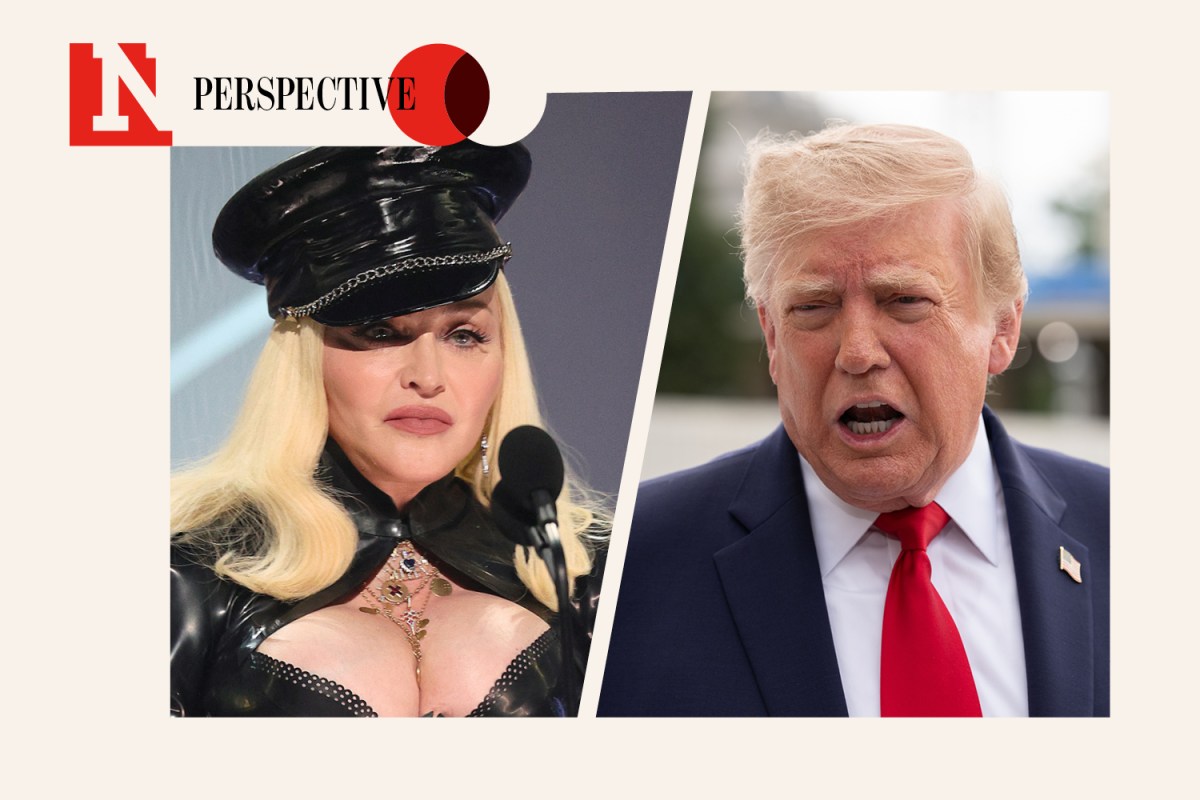
Madonna opened the increasingly, almost traumatically, passé MTV Video Music Awards on Sunday night surrounded by women young enough to have grown up in a world she had already remade.
There was Sabrina Carpenter, 27, singing "Bring Your Love," the collaboration from Madonna’s Confessions II. Then came Charli XCX, 34, emerging from a bathroom stall for "Danceteria Afterhours," followed by a small parade of cameos that included Julia Garner, Debi Mazar, Sombr and Seth Rogen. It was Madonna’s first VMA performance in 23 years and Madonna, 68, was certainly still Madonna.
The "Queen of Pop" wore the corset and thigh-high boots that have come to define both her onstage and offstage personas. There were also bondage-clad dancers that worked well with the old mixture of sex, spectacle and provocation that Madonna is associated with.
There are many ways to read a 68-year-old pop star returning to a stage she helped make culturally important. Nostalgia is the easiest and another go-to would be vanity, but Madonna offered a more interesting possibility: perhaps longevity begins with declining to cooperate with other people’s timetable for your disappearance.
It is a rule President Donald Trump appears to understand unusually well but that Madonna learned first.
Later that night, while accepting the VMA for Artist of the Year, Madonna told a story about the first time she performed at the awards, back in 1984. During "Like a Virgin," one of her stilettos came off so she dove after it and, as she moved through the air, her dress went up and her derriere was exposed. According to her own retelling, Madonna went backstage rather pleased with herself.
Her manager’s assistant had a different assessment: her "career was over."
This is funny now for obvious reasons: Madonna went on to become one of the defining pop stars of the next four decades. But there is something else in the story that explains Sunday night better than any corset could.
Madonna has been being told she is over almost as long as she has been Madonna.
At first, she was too vulgar. Then too controversial. Eventually, inevitably, she became too old. Pop music kept producing replacements and Madonna kept encountering them, collaborating with them, kissing them, competing with them and occasionally collecting awards alongside them. Case in point: all of last night.
Madonna doesn't want to be the building block on which the Taylor Swifts and Sabrina Carpenters of the world build their careers. She intends to keep building her own tower alongside them.
Madonna showed generations of women what a female pop star could be, but she has never seemed particularly interested in showing them how a female pop star gracefully leaves. Whether we approve of that, or whether it ends up reinforcing exactly the kind of feminism many people reject—the idea that a woman remains relevant only so long as she can remain young—is almost beside the point. Madonna seems to be asking a different question: Why, exactly, should Madonna help us replace Madonna?
She does not want to be the former Queen of Pop. She wants to be the current Queen of Pop, perennially, forever, everlastingly, almost defiantly unaging. It is a kind of mental pyrotechnic remarkably close to the way Trump understands power—which is especially ironic considering how loudly Madonna has opposed him for years.
The comparison between Madonna and Trump is not a political one. It’s clear that the powers of a pop star and a president aren’t comparable, even though Trump has made it clear he is a cultural phenomenon and wants to be treated as a celebrity, and the celebrity world has come to show that chiming in on politics is now part of their job.
But moving past that, what Trump and Madonna share is an acute understanding of the theater surrounding power: people can tell you that your era has ended and institutions can prep for who is next—heck, the entire culture can start speaking about you in the past tense…but you are under no obligation to join them.
Trump demonstrated the principle after 2020 with considerably greater consequences. He lost the election, left the White House and then declined to assume the cultural role America normally assigns former presidents. Four years later, he defeated Kamala Harris, winning the Electoral College 312-226, and returned to the White House as the 47th president. At the very least, we can admit that, by the terms of his own playbook, something worked: he refused to behave like a man whose political moment had passed, and eventually the presidency was his again.
Whatever else Trump’s return means, it established a useful distinction about power: losing it and agreeing that your time is over are two different things.
Madonna has mastered that move. At 68, she was back at the VMAs performing with women born after some of her most famous performances, dressed recognizably as herself and later accepting Artist of the Year. She won seven awards Sunday night.
Perhaps there will come a point when the strategy stops working. We can refuse to get older but, guess what?, we’re all getting older and the world keeps spinning. Trump, for example, will be forced to exit by the terms of the Constitution soon enough, whereas Madonna’s (possible?) departure will likely be one of choice.
Peter Pan could refuse to grow up because Neverland let him but, alas, Madonna and Trump live in a less forgiving place. Even the most stubborn public figure runs into forces that cannot be stared down by sheer refusal.
But that is also what makes their instinct so powerful: they understand that there is often a long stretch between the moment other people decide you are finished and the moment you actually become so. And during that stretch, one of the most effective things a person can do is refuse to rehearse his or her own obsolescence.
Madonna has spent more than 40 years doing exactly that.
Maybe the real trick is not staying young. Maybe it is refusing to become the past before the present has actually finished with you.