Mahatma Gandhi remembered at Phoenix Settlement on 157th birth anniversary - IOL
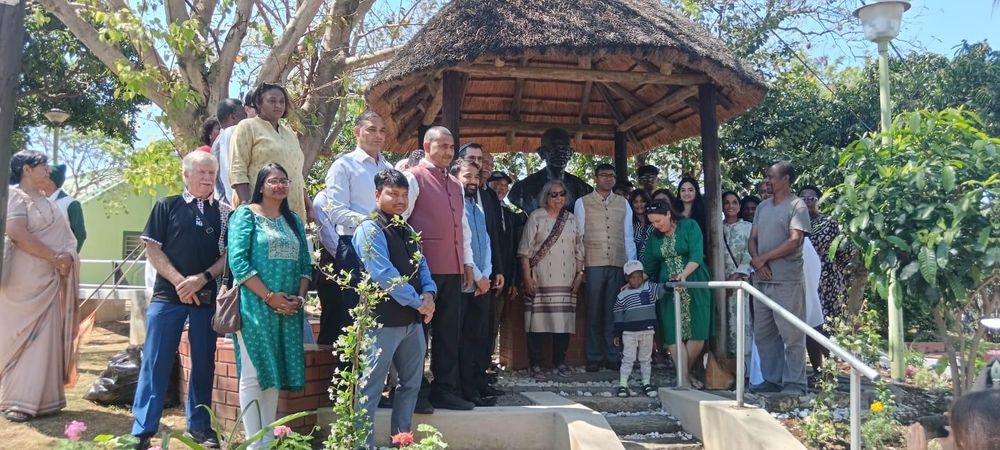
Ela Gandhi and Niteen Subhash Yeola with attendees at the celebration.
Ela Gandhi and religious leaders gathered at Phoenix Settlement in Inanda, on Friday, to commemorate Mahatma Gandhi’s birth anniversary and promote non-violence amid concern over gender-based violence in South Africa.
Gandhi, who died at 78-years-old in 1948, would have been 157 years old.
Gandhi’s granddaughter Ela Gandhi was joined by religious leaders, the Consul General of India to Durban Niteen Subhash Yeola, and supporters of Gandhi’s ideology of Satyagraha.
The event also marked the commemoration of the International Day of Non-Violence, which coincides with the iconic freedom fighter’s birthday.
Inter-faith prayers, a film and messages on Gandhi’s life were a part of the day’s programme.
Ela Gandhi said the event reflected on and promoted the ideology of her late grandfather.
“We promote non-violent lifestyles in thought, the way we communicate and act,” she said.
Ela Gandhi believed people’s way of thinking determined if they would adopt a non-violent philosophy and way of life.
“We have highlighted the need for people’s attitudes to change to achieve peace and non-violence in society,” she said.
Attendees at the event, held at the Phoenix Settlement in Inanda.
Responding to the recent spate of violence against women in South Africa, Ela Gandhi said perpetrators of gender based violence (GBV) would not commit such crimes if peace and tranquility existed in their homes.
“If you do not practice this (peace and non-violence) in your own home you are not likely to do so elsewhere. Conflict exists at homes everywhere, how you deal with it is important,” she added.
Yeola said the International Day of Non-Violence gave Gandhi’s philosophy of Satyagraha a universal significance.
“We live in a world facing conflict and mistrust. Technology has brought people closer together, but it has also made it easier for anger and division to spread.
“In such an environment, Gandhi’s emphasis on truth, dialogue, restraint and respect for human dignity remains deeply relevant.
“Non-violence is not simply the absence of physical violence. It is also a way of approaching differences – with dialogue rather than hatred, courage rather fear, and respect rather than dehumanisation,” added Yeola.
Gandhi, a lawyer by profession, was renowned for his philosophy of Satyagraha which translates to “resistance to injustice through truth and non-violence.”
This philosophy had gained widespread support in India leading to its independence on August 15, 1947.
Gandhi arrived in South Africa 1893 to represent a merchant Dada Abdullah Jhaveri in a legal dispute.