Mahira Khan in a saree at TIFF, and the drape's complicated history in Pakistan
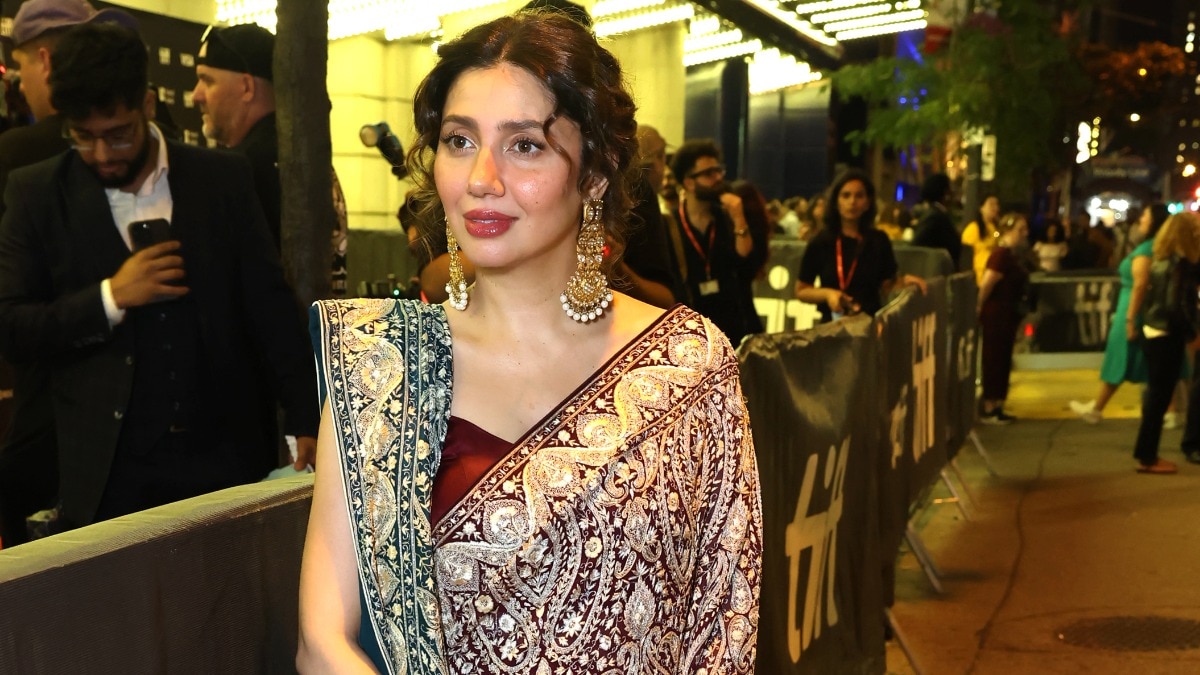
Pakistani actress Mahira Khan made a striking appearance at the Toronto International Film Festival 2026, draped in a regal wine-coloured saree that combined old-world craftsmanship with a distinctly contemporary elegance.
The appearance also came alongside the announcement that the 41-year-old actor is expecting her second child, her first with husband Salim Karim, whom she married in October 2023. Mahira Khan exuded pregnancy glow in a saree at TIFF 2026. (Photo: Getty)
For the occasion, Khan chose a hand-embroidered Kashidakari saree from Aafrinish By Niazi. The rich wine chiffon creation reportedly took more than 1,440 hours to bring to life. Delicate Kashidakari, Cutdana and silver Zari came together with lotus motifs woven into the embroidery - symbols associated with fertility, renewal and new life.
She paired the saree with a contrasting teal shawl, also embellished with Kashidakari embroidery. Heavy earrings, softly highlighted curls and naturally flushed makeup completed the look, allowing the craftsmanship of the six-yard drape to remain the focus. Mahira Khan wore a saree from the label Aafrinish By Niazi. (Photo: Getty)
But Khan’s saree moment is interesting for another reason. In Pakistan, the saree has a history far more complicated than its status today as a glamorous red-carpet or wedding outfit. Our colleague Yudhajit Shankar Das explored the “pleated” history of the saree in Pakistan in this elaborate report. But here’s the gist of it:
Before Partition, it was commonly worn by Hindu and Zoroastrian women. And after 1947, families who moved to Pakistan in 1947 brought the tradition of wearing sarees with them. For years, the saree was also a familiar sight in Pakistani films, television, advertisements and regular life.
But things changed after General Zia-ul-Haq came to power in 1977 and began his campaign of Islamisation. The saree was increasingly seen as too closely linked to India and was considered by the regime to be an “un-Islamic” form of dress. By the 1980s, it had been pushed out of official spaces and became much less common in everyday life.
The saree eventually disappeared from Pakistan’s streets for the most part, while the salwar kameez became the everyday choice. But it never really went away. It stayed tucked into family cupboards and survived as heirlooms, memories and something women brought out for special occasions.
Now, it is slowly making its way back. Sarees are increasingly being worn at weddings, on Eid and at other formal events.
Pakistani celebrities have played a role in that revival, too. Sarees have increasingly appeared on award-show red carpets and at premieres, with Pakistani media describing the trend as a refreshing departure from the gowns traditionally seen at such events.
And Mahira Khan is hardly a stranger to the garment. She has previously worn sarees, including a black saree from her own fashion label, M by Mahira, and also from Indian labels like Manish Malhotra.- EndsPublished By: Medha ChawlaPublished On: Sep 14, 2026 17:00 IST