Map Shows Earliest Snow Dates in US as 11 Inches to Hit Alaska - Newsweek
A winter weather advisory warning of up to 11 inches of snow has been issued in Alaska, while frost and freeze alerts have been issued in four other states.
The advisory was issued roughly a week after the official start of fall. Much of the United States is still experiencing warm temperatures, and a heat advisory is in place across California, making it feel as though winter is still far off.
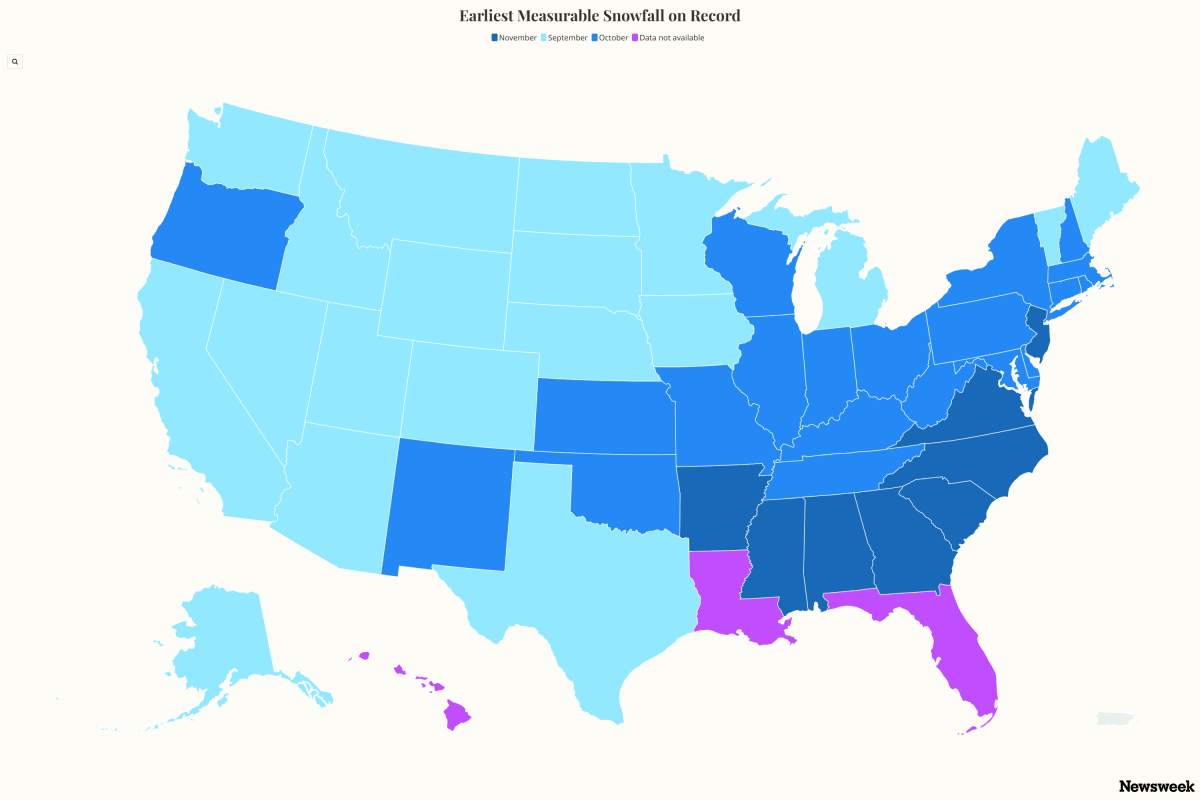
However, data from the National Oceanic and Atmospheric Administration (NOAA) reveals that many U.S. states have seen the first measurable snowfall of the season as early as September or October, meaning those first flakes are possible in the coming days and weeks.
The National Weather Service (NWS) office in Fairbanks, Alaska, issued a winter weather advisory on Thursday morning for Donnelly Dome, Trims Camp and parts of the Richardson Highway. Forecasters warned that between 6 and 11 inches of snow was possible in the Eastern Alaskan Range through Thursday night.
"Travel could be very difficult. Roads, and especially bridges and overpasses, will likely become slick and hazardous," NWS Fairbanks said in the alert. "Snowfall rates may be as high as 0.5"-1.0" per hour Thursday morning. Most of the snowfall will be between MP 205 and MP 235 on the Richardson Highway."
Four other states are facing freeze warnings and frost advisories for overnight Thursday into Friday morning as temperatures dropped into the low 30s across the Upper Midwest and Colorado.
The NWS offices in Grand Forks, North Dakota, and Duluth, Minnesota, issued freeze warnings for temperatures as low as 30 degrees Fahrenheit. Meanwhile, NWS offices in Wisconsin and Colorado issued frost advisories.
"Frost and freeze conditions could kill crops, other sensitive vegetation and possibly damage unprotected outdoor plumbing," NWS Duluth said in the freeze warning.
The cold snap is a reminder that winter is not far off.
NOAA data compiled by The Weather Channel revealed that the earliest measurable snowfall, in which at least one-tenth of an inch fell, is September for many states. Even southern states have seen snow as early as November in some years.
Florida, Hawaii and Louisiana did not show any data in The Weather Channel's report.
However, just because snow has fallen early in the season doesn't mean that's what typically happens. The average first snowfall dates are much different. For example, when looking at average snowfall, only Alaska, Montana and Idaho typically see first snow in September.
Most of the U.S. sees its first average snowfall in October or November.
"Early-season snow can catch us off guard! Those first flakes falling on warmer ground create slushy, slippery conditions that make travel hazardous," the NWS posted on X last week. "And trees still holding their leaves can be weighed down by heavy snow, leading to broken branches and potential power outages. Stay weather-aware, check your local National Weather Service forecast before heading out, and give yourself extra time to travel safely."
Snowfall dates might happen later than normal across much of the U.S. this winter as El Niño continues to strengthen in the Pacific Ocean. El Niño is the warm phase of the El Niño-Southern Oscillation cycle and can influence storm track across the U.S., most strongly felt in the winter months.
While the South can be wetter and cooler during El Niño years, the northern states are often warmer and drier, meaning snowfall might happen later than normal.
People living in areas prone to snow are advised to follow local weather guidance as winter approaches. In the coming weeks, more cold temperature alerts and winter weather advisories are likely to be issued across the U.S. as winter takes hold.
Contact Newsweek editors on this story: Anna Skinner and Dave Siminoff.