Map Shows Senate Seats Most Likely to Flip as Forecaster Shifts 3 Races
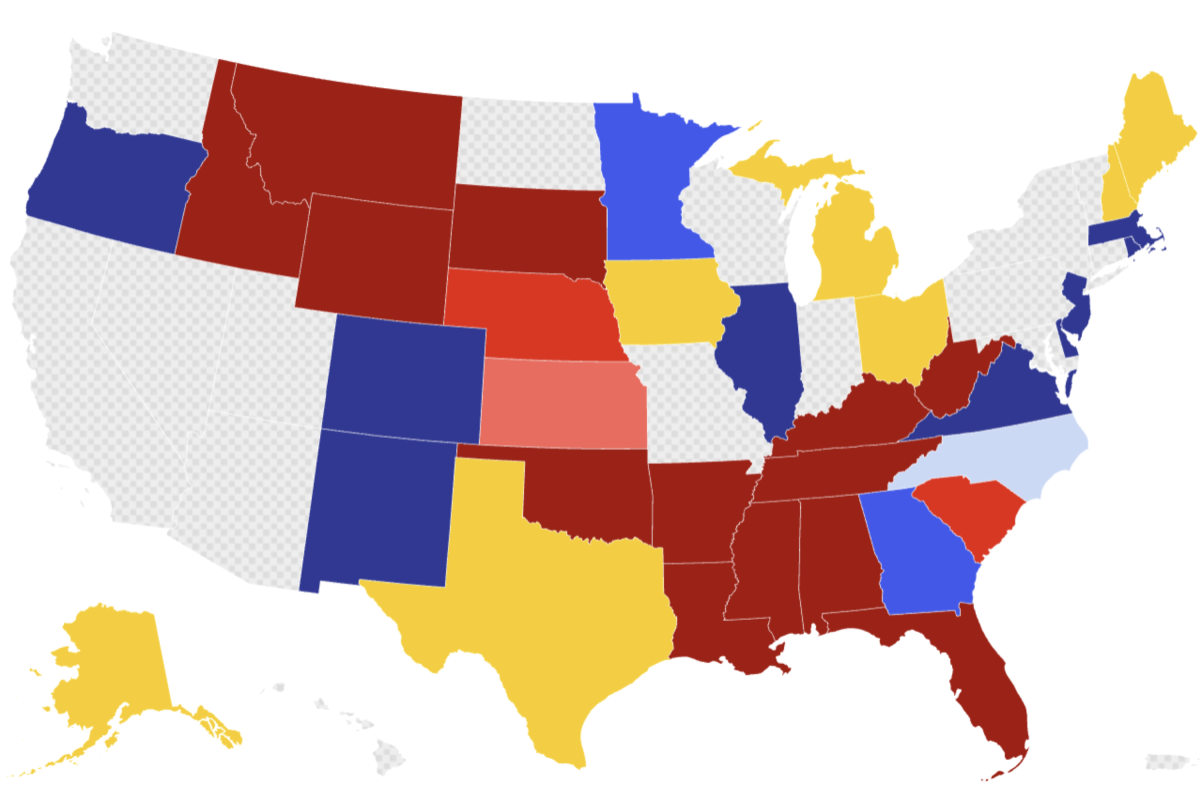
The Cook Political Report shifted Senate races in Georgia, Kansas and South Carolina toward Democrats on Wednesday, as Republicans are facing an increasingly competitive race to hold onto the chamber in the November midterm elections.
Democrats hope to expand the electoral battleground this year and flip more conservative seats that backed President Donald Trump by double digits in the 2024 election. Trump’s approval rating has continued to fall to new lows in recent polling, as economic concerns around inflation, cost of living and gas prices remain key issues nearly two years into his term.
Flipping the Senate has been seen as a heavy lift for Democrats. Republicans currently hold a 53-47 majority, and only a handful of GOP-held seats are up for grabs in traditionally conservative states, meaning Democrats must win some races in tough states to win a majority. But the new ratings reflect a narrow, yet plausible, path for them to do so.
The following changes were made in Wednesday’s update from the Cook Political Report.
Overall, the Cook Political Report points to a tight race for Senate control, which could come down to just a handful of toss-ups in Alaska, Iowa, Maine, Michigan, New Hampshire, Ohio and Texas.
Here is a look at where each race stands in their ratings as of Wednesday.
Senator Jon Ossoff, a Democrat first elected in 2021, has carved out a polling lead over his Republican challenger, Representative Mike Collins. Georgia is a closely divided battleground that backed Trump over former Vice President Kamala Harris by about 2 points in 2024.
Democrats believe the national environment and Ossoff’s popularity will give him an advantage over Collins, but Republicans are still hoping it can be competitive, as it’s a closely divided state.
Ossoff was up 10 points, 51 percent to 41 percent, in a new YouGov poll published on Wednesday. It surveyed 3,446 registered voters from September 15 to 18 and had a margin of error of plus or minus 2.7 percentage points.
A recent Quantus Insights poll pointed to a closer race but still gave Ossoff a 4-point lead, 49 percent to 45 percent. It surveyed 645 likely voters from September 14 to 16, with a margin of error of plus or minus 4.3 percentage points.
Meanwhile, Ossoff held a 9-point lead, 52 percent to 43 percent, in an AARP poll, which surveyed 1,060 likely voters from July 13 to 16, 2026.
An Ossoff spokesperson told Newsweek that Georgia “is a battleground state and Senator Ossoff is already facing millions of dollars of Republican spending against him.”
“The Ossoff campaign will continue to build unstoppable momentum and work to earn every vote across the state of Georgia,” the spokesperson said.
Collins spokesperson Sam Densmore told Newsweek that Ossoff has “every advantage an incumbent can buy,” but the “race is still competitive.”
“Mike Collins is right on his bumper and outworking him in every corner of Georgia. Ossoff stands with the far-left fringe of his party, and Georgians are done riding along,” Densmore said.
In the Sunflower State, polls are starting to show a race that is closer than expected. Kansas is viewed as a Republican-leaning state, having backed Trump by 16 points in 2024. But it does have a Democratic governor, and suburban areas around Kansas City have narrowed Republican margins in statewide contests.
Democrats also view Hamilton, a pastor, as a strong candidate in the conservative state against incumbent Senator Roger Marshall, who has faced criticism after The New York Times reported that he allegedly sued more than 700 patients over unpaid bills.
A recent poll from Emerson College was a statistical tie, with Hamilton receiving 45 percent and Marshall 43 percent. It surveyed 750 likely voters from September 15 to 16, 2026, with a margin of error of plus or minus 3.6 percentage points.
A co/efficient poll also pointed to a close race, giving Marshall a 5-point lead, 49 percent to 44 percent. It surveyed 915 likely voters from September 8 to 10, 2026, with a margin of error of plus or minus 3.22 percentage points.
Glynnis Harvey, campaign spokesperson for Hamilton, told Newsweek Kansans are “ready for something different” and that Hamilton has “momentum.”
“Roger Marshall abandoned Kansas. Instead of fighting for Kansas farmers, aviation workers, and families, he’s been a yes-man to Washington power, supporting policies that are driving up costs and cutting healthcare. He’d rather spend his days in Florida than meet with and actually listen to the people he’s supposed to represent,” Harvey said.
Newsweek reached out to the Marshall campaigns for comment via email.
The new ratings bring South Carolina onto the battleground, where Senator Darline Graham is facing a challenge from Democrat Annie Andrews in a state that backed Trump by 18 points in 2024.
Graham is the sister of the late Senator Lindsey Graham, who died on July 11 from an aortic dissection. Lindsey Graham had already won the Republican nomination, so a late primary was held to pick his successor as the Republican nominee. Darline Graham, who had been appointed to the seat, won the primary with the endorsement of Trump.
Although the state has a stronger Republican lean, some Democrats view it as a potential flip opportunity as their internal polls show a tight race.
An Impact Research poll, sponsored by the Andrews campaign, showed a tied race, with each candidate receiving 41 percent support. It polled 700 likely voters from August 18 to 24, with a margin of error of plus or minus 3.7 percentage points.
However, Graham led Andrews by about 2 points, 45 percent to 43 percent, in a recent InsiderAdvantage poll, which surveyed 1,200 likely voters from September 8 to 9. It had a margin of error of plus or minus 2.83 percentage points.
T.W. Arrighi, a spokesperson for Graham, cast doubt on the forecaster in a statement to Newsweek.
“Buyer beware. Cook Political Report listed the 2020 South Carolina Senate race as a 'Toss Up'. Senator Lindsey Graham won by 10 points,” Arrighi said.
Andrews wrote in a statement that the race is “getting the attention it deserves because South Carolinians are tired of paying record-high diesel prices, watching their health care get gutted, and getting squeezed by higher interest rates.”
“All while they have a senator in name only, someone they didn’t choose, taking direction from Washington and the party bosses instead of standing up for them,” she said.
Prediction markets have recently shifted momentum toward Democrats for control of the Senate in November. As of Wednesday, Democrats had a 63 percent chance on Kalshi and a 66 percent chance on Polymarket of flipping the Senate.
That marks a shift from one month ago, when Republicans had a 53 percent chance on Kalshi, while their chances were tied on Polymarket.
Republicans had even stronger chances at the start of the year, holding a 68 percent chance on Kalshi and a 66 percent chance on Polymarket of holding onto the Senate.
Prediction markets let traders buy and sell contracts tied to political outcomes and current events, aggregating real-money wagers into probability estimates. Prices fluctuate as traders react to polling, fundraising, candidate developments and broader political trends. They measure trader sentiment at a given moment but do not always predict the future accurately.
These three races are not expected to decide the Senate outcome. At this point, a Republican victory in Georgia would be surprising, while Democrats flipping Kansas and South Carolina would indicate a blue tsunami, since they have already flipped more competitive seats.
Here is a look at where the RealClearPolitics’ polling averages stood in key races as of Wednesday.
Election Day is November 3, 2026. Polls will be watched closely as a gauge of where the electorate stands over the coming weeks. Issues like the economy, gas prices and Trump’s popularity could factor into how voters are feeling about the elections as early voting begins in several states next month.
Newsweek’s reporters and editors used Martyn, our AI assistant, to produce this story. Learn more about Martyn here. Contact Newsweek editors on this story: Jason Lemon and Gray R. Thomas