Map Shows States That Approved Permanent Daylight Saving Time - Newsweek
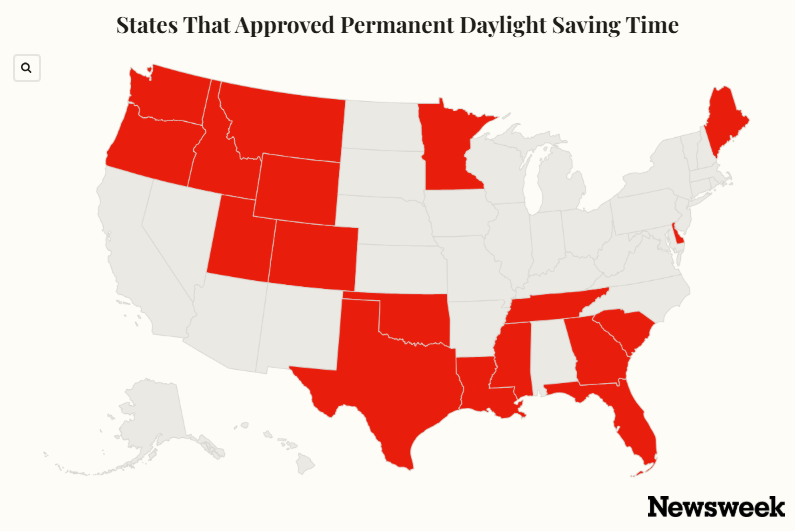
Nineteen states have already approved permanent daylight saving time, but those laws cannot take effect unless Congress changes federal law first.
As the November 1 clock change approaches, the fate of a national push to “lock the clock" now rests with the U.S. Senate, where legislation appears stalled despite clearing the House earlier this year.
The growing number of states that have passed conditional daylight saving laws reflects a larger demand to maintain daylight saving time permanently.
But with no Senate vote currently scheduled and lawmakers set to leave Washington before the next time change, Americans are still expected to turn their clocks back one hour on November 1.
The debate over daylight saving time affects nearly every American.
While permanent daylight saving time would provide more evening daylight and eliminate the need to change clocks twice a year, some sleep experts and lawmakers have raised concerns that permanent daylight saving time could result in very late winter sunrises and mess with natural sleep cycles.
The issue has gained renewed attention this year after the House passed the Sunshine Protection Act. President Donald Trump has also expressed support for making daylight saving time permanent, adding pressure on the Senate to act before the end of the year.
“People are sick and tired of having to change their clocks twice a year,” Trump previously wrote on Truth Social. “It is foolish, inconvenient and, in some cases, very costly. For Cities and States with Watchtowers, and hard to reach places, it costs Millions of Dollars.”
So far, 19 states have enacted legislation or resolutions that would allow them to observe daylight saving time year-round if the federal law changes.
However, several states attached conditions to their laws.
Delaware, for example, requires neighboring states to adopt similar measures before its law can take effect.
While the Senate needs to take the next step, Trump has been vocal in his support for a permanent daylight saving time, saying it will lead to reduced crime and better health for Americans.
"Leading Medical, Crime, and Economic Studies have shown that ceasing the biannual time change, giving us one extra hour of natural sunlight in the evenings, will help Decrease Robbery and Murder Rates, Reduce Car Accidents (especially those involving Pedestrians!), Lower Risk for Cardiac Issues, Stroke, and Seasonal Depression, Make It Safer for Children to Walk Home from School, Increase Time with your Family, Strongly Support Extracurricular Activities, Be a Big Boost to Sports, Fitness, Tourism, Retail, and the Restaurant Industries (and more!), and Save Money on Energy Bills, because everyone will be enjoying an EXTRA HOUR OF DAYLIGHT,” Trump wrote on Truth Social.
The House passed the Sunshine Protection Act earlier this year, but the bill is currently awaiting action in the Senate. While the bill remains before the Senate's Committee on Commerce, Science and Transportation, no floor vote has been scheduled.
The legislative calendar could present a challenge as the Senate has only a limited number of session days remaining before lawmakers leave Washington in early October. Subsequently, they are not expected to return until after the November time change.
Due to this, the chances of the legislation becoming law before November 1 appear slim.
A vote would not be a surefire bet either.
Some senators support permanent daylight saving time, while others have expressed concerns about pushing winter sunrises later into the morning.
In 1974, the U.S. experimented with permanent daylight saving time, but large numbers of children waiting for school buses in the dark and concerns over late winter sunrises leading to accidents caused Congress to reverse the decision.
Because Congress has not yet approved a change to federal law, daylight saving time is still scheduled to end on Sunday, November 1. Americans in states that observe daylight saving time will move their clocks back one hour, returning to standard time.
Even in the 19 states that have approved permanent daylight saving time measures, those laws are dormant until Congress authorizes states to adopt daylight saving time year-round.
Under current federal law, states may opt out of daylight saving time and remain on standard time permanently, as Hawaii and most of Arizona do, but they cannot independently adopt permanent daylight saving time.
The next major development will be whether Senate leadership schedules a vote on the Sunshine Protection Act. If the bill passes the Senate and is signed into law, states that have already approved permanent daylight saving time legislation could move forward with their laws
If the Senate fails to act this year, Americans will continue changing clocks twice annually, and the 19 state laws will remain on hold.
Newsweek’s reporters and editors used Martyn, our AI assistant, to produce this story. Learn more about Martyn here. Contact Newsweek editors on this story: Jason Lemon and Gray R. Thomas