Map Shows States Where Social Security Retirees Face Biggest Shortfall - Newsweek
For millions of Americans, Social Security provides the financial foundation of retirement, supplying a dependable monthly income long after regular paychecks have stopped.
Those payments are adjusted each year to account for inflation, and beneficiaries are now gearing up for another increase. Current projections suggest the 2027 cost-of-living adjustment, or COLA, could be larger than the 2.8 percent increase retirees received this year, which will add additional cash to the average monthly check.
Benefits are expected to rise again in 2027, and AARP, an advocacy group for the over 50s, currently projects a 3.6 percent COLA based on inflation data released so far. AARP estimates an increase of that size would add around $75 a month to the average retired worker's benefit. The final COLA will depend on September's inflation figures and will not be known until October.
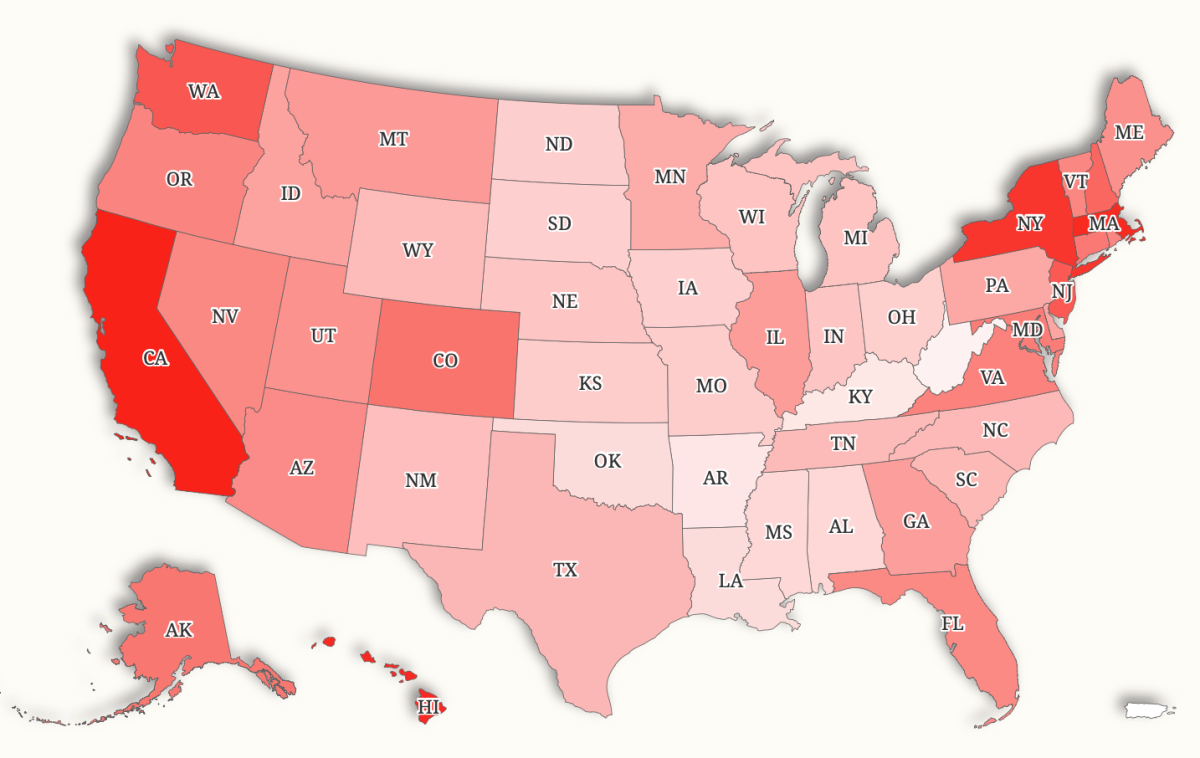
To examine how far next year's benefits could stretch, Newsweek analyzed the projected average Social Security retirement benefit against the annual after-tax income required for a single adult with no children in every state, as calculated by the Massachusetts Institute of Technology (MIT). The analysis shows a shortfall in all 50 states, with the gap exceeding $20,000 a year in six of them and reaching more than $25,000 in some.
The comparison provides a picture of where retirees who depend heavily on Social Security could face the greatest pressure from basic living costs, even with an incoming boost to benefits. Individual circumstances can differ substantially, and many retired households have pensions, savings, investment income or earnings in addition to Social Security payments.
The analysis compares the projected $25,716 annual Social Security benefit with the required annual income after taxes for one adult with no children in each state.
California has the widest gap in the country, with a required annual income of $51,416, almost exactly twice the projected Social Security amount, leaving a shortfall of $25,700 a year. Hawaii ranks second, with required income of $50,771 and a gap of $25,055. Massachusetts follows at $50,697, leaving the projected average benefit $24,981 short.
In New York, the required annual income of $49,855 produces a $24,139 gap. Washington rounds out the top five, with required income of $46,879 and a shortfall of $21,163. New Jersey follows closely with a gap of $21,030, meaning six states have shortfalls exceeding $20,000 a year.
Across all 50 states, the average gap is approximately $15,052 a year, while 23 states have shortfalls of at least $15,000.
The gap remains substantial even in states with the lowest income requirements. West Virginia has the smallest shortfall, but its required annual income of $33,999 remains $8,283 above the projected Social Security benefit. Kentucky has the second-smallest gap at $9,065, followed by Arkansas at $9,201.
The figures represent a comparison between an average Social Security benefit and a statewide living wage income benchmark rather than the finances of any particular retiree. Living costs can vary substantially within a state, while Social Security payments depend on a beneficiary's own work and claiming history.
Social Security benefits are calculated using a worker's earnings record, generally based on their highest 35 years of earnings. Claiming age can also change the amount received: workers can begin collecting retirement benefits at 62, with a reduced monthly payment, while delaying retirement benefits beyond full retirement age can increase payments up to age 70.
Social Security's COLA is calculated using the Consumer Price Index for Urban Wage Earners and Clerical Workers, or CPI-W. The adjustment is based on the average CPI-W during July, August and September compared with the corresponding third-quarter average used to determine the previous COLA. The precise size of next year's increase remains unknown, with one month of inflation data still to come next month.
AARP currently projects a 3.6 percent COLA for 2027, based on the inflation data released so far and projections for September. AARP estimates that an increase of that size would add roughly $75 a month to the average retired worker's current benefit. The forecast moved higher after the August inflation report, when the CPI-W was 3.5 percent above its level a year earlier. July's reading had been 3.4 percent higher than a year earlier.
The Senior Citizens League (TSCL) is projecting a 3.5 percent COLA, which fell from 3.6 percent the previous month following the latest inflation figures. The Committee for a Responsible Federal Budget (CRFB) has predicted a 3.4 percent COLA.
The forecasts are at this point estimates rather than guarantees. September's CPI-W reading could push the final number higher or lower, and the official adjustment will only be known once all three third-quarter figures are available.
Any increase around the current projections would exceed the 2.8 percent COLA applied in 2026. AARP said a 3.6 percent increase would also be above the roughly 2.6 percent average annual COLA between 2001 and 2025.
The gaps matter most for retirees with few resources outside the program. Social Security was designed to replace a portion of earnings in retirement, with pensions, savings and other income historically expected to supplement benefits. The program also replaces a larger share of earnings for lower-paid workers than for higher earners. Yet millions of older Americans have little additional income to draw on.
The Senior Citizens League estimated in June that 24.6 million seniors, or 44 percent of the retirement-age population used in its analysis, receive 100 percent of their income from Social Security. The estimate came from TSCL's 2026 Senior Survey of 904 people and was extrapolated to the wider retirement-age population, so it should be viewed as a survey-based estimate rather than a federal count.
For 2024, the Federal Reserve found that 91 percent of retirees age 65 and older received Social Security, while 64 percent received pension income, 54 percent had income from interest, dividends or rent and 25 percent received wages, salaries or self-employment income. The categories can overlap, since retirees may have several sources of income.
Overall, 82 percent of retirees said they were doing OK or living comfortably financially. Among retirees with no private income, however, that share fell to 54 percent. The Federal Reserve said that group included retirees relying solely on Social Security and other public cash benefits as well as people reporting no income sources.
Financial well-being was considerably stronger among retirees with private resources, with 84 percent of those with pension income but no interest, dividend or rental income saying that they were doing OK or living comfortably, rising to 93 percent among those with investment or rental income and 96 percent among those with both.
One inflation report remains before retirees learn exactly how much their checks will rise. The Bureau of Labor Statistics is scheduled to release its September Consumer Price Index data on October 14 at 8:30 a.m. ET. That report will contain the final CPI-W reading needed to calculate the 2027 COLA.
The SSA is expected to announce the official 2027 COLA after the figures are released that day. The adjustment will then take effect with Social Security benefits paid in January 2027.