Map Shows States With Most Coal Plants as EPA Repeals Major Climate Rule - Newsweek
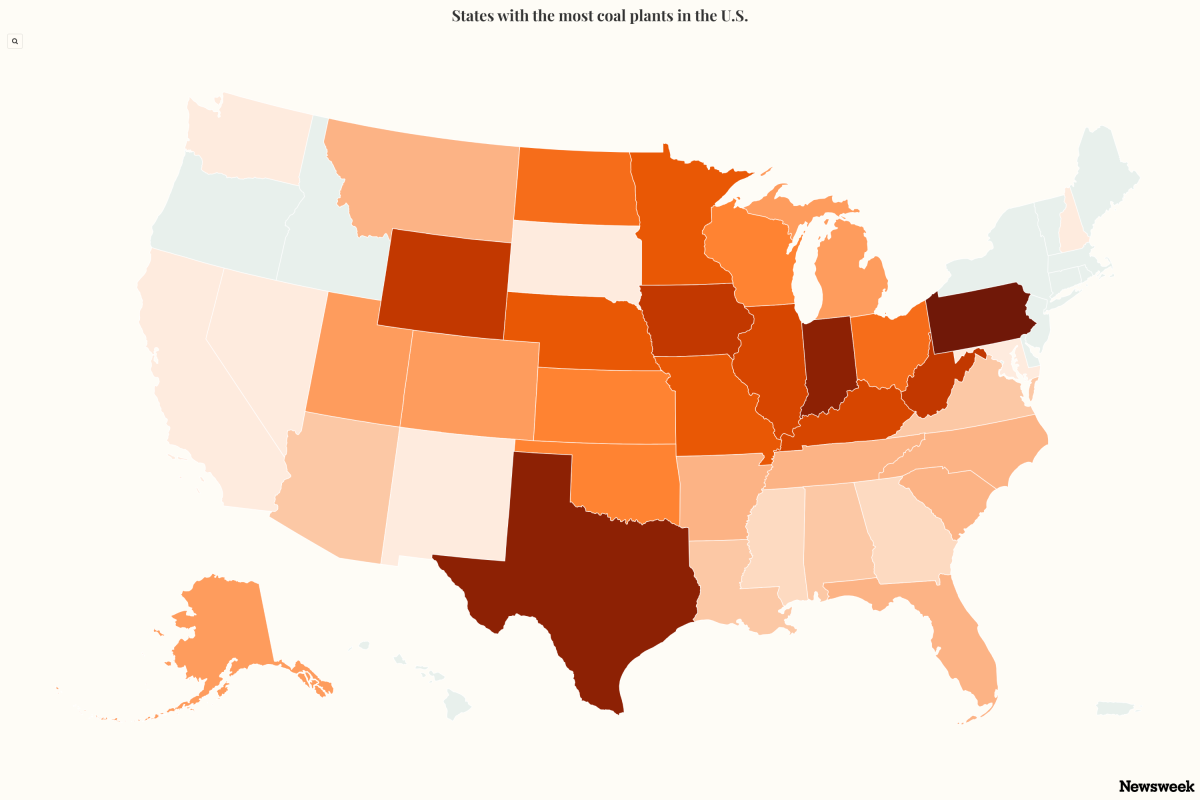
A map created by Newsweek shows the states boasting the most coal plants as the Environmental Protection Agency (EPA) finalized its repeal of a major Biden-era climate rule that limits greenhouse gas emissions from coal and natural gas power plants on Monday.
The rule change was proposed last year and comes as the United Nations has repeatedly warned of worsening climate change because of global warming. Meanwhile, President Donald Trump has expressed support for coal and other fossil fuel industries and EPA Administrator Lee Zeldin has said the change could eliminate significant costs across the industry as well as “unleash” American energy. The change is not the first major EPA shift to occur this year. In February, the EPA repealed its 2009 Greenhouse Gas Endangerment Finding, meaning that engine and vehicle manufacturers no longer were required to measure, control, or report greenhouse gas emissions for vehicles.
Newsweek reached out to the EPA by email on Monday for comment.
Domestic coal use has declined over the past 20 years due to shifts toward renewable energy, but the United States remains among the world’s top coal producers. According to data from Cleanview, a platform that tracks U.S. energy infrastructure, there are more than 200 coal-powered plants in the country. At 13 facilities, Pennsylvania leads the country with the most coal plants followed by Indiana and Texas with 12 each.
Several states have no reported facilities, such as Idaho, Oregon, Hawaii, New York, New Jersey, Delaware, Connecticut, Rhode Island, Massachusetts, Vermont, and Maine, according to the data.
With the repeal now finalized, the states with the greatest concentration of coal plants could see the most drastic health impacts, Center for Climate and Energy Solutions President Nathaniel Keohane told Newsweek, particularly in Appalachia and the Ohio Valley. However, the impacts on global warming would be much more widespread and affect everyone, he added.
Despite concerns from some energy experts, the American Coal Council has praised the EPA's effort.
"The EPA's proposal is an important step toward preserving a reliable, affordable, and secure electric grid," American Coal Council CEO Emily Arthun told Newsweek. "Coal remains one of the nation's most dependable sources of baseload power, providing the around-the-clock electricity that supports American households, businesses, manufacturers, hospitals, and critical infrastructure."
While the EPA change could reduce the cost of producing electricity, it comes with a cost of its own, Bryan Hubbell, a senior fellow at Resources for the Future and the former national program director for the Air, Climate, and Energy Research Program at EPA's Office of Research and Development, told Newsweek.
"[T]he rollbacks are expected to worsen air quality, which could be responsible for tens of thousands of premature deaths, hospital and emergency department visits, and millions of asthma exacerbations," he said. "The bottom line is that the reduced costs of producing electricity may save money over the coming decades, but the increased climate and air quality damages will cost society much, much more. This rollback is a bad deal for the American people and the world."
The change has sparked pushback from energy industry experts, who cited health issues and global warming among their greatest concerns.
“At a moment when electricity demand is growing more rapidly than it has in a half-century, and businesses, utilities, and consumers need greater certainty, the Environmental Protection Agency has taken a giant step backward,” Keohane told Newsweek. “In repealing carbon pollution standards for power plants, EPA has ignored sound science and economics and abdicated its responsibility to protect public health and welfare.”
Keohane went on to stress that carbon emissions from power plants “are a major contributor to climate change.”
However, the American Coal Council said that surging electricity demand is the reason why coal still plays an important role in America's energy sector.
"Maintaining a diverse energy portfolio is essential to both economic competitiveness and national energy security," Arthun said. "Coal-fired generation continues to play a vital role in ensuring grid reliability, particularly during periods of extreme weather, peak demand, and other challenging operating conditions. The greatest benefit of this change is that it recognizes the ongoing value of coal as the backbone of a resilient electric system."
She continued: "Keeping existing coal generation available helps protect consumers from price volatility, supports high-paying jobs in energy-producing communities, and strengthens the reliability and resilience of the electric grid. At the end of the day, reliable baseload power is fundamental to the well-being of American citizens and the strength of our economy. Policies that support energy reliability, affordability, and security are critical to ensuring the United States remains economically competitive and energy independent."
However, Keohane said future regulations are inevitable, and if finalized, the proposal would only "throw uncertainty into the mix."
With the repeal now finalized, coal plants would no longer need to meet the standards imposed under the Biden administration, which could potentially significantly reduce costs for utilities. However, immediate legal pushback is expected, which could delay or potentially derail any changes.
Meanwhile, coal plants would still be required to abide by other federal and state environmental regulations covering pollutants such as mercury, sulfur dioxide, and particulate matter.
Contact Newsweek editors for this story: Jason Lemon and Anthony Murray.