Map Shows States With Most Redistricting Changes Ahead of Midterms - Newsweek
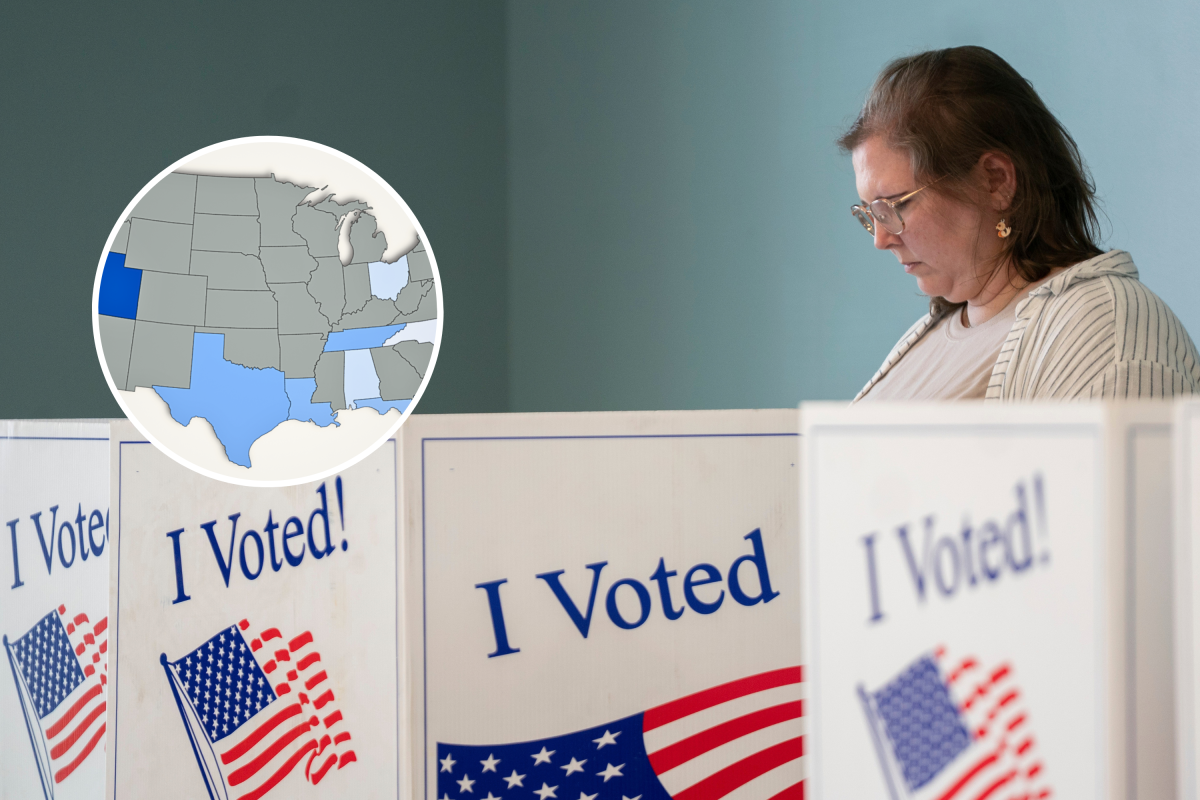
A partisan redistricting battle sparked by President Donald Trump has moved an estimated 34.8 million Americans into new congressional districts across nine states ahead of the November 2026 midterms, a new analysis has found.
A new study from Protect Democracy, which describes itself as a nonpartisan, nonprofit group working to "prevent American democracy from declining into a more authoritarian form of government," found that roughly one in 10 Americans was placed in a different congressional district between 2024 and 2026, according to U.S. census data.
The current so-called "redistricting wars" began when Trump pressed Republican-controlled Texas to redraw its House map for partisan advantage, prompting Democratic-led California to respond with its own voter-approved plan.
Texas recorded the largest reassigned population, at more than 10.4 million, while Utah experienced the biggest proportional change, with 69.1 percent placed in different districts, according to Protect Democracy’s report.
"If this trend continues, it really brings into question whether or not elected officials are really representing their constituents anymore, or if the voters are being randomly picked by mapmakers to squeeze out partisan advantage," Ben Raderstorf, a policy advocate at Protect Democracy and one of the paper’s co-authors, told The Associated Press.
In an email, Policy Strategist at Protect Democracy Drew Penrose told Newsweek, “Gerrymandering is often talked about in the context of the political horse-race between the two parties, but the more direct cost to voters is often overlooked. The scale is extraordinary: one in ten Americans has been reassigned to a different congressional district since 2024, and even people who haven’t been gerrymandered are now in a district where more than a quarter of the electorate is new.
"It’s confusing; it makes political organizing harder, and it erodes relationships and trust between constituents and their elected representatives. Right now, politicians are picking the winners and losers rather than voters. It isn’t working, but it’s fixable. Getting rid of gerrymandering and giving voters meaningful representation in Congress will take ambitious, structural reform—like not relying entirely on district lines to choose representatives, but instead using a more proportional system where each party wins a share of seats by earning a share of votes.”
Hover over each highlighted state in the map below to see how many people were reassigned to a new congressional district and the share of the state’s population affected.
What began as an attempt to improve Republican prospects in Texas became a wider contest over control of the House, with each party facing pressure to answer the other side’s gains rather than leave seats on the table.
Protect Democracy says the result is the largest modern wave of mid-decade redistricting, reviving a practice once common in the 19th century but rare during the past 50 years.
The nine-state overhaul is striking both for the number of people affected and for how quickly it unfolded.
Congress usually reconsiders boundaries after the once-a-decade census, giving candidates, election officials, and voters time to adjust before the next contest.
That norm broke down after Trump began pushing states to redraw outside the regular cycle in 2025.
Texas moved first that summer, followed by Florida, California, Tennessee, North Carolina, Ohio, Alabama, Louisiana and Utah.
The report says most of those maps were designed to maximize partisan advantage, although it identifies Ohio and Utah as arguable exceptions.
New lines can leave voters evaluating candidates who did not appear on their previous ballot or represented another area during the last Congress.
Election administrators may also have to revise ballot combinations, polling arrangements and voter information on compressed schedules.
"We tend to talk about political parties as the ‘winners’ or ‘losers’ of gerrymandering, but voters are the ones who pay the price," Raderstorf said.
"When legislative maps change, voters can find themselves in a new district with a new polling place and new representative—without ever even knowing it.
"Independent redistricting commissions can make congressional maps fairer, but as long as we rely on single-member districts, there will always be an incentive to manipulate the lines."
The report argues that multimember districts and proportional representation would reduce the power of mapmakers by allocating seats more closely to each party’s vote share.
"Proportional representation tackles the problem at its source by making the lines much less important to who wins," Raderstorf said.
That proposal reflects the authors’ preferred policy response, not a conclusion generated by the population analysis.
Texas combined the largest numerical impact with one of the highest reassignment rates.
Its new boundaries moved 10,448,258 people, equivalent to 35.8 percent of the state’s population.
The Republican initiative produced a rapid answer from California, where voters approved boundaries drawn by the Democratic-led legislature.
Those lines reassigned 9,214,062 people, or 23.3 percent of the state.
Together, the country’s two most populous states accounted for more than half of everyone identified as reassigned in the analysis.
Their competing approaches also captured the central dynamic of the wider battle: once one party moved to protect or expand its position, the other had a strong incentive to retaliate rather than accept a possible disadvantage.
That cycle makes disputes over geography more explicitly political.
Boundaries can split or combine communities to alter the partisan composition of individual seats, although the Protect Democracy study measures population movement rather than projected party gains.
Utah moved fewer people than Texas, California, Florida or Tennessee, but its electorate experienced the most extensive disruption.
An estimated 2,260,487 residents were reassigned there, representing 69.1 percent of the state.
That was nearly twice the rate recorded in Texas and more than three times California’s share.
Florida ranked third by population affected, with 6,265,306 people moved, or 29.1 percent.
Across all nine states, 26.3 percent of residents were placed in a new congressional district.
Protect Democracy produced its estimate by comparing block-level 2020 census populations under the previous and revised boundaries.
The calculation does not account for people who moved independently between 2020 and 2026.
Researchers also examined whether the makeup of each district had changed substantially, capturing residents who kept the same district number but acquired a markedly different set of fellow constituents.
A district was classified as "materially different" when more than one-quarter of its electorate had changed since 2024.
Using that threshold, the report found that 18.5 percent of Americans now live in a substantially altered district.
At least eight sitting House members are seeking reelection in districts different from those in which they previously ran.
That count excludes lawmakers who retired following redistricting and incumbents placed together in the same seat.
According to the report, officials in Georgia, Washington, Colorado, New York, Maryland, Virginia and New Jersey have considered or signaled possible redraws before the 2028 elections.
That raises the prospect of congressional maps becoming temporary political instruments rather than boundaries expected to last through the decade.
Electoral shifts may weaken a gerrymander over time, giving governing parties a reason to revise the lines again while neither side wants to disarm first.
Newsweek’s reporters and editors used Martyn, our AI assistant, to produce this story. Learn more about Martyn here.