Map Shows Which State Economies Are Growing and Shrinking Ahead of Midterms - Newsweek
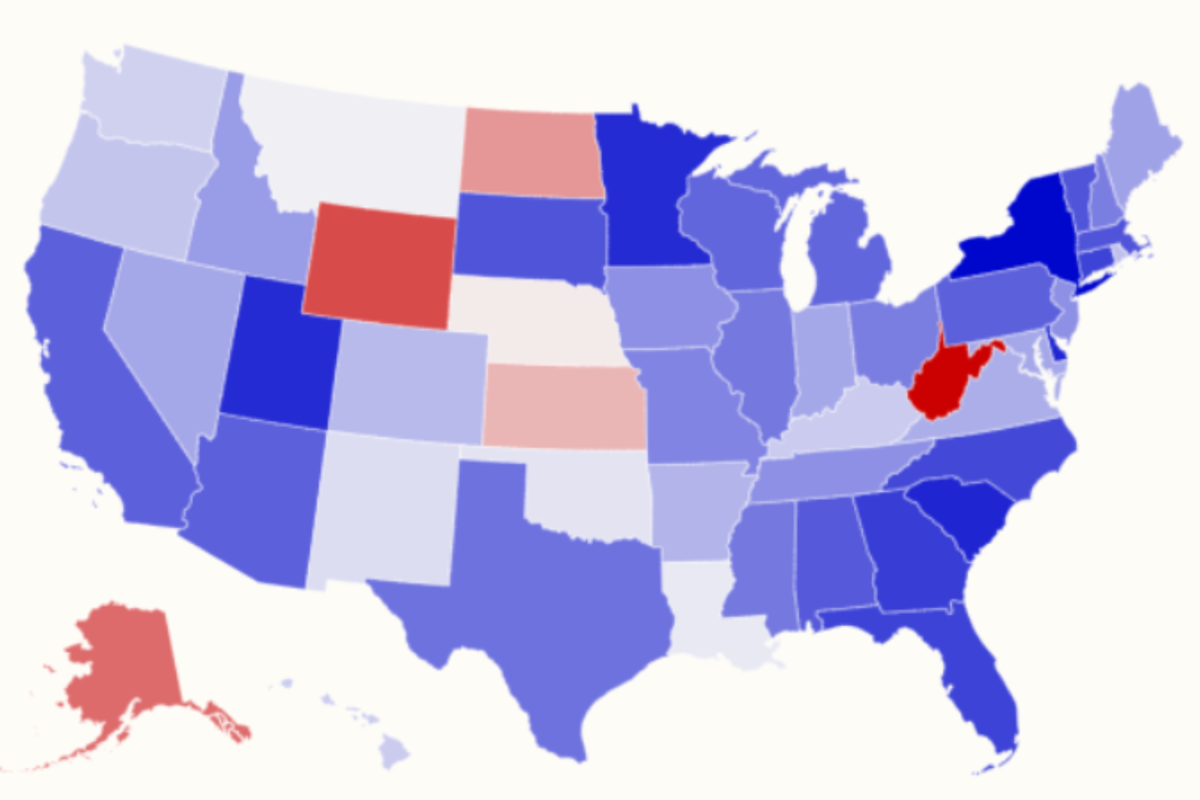
New York’s economy grew 4 percent at an annual rate and by more than any other state for the April, May and June period, according to the Bureau of Economic Analysis (BEA), which released its quarterly estimates for state-level gross domestic product growth for the second quarter on Wednesday.
Real GDP rose in 44 states as well as Washington, D.C., in the second quarter, the BEA said, as overall economic growth was upwardly revised to 2.2 percent. New York was followed by South Carolina and Delaware—both at 3.5 percent. Six states saw their economies contract.
West Virginia’s real GDP sank by 2.3 percent, followed by Wyoming, Alaska, North Dakota, Kansas and Nebraska when it came to the worst performing economies in the second quarter.
The previous report, released in June, found that Washington state had the fastest-growing economy in the first quarter, followed by California and South Carolina.
For the wider economy, the BEA said GDP rose 2.2 percent at an annual rate in the second quarter, upwardly revised from 1.5 percent in the initial reading. First-quarter growth was also revised up, to 2.5 percent from 2.1 percent.
Looking ahead, the International Monetary Fund (IMF) has projected that U.S. GDP growth will reach around 2.3 percent for 2026 following 2.1 percent in 2025, which was above the 1.9 percent average for other advanced economies. However, in its latest World Economic Outlook report, the organization forecast that it would slow to 2.2 percent in 2027.
According to the BEA, economic growth was spread out in the second quarter, with growth ranging from 4 percent to -2.3 percent across the U.S. Regionally, that is a shift from the first quarter, when the fastest-growing economies were in the West and Southeast.
New York’s economy has benefited from a number of long-term and contemporary supports, including strong Wall Street profits in 2026 and its large healthcare sector—consistently one of the leading contributors to payroll growth in the U.S. But state officials have faced criticism for policies seen as weakening the prospects for economic expansion, such as high taxes and spending relative to other states.
With economic issues remaining central for voters in the November midterm elections, GDP growth—or decline—could prove an additional campaigning issue for incumbents or those looking to unseat them.
According to the nonpartisan Cook Political Report, seven Senate seats remain “toss-up” races—states that have seen varying fortunes when it comes to GDP growth this year.
In addition to state-level economic growth and a final reading on U.S. GDP in the second quarter, Wednesday’s report from the BEA contained the monthly reading on Personal Consumption Expenditures (PCE)—the Federal Reserve’s preferred gauge of inflation.
The PCE Price Index climbed 0.3 percent month-over-month in August after a 0.1 percent bump in July, as the core rate increased 0.2 percent following a 0.1 percent gain. Both readings, along with the annual rates, came in below consensus forecasts.
“America’s softening inflation has given a caffeine shot to U.S. stock markets but opened up a beartrap for Fed Chair Kevin Warsh,” said James Bentley, director at the financial education platform Financial Markets Online, in a press note shared with Newsweek.
“The U.S.’s chief ratesetter has been under intense pressure from President [Donald] Trump to reduce interest rates ever since he took the job back in May. With inflation cooling in August, the pressure from the Oval Office will now be turned up to 10.”
Contact Newsweek editors on this story: Daniel Orton and Dave Siminoff.