Maps Show States to be Most Impacted by El Niño, Nor'easter and Polar Vortex - Newsweek
A powerful nor’easter is expected to impact parts of the East Coast this weekend, while a record-breaking El Niño and possible polar vortex intrusions could also shape weather across the U.S. in the coming months.
Forecasters have warned a nor’easter is expected to bring powerful gusts, heavy rain, and flooding impacts to portions of the East Coast this weekend.
A nor’easter is a storm along the East Coast of North America where winds over coastal regions usually come from the northeast, according to the National Weather Service (NWS). Such storms can form at any time of year but are most common and powerful between September and April. They "nearly always" bring heavy rain or snow, as well as gale-force winds, rough seas and occasional coastal flooding, the NWS says.
AccuWeather meteorologist Chad Merrill told Newsweek on Thursday that the nor’easter’s strongest wind gusts are expected to reach between 40 and 60 miles per hour along the Mid-Atlantic and Northeast coasts this weekend.
"Some offshore buoys off the Northeast coast" could record gusts of up to 74 mph, he said, "which is the equivalent of a Category 1 hurricane."
Merrill said the storm would be notable for major coastal flooding along the Mid-Atlantic and Northeast coasts, driven by persistent northeasterly winds. Coastal damage and beach erosion are expected in several areas, including from Atlantic City to Cape May in New Jersey; along the Delaware coast; from Virginia Beach, Virginia, to Nags Head, North Carolina; on eastern Long Island; and across the eastern Massachusetts coastline, according to the meteorologist.
Regional power outages are expected on eastern Long Island and from Cape Cod to Boston, Merrill said, adding that eastern Massachusetts could receive between four and eight inches of rain.
Merrill also said some beaches could need additional restoration work after the storm.
"Some of the work done this past summer to replenish the beaches in Ocean City, N.J., that were eroded by a combination of Hurricane Erin last year in August, a coastal storm in October of 2025 and the blizzard in February of this year will likely need more work for restoration following this weekend's nor'easter," said Merrill.
"There will likely be some replenishment projects needed for a few other northeast facing beaches along the Mid-Atlantic and Northeast coast following this weekend's storm due to the persistence of the gusty northeast wind pushing lots of ocean water into these areas," the meteorologist added.
The polar vortex is a large area of cold air and low pressure surrounding Earth’s poles, according to the NWS. It is present year-round but weakens during the summer months and strengthens during winter.
It often expands during winter, sending blasts of Arctic air southward over the U.S., the agency says.
Merrill told Newsweek that the Great Lakes and Northeast are among the regions of the U.S. that could be most susceptible to cold air intrusions from the polar vortex this winter.
A record-breaking El Niño is also likely to continue shaping weather patterns through the coming months.
This naturally recurring climate pattern is associated with warmer waters in the Pacific and is known to influence temperatures and rainfall worldwide.
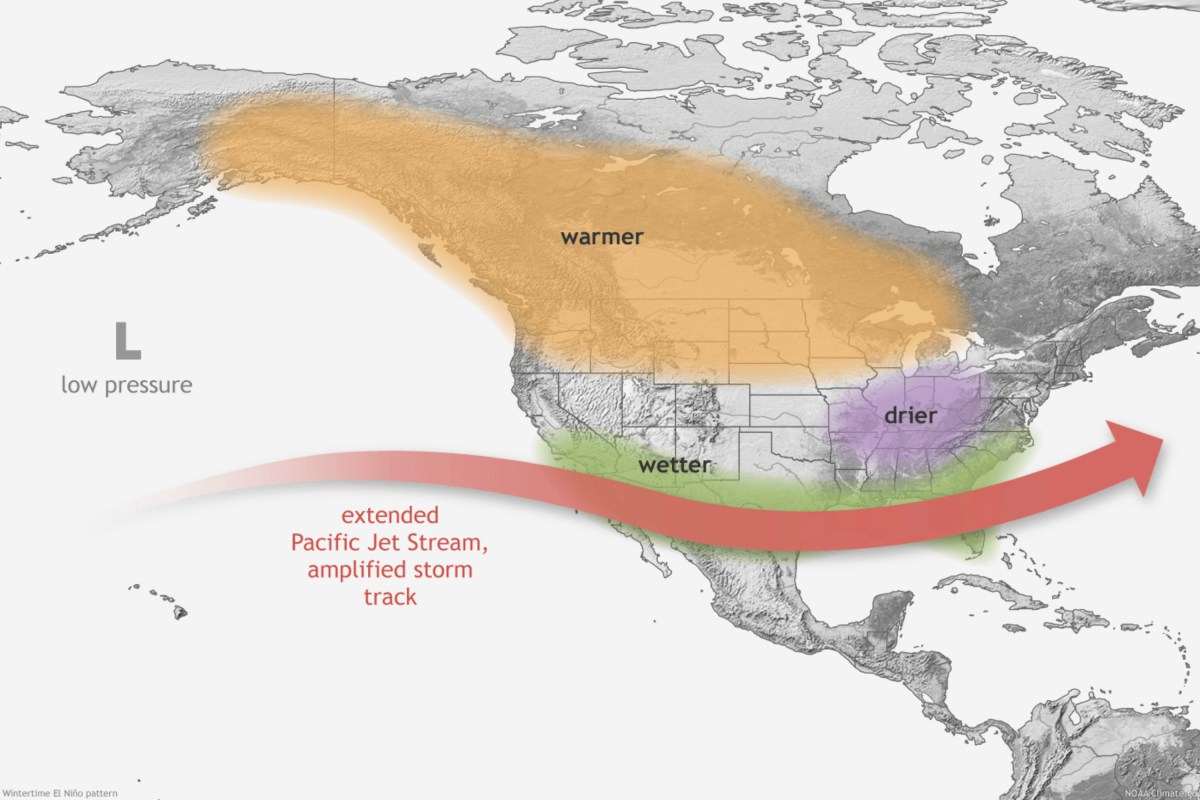
In the U.S., typical El Niño effects can include wetter conditions across the Southern U.S. and warmer, drier conditions in the North during winter.
"The central and northern California coast into the Northwest have potential to see greater impacts from this El Niño in terms of heavy rain and mountain snow," Merrill said.
Federal forecasters indicated earlier this month that El Niño was strengthening and assigned a greater than 90 percent chance for a "very strong event" during fall and winter. There was also a 75 percent chance for the event to reach historic strength during the October-December period.
"With an event of this magnitude, the chances of experiencing impacts consistent with El Niño are larger, though not guaranteed," the Climate Prediction Center noted.