
Mark Carney and Donald Trump find rare common ground: doubts about calls to slow AI - Toronto Star
The prime minister told Bloomberg that “there’s a need for co-ordination” when it comes to monitoring the development and use of AI.
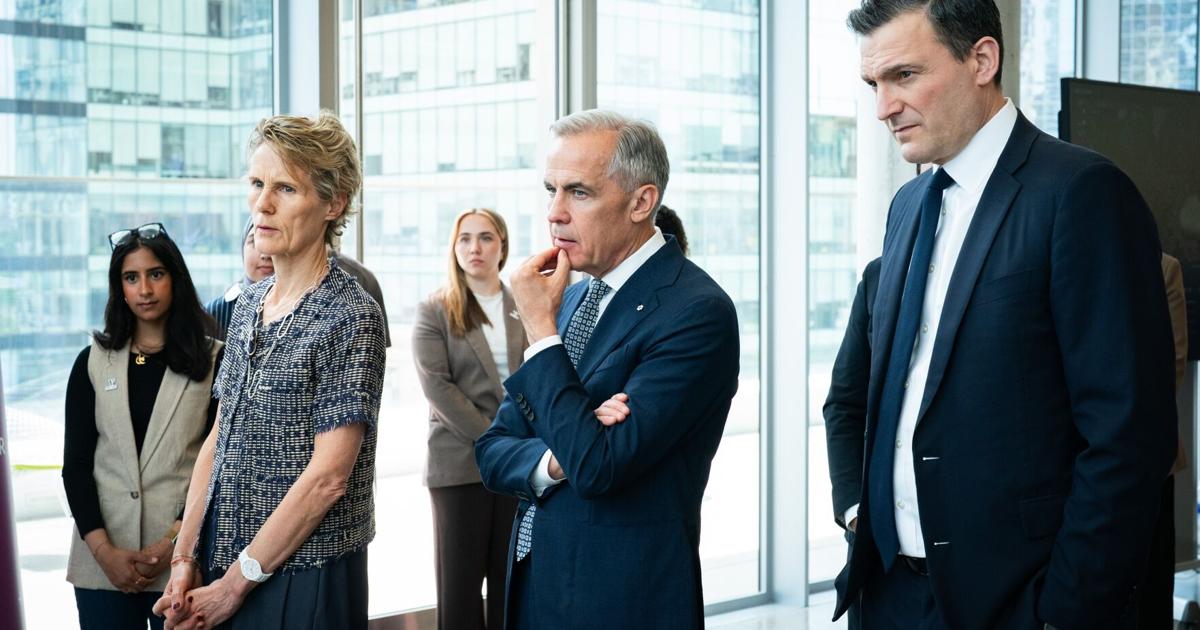
Diana Fox Carney, front left, Prime Minister Mark Carney, centre, and Artificial Intelligence Minister Evan Solomon visit technology startups at the Vector Institute, in Toronto on Thursday, June 4, 2026.
OTTAWA—They may be on opposite sides of a trade war, but Prime Minister Mark Carney and U.S. President Donald Trump found some common ground this week: fears about the catastrophic risks of AI shouldn’t halt the race to harness it — even if they disagree on what comes next.
“The tone of Canadians is: let’s get on with it, let’s build, let’s control our future, let’s be positive, let’s come together,” Carney said Monday at his inaugural investment summit, after Bell Canada announced plans to quadruple an existing data centre project in Saskatchewan.
Earlier in the day, the prime minister told Bloomberg that he had previously spoken with frontier AI leaders — several of whom have called for slowdowns amid warnings that advanced forms of the technology could stamp out humanity — about balancing innovation with government oversight.
“I think we have to be careful in this situation that the best is not the enemy of the good,” said Carney, highlighting one of his government’s core beliefs that striving for regulatory perfection cannot come at the cost of stifling a technology he has placed at the centre of his economic agenda.
Behind his keyboard on Monday, Trump was sounding a not dissimilar note.
“Concerning AI, when, in the History of Business, did anyone see the Leaders of an Industry call for Regulation that, if strongly implemented, will drive them into oblivion and bankruptcy?” the president posted on his Truth Social account.
“AI, and Data Centers, will be the Greatest Economic Development Engine in History — Bigger than Oil, Gold, Diamonds, or even the Internet,” he wrote.
Trump went on to say that “the only control or ‘guardrails’ that AI needs is a STRONG AND SMART (High IQ!) PRESIDENT” and that there is a “SICK conspiracy going on against AI” in the West that is handing China an advantage.
Carney, meanwhile, told Bloomberg that “there’s a need for co-ordination” when it comes to monitoring the development and use of artificial intelligence.
“We’ve had initial discussions at the G7 of how that might be done,” he said. “Ultimately, a technology stability board, in our view, along the lines of a financial stability board, would make sense.”
Carney said such a body could operate similarly to the U.S. Financial Industry Regulatory Authority — an independent regulator that oversees the brokerage industry — which is a proposal the Trump administration reportedly considered earlier this year.
The leaders’ comments come as a growing number of AI leaders and researchers have warned about the dizzying speeds at which artificial intelligence is evolving, spurring calls for restraint lest the technology “misalign” itself with human values, leading to extinction-level consequences.
Over the weekend, Anthropic co-founder and CEO Dario Amodei published a lengthy missive arguing that while AI is one of many “technological miracles,” frontier AI companies in democratic countries must work with governments to strike safety standards and limit the rate of “unchecked AI progress.”
Tech titan Elon Musk, OpenAI’s Sam Altman, and Demis Hassabis, the head of AI research lab Google DeepMind, all agreed with Amodei’s plan to “pace the frontier.”
The NDP’s Avi Lewis, however, wants to see Canada at the forefront of those discussions, not executives.
“Canada has binding legal regulations on everything from guns to butter. And none for AI,” Lewis wrote on X on Monday.
“Are we going to trust people like Elon Musk and Sam Altman to regulate themselves? Or is our government going to stop cheerleading and start regulating in the public interest?”
It is unclear what abilities Canada would have — if any — to constrain the powers of tech companies headquartered on foreign soil.
The Liberal government introduced earlier this year one proposed law that would launch a digital regulator that would oversee safety standards for AI and another bill that would safeguard Canadians’ data and privacy.
Both Carney and Artificial Intelligence Minister Evan Solomon have also said trust in the technology and data sovereignty remain their top concerns.
“The Canadian government’s in a pretty tricky spot,” said Taylor Owen, the director of McGill University’s Centre for Media, Technology and Democracy, and member of Solomon’s AI task force.
“What the government’s done is taken this basically consumer product focused approach, which I think they can do, right? Because it’s a product that’s in our market, and we can regulate the downside risks, whether they’re privacy or safety or whatever they might be,” Owen said.
“But this (superintelligence) risk is something sort of different, it seems to me, and requires a different mechanism. And the problem is, is that mechanism doesn’t exist in any form right now.”
Olivier Blais, the co-chair of Ottawa’s advisory council on AI and another task force member, told the Star that Carney has several tools at his disposal.
That includes banning the use of some AI models to perform certain tasks, a form of “leverage” Canada could wield if any incidents emerge, Blais said, even if that risks inflaming trade tensions with U.S.-based AI giants.
“I would love Canada to be able to say, ‘You know what? There were some cybersecurity attacks. We have asked, for instance, OpenAI or Anthropic to remove these models from Canada,’” he said. “At least it would show leadership.
“I think every government needs to step up, including Canada,” Blais added. “We all need to step up the way we are perceiving these companies … at the end of the day, they’re the equivalent of nuclear reactors. Anybody could build whatever they want, however they want.”
Error! Sorry, there was an error processing your request.
There was a problem with the recaptcha. Please try again.
You may unsubscribe at any time. By signing up, you agree to our terms of use and privacy policy. This site is protected by reCAPTCHA and the Google privacy policy and terms of service apply.
Raisa Patel is an Ottawa-based reporter covering federal politics for the Star. Follow her on Twitter: @R_SPatel.

