Mark Carney cites LNG terminal expansion as the kind of major project Canada needs - Toronto Star
LNG Canada said the second phase of its terminal in Kitimat, B.C. will double the annual capacity of the terminal, which first started shipping liquid natural gas last year, to 28 million tonnes.
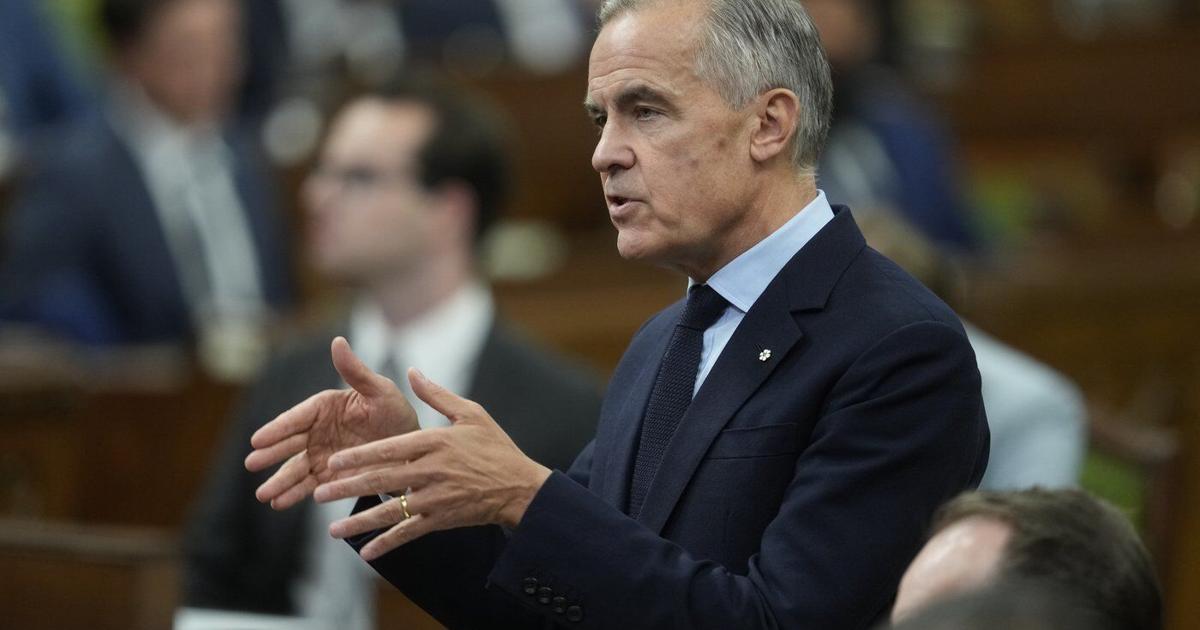
Prime Minister Mark Carney rises during Question Period on Parliament Hill in Ottawa, Thursday, Sept. 24, 2026.
OTTAWA — Days ahead of a key decision that could fast-track Alberta’s proposed West Coast oil pipeline, Prime Minister Mark Carney championed investments in fossil fuels, while promising to protect Canada’s waters and the whales within them from the damage they can cause.
The prime minister was in Vancouver on Tuesday as LNG Canada announced it would be moving ahead with its massive Phase 2 expansion, doubling the amount of liquefied natural gas (LNG) shipped from its Kitimat, B.C. terminal. Under its agreement with Alberta, the Carney government must decide by Thursday this week whether it will designate the proposed West Coast Oil Pipeline as a project in the national interest, which would fast-track it through the regulatory process.
The Build Canada Act, passed last year, and the Build Canada Strong Act that Carney’s government put before Parliament last week, give the federal government extraordinary powers to circumvent laws and regulations, including letting it override the Species at Risk Act when a project is deemed in the national interest. The proposed oil pipeline would end near the Roberts Bank Terminal in Delta, B.C., and would mean more ships entering those waters, potentially threatening killer whales and the salmon stocks they feed on.
As he pledged $1.2 billion in new funding for ocean protection, Carney acknowledged that his agenda needed to be paired with more environmental protection.
Prime Minister Mark Carney announces details of the phase 2 expansion of LNG Canada's facility in Kitimat, B.C. The expansion will double the output of Canada's first liquefied natural gas export terminal, a project Carney says will create thousands of new jobs and connect low-cost, low-carbon Canadian energy to global markets. (Sept. 29, 2026)
“We must scale up our systems to protect marine life in the event something goes wrong. We are investing in a national marine-mammal oil spill response plan and working with local partners to respond more quickly and effectively,” he said. “The further we reach, the greater is our responsibility to protect what sustains us. We inherited these oceans, and it is our obligation to pass them on better than we found them.”
The new money will go to the Canadian Coast Guard to step up monitoring, new projects to reduce vessel noise that can disorient whales, and restoration of the Fraser River Estuary.
The pipeline and the Roberts Bank Terminal expansion are both being considered for that national-interest designation, and both would mean many more ships in the waters around Vancouver. Canadian taxpayers are currently set to own as much as 45 per cent of the new pipeline, with the Alberta government owning 45 per cent and Pembina Pipeline owning the remaining 10 per cent share.
Carney didn’t reveal the government’s decision on fast-tracking the pipeline, but said the project has tremendous potential for Canada.
“This project would diversify our economy, create almost 150,000 new jobs across Canada and make us much less dependent on the United States,” he said.
Carney took credit Tuesday for the long-in-the-works expansion of the Kitimat terminal, as investors green-lit the project that will eventually ship 28 million tonnes of liquefied natural gas per year.
Last year, the Liberals referred the project to the new Major Projects Office for fast-tracking, but it was never designated and most of its permits were in place before the office got involved. Still, Carney said it was proof that the sped-up regulatory system was working.
“Twelve months from referral to final investment decision is the pace that this pivotal moment in Canada’s history demands.”
Heather Exner-Pirot, a senior fellow at the Macdonald-Laurier Institute, said that while the Carney government may have helped smooth out some minor issues, this was a project that would have happened eventually.
“When they designed it and got it approved, it was always meant to be a Phase 1 and a Phase 2 and Coastal GasLink (the pipeline that feeds the terminal) was built to have the capacity for Phase 2, so it was kind of always a matter of time,” she said in an interview.
Exner-Pirot said the Carney government’s new tax measures, including accelerated capital cost deductions, likely sweetened the deal, but that there is also high demand for Canada’s LNG around the world, especially since the war in Iran started.
While Conservative Leader Pierre Poilievre welcomed Tuesday’s announcement, he said the project would have been under way long ago under a Conservative government.
“Today’s announcement on LNG Phase 2 is long-delayed good news, but this project got its permit a decade ago,” he said. “Bad Liberal policies delayed its construction, which has still not begun.”
Construction on the first phase began in 2019 and the terminal went into service last year. At a cost of more than $40 billion, it was one of the largest private sector investments in Canadian history. The second phase is expected to cost more than $20 billion, while upgrades to the Coastal GasLink pipeline will push the total cost to an estimated $33 billion.
Earlier this summer, the Wet’suwet’en Hereditary Chiefs and the Union of British Columbia Indian Chiefs, who triggered nationwide protests with their initial opposition to Coastal GasLink, promised to renew that protest for any expansion of the pipeline and warned banks and pension funds not to invest in the project.
Breaking news, interactive polls, video, and voice notes. Star stories you’ll want to share, delivered where you’re already chatting. Follow the Star on WhatsApp.
The project is a joint venture between Shell, which holds the largest stake, and several Asian companies, including Petronas, PetroChina, Mitsubishi and Korea Gas Corporation, which will actually purchase much of the natural gas.
While the project is promising to provide lower-carbon LNG compared to global standards, the first phase of the project emits more than four million tonnes of greenhouse gases per year, according to the B.C. government, an amount equivalent to that produced by nearly 900,000 cars in a year.
Alex Walker, a program manager with Environmental Defence, said the project is a mistake, and that its first phase has already broken environmental commitments through gas flaring on site.
“No amount of rebranding into ‘natural gas’ changes the environmental and economic harms it causes. The economic benefits are overhyped, and the harms are under-reported,” Walker said.
Carney defended the project’s emissions and said natural gas is a part of a broader energy picture, which also includes massive clean-energy projects like the Churchill Falls dam project the government supported.
“There are transition fuels and natural gas is one of the core transition fuels and that’s the role there,” he said.
Two other LNG projects under construction in British Columbia, Woodfibre LNG and Cedar LNG, are expected to come online in the next three years. LNG Canada’s Phase 2 is targeting a start date in the 2030s. A final investment decision is expected soon for another project, Ksi Lisims LNG.
Error! Sorry, there was an error processing your request.
There was a problem with the recaptcha. Please try again.
You may unsubscribe at any time. By signing up, you agree to our terms of use and privacy policy. This site is protected by reCAPTCHA and the Google privacy policy and terms of service apply.
Ryan Tumilty is an Ottawa-based reporter covering Parliament Hill. Reach him at rtumilty@thestar.ca and follow him on X: @ryantumilty.