
Mark Carney wants to attract $1 trillion to Canada. It’ll only make sense if we fix this glaring problem - Toronto Star
Foreign investment has to grow Canada's economy, not merely sustain it.
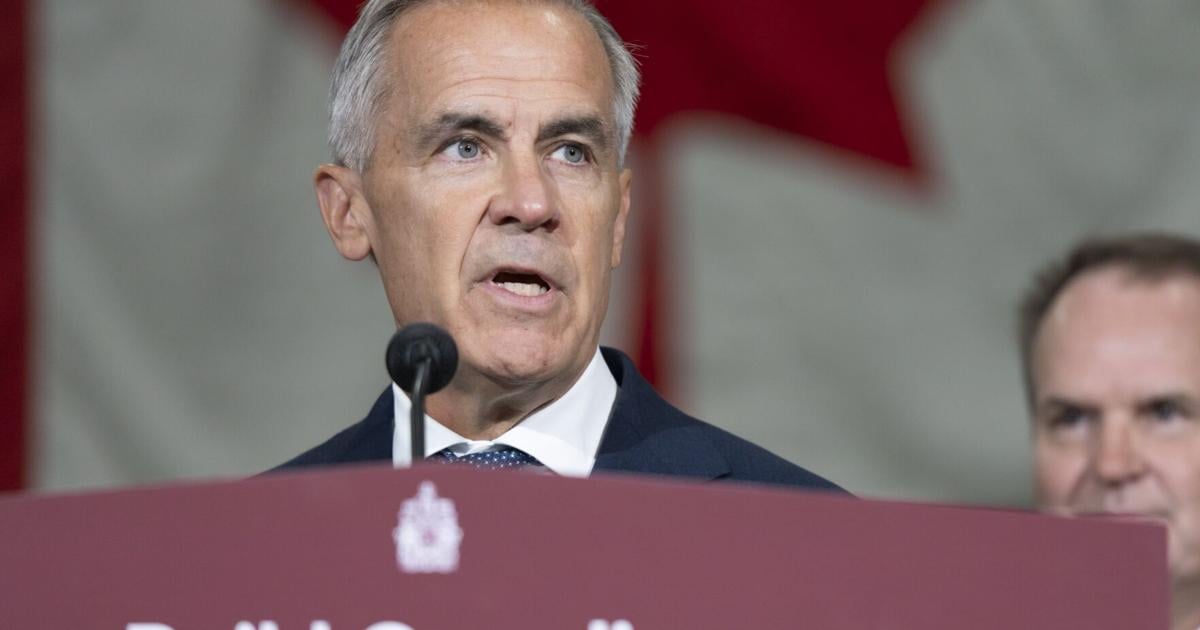
Mark Carney’s desire for more foreign investment has to line up with what Canada needs, writes Vass Bednar.
Vass Bednar is the managing director of the Canadian Shield Institute and co-author of "The Big Fix."
Canada, we are told, has become an extraordinarily attractive place to invest.
In his recent Forward Guidance address, Prime Minister Mark Carney said that foreign direct investment in Canada is at its highest level in two decades, running at twice the rate of our nearest G7 competitor. Canada, he added, is now “the most attractive country in the world for infrastructure investment.”
And our government wants much more.
Ottawa has set an extraordinary goal:attract $1 trillion in new investment over five years. The idea is that capital investment is needed to build new infrastructure, grow companies and develop the industries that will keep Canada prosperous and competitive in spite of the U.S. trade war.
But these two claims sit together somewhat awkwardly. If Canada is already attracting foreign investment at such a remarkable rate, what exactly are we trying to fix by attracting so much more.
Canada is not exactly starved for foreign capital. In fact, our stock of inward foreign direct investment has increased roughly five times since 2000, reaching about $1.6 trillion. By international standards, Canada is already one of the most FDI-intensive major economies. We’ve grown reliant on other people’s money to build up our economy.
At the same time, some of the largest pools of Canadian capital have been steadily investing elsewhere. Our top pension funds (the so-called “Maple 8”) have been progressively underinvesting in Canada. Their investment here has been declining ever since we eliminated the Foreign Property Rule in 2005, which set a ceiling for foreign content in Canadian retirement plans. And when they do invest here, they play it nice and safe: funds tend to be concentrated in government bonds and infrastructure, two asset classes that tend to provide reliable returns but do not spur the creation of new businesses.
Consider CPP Investments. As the fund more than quadrupled between 2013 and 2026 — from roughly $183 billion to $793 billion — the share invested in Canada fell from about 37 per cent to just 12 per cent.
There are defensible reasons for the shift. Pension managers have a fiduciary responsibility to seek strong risk-adjusted returns. This can justify a strategy that seeks to diversify geographically, thus avoiding the risk of concentrating retirees’ savings in the same economy that already determines their wages and housing wealth.
Still, the juxtaposition is difficult to ignore: Canada is aggressively trying to persuade foreigners to invest here while our biggest domestic investors are putting an ever-smaller share of their money into Canada.
Notably, Quebec’s Caisse de dépôt et placement, an institutional investor that manages several public and parapublic pension plans, offers a useful counter-example in all this. Unlike most of its peers, the Caisse has a dual mandate: earn returns for depositors while also contributing to Quebec’s economic development.
But there’s a really basic problem with this whole conversation around FDI, in which we treat all capital investment as equivalent.
In reality, the composition of FDI matters at least as much as its quantity.
Economist Mariana Mazzucato has argued that modern economies have become increasingly sloppy about distinguishing between value creation and value extraction, blurring between producing new value and capturing value that already exists.
Recent research finds that the overall effect of FDI on economic growth is frequently statistically insignificant.
Whether FDI actually leads to increased growth varies according to the sector and a country’s position within global value chains. FDI is positively associated with growth in primary industries, has no significant positive relationship with manufacturing growth, and is associated with lower growth in services, where investment more often takes the form of mergers and acquisitions rather than new productive capacity.
So “more investment” cannot be the entire objective here. When we’re courting foreign capital, we should care about whether investment helps Canadian firms move into higher-value positions on global value chains, retain intellectual property, develop domestic suppliers and build capabilities that remain here long after the initial cheque is e-transferred.
That could mean foreign capital helping us build infrastructure that Canada would struggle to finance on its own, or bringing in growth capital to help scale up domestic firms without giving up Canadian ownership or strategic control.
We shouldn’t just be chasing these investment dollars for the sake of it. We must get much better at distinguishing between capital that creates new value, capital that merely acquires value we already created.
The Investment Summit should clarify what kind of capital Canadians really want instead of just counting it.
Error! Sorry, there was an error processing your request.
There was a problem with the recaptcha. Please try again.
You may unsubscribe at any time. By signing up, you agree to our terms of use and privacy policy. This site is protected by reCAPTCHA and the Google privacy policy and terms of service apply.
Vass Bednar is the managing director of the Canadian Shield Institute and co-author of “The Big Fix.”
Opinion articles are based on the author’s interpretations and judgments of facts, data and events. More details

:quality(30):format(webp):focal(0.5x0.5:0.5x0.5)/kaltim/foto/bank/originals/prasasti-lanud-tarakan_20180731_183347.jpg)
