Mark Carney, Xi Jinping deepen China ties with $400-million trade deal - Toronto Star
Canadian pork and seafood exporters get tariff relief as Ottawa extends breaks on some steel and aluminum products to 2028.
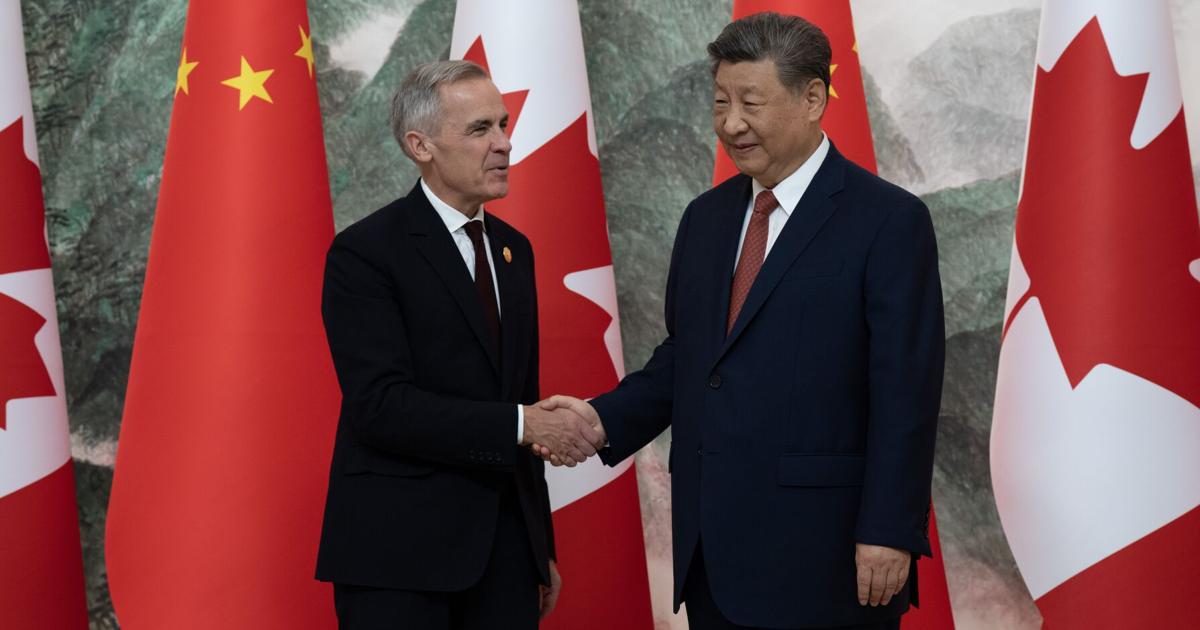
Chinese President Xi Jinping greets Prime Minister Mark Carney at the Kylin Villa State guest house in Shenzhen, Tuesday, Nov. 17, 2026.
SHENZHEN, China — Canadian pork and seafood exporters will see tariff relief in a $400-million deal struck Tuesday between Prime Minister Mark Carney and Chinese President Xi Jinping, with Ottawa cutting a break on certain Chinese steel and aluminum products in return as the two countries continue to thaw relations.
The two men met Tuesday on the sidelines of the Asia-Pacific summit, which has turned into a gathering dominated by the superpowers or “hegemons” — China, Russia and the United States — whose flouting of the international trading and security norms prompted Carney’s rallying cry this year to middle powers.
In a bilateral meeting before the summit, Carney and Xi shook hands and later sat down with officials, as Carney said “the stabilization of our bilateral trade is indicative of how we can work together more broadly, pragmatically, to solve problems.”
Canada’s meat industry is praising a further opening of Chinese market access during Prime Minister Mark Carney’s second meeting with Chinese President Xi Jinping. Beijing agreed to drop trade restrictions on more Canadian goods in exchange for more steel and aluminum access, which the Liberals say shows pragmatic diplomacy. (Nov. 17, 2026)
“As we look to the future, we have the opportunity to advance in areas of mutual interest, building decades of engagement between our peoples and guided by our national interests and values,” said Carney. “We can help shape the global order that is open to sustainable, peaceful and human-centred growth.”
Xi greeted Carney, one of the 20 other leaders he’ll host here, saying the turnaround in the relationship began at last year’s Asia-Pacific meeting and led to their January rapprochement, which produced a “new China-Canada strategic partnership” that he welcomed after the chill that descended several years ago.
“The development of China-Canada relations over the years has provided us with an important lesson: we must respect each other, pursue equality and mutual benefit, and seek common ground while setting aside differences,” Xi said.
Xi said “facts” have proved that “the improvement and development of China-Canada relations serve the interests of the peoples of both countries and also contribute to maintaining world peace, stability, and development and prosperity. This is the right choice,” he added, according to a Bloomberg translation of his remarks.
Carney’s deal with China includes a suite of other measures that will help the two countries expand bilateral travel, study and cultural ties, and kick-start high-level business talks between CEOs of each country to improve other areas of trade.
The federal government says it has restored access to markets worth about $7.4 billion of the $8 billion in products affected by China’s tariffs.
The two-year agreement, which extends tariff-relief measures agreed to in January, means China will lift 25-per-cent tariffs on $400 million worth of Canadian exports, including $116 million in pork products (though Canadian pork exporters say exports this year would total about $250 million) and more than $285 million in fish and seafood exports.
In parallel, Ottawa says it will extend existing remission measures for certain Chinese steel and aluminum products until the end of 2028, a concession worth about $360 million — so, not quite a dollar-for-dollar deal, but close.
The steel and aluminum relief is also targeted, according to the Canadian government, to ease the impact of Canada’s own steel and aluminum tariffs against Chinese imports on 23 steel and 9 aluminum items that the Carney government says are in short supply and “are not made by Canadian producers in sufficient volumes to serve the Canadian economy.”
The announcement expands the January package of relief measures that dropped or lowered, for one year, China’s so-called “anti-discriminatory” tariffs against Canada, which Beijing imposed after Ottawa aligned with the United States on tariffs targeting Chinese EVs, steel and aluminum.
A few weeks ago ahead of this visit, Canada and China agreed to extend that deal giving Canadian canola meal, peas, lobster and crab access to the China market for two additional years, to the end of 2028, and to extend remissions on Chinese metals as well. But the relief for pork and other seafood products was not announced at that time.
Kyle Larkin, head of the Canadian Meat Council representing pork processors, and Karan Sangfai, CEO of Hylife, one Canada’s top four pork exporters, said it was “great news” but they clarified the deal gets Canada “halfway there” in terms of restoring Canadian pork in Chinese markets to the level they were at in 2024.
Sangfai said his company, based in Manitoba, estimates Chinese tariffs in the past two years cost his company $36 million in profits, largely because China is the main market for items like pigs’ feet and heads, known as offal. The lifting of China’s punitive 25-per-cent tariffs is a big help, they said.
Additionally, Ottawa agreed once again not to impose tariffs on imports of certain Chinese solar products and semiconductors — two industries where the U.S. administration of President Donald Trump is in fierce competition with China.
Carney’s parliamentary secretary Kody Blois shrugged off questions about whether the U.S. would be irritated by Canada moving even closer to China, saying both the U.S. and Canada are seeking to engage more with China, and “the commitment between the two leaders, Americans and China, Canada and China, is relatively similar.”
Carney said Canada is ahead of its goal to increase Canadian trade with China by 50 per cent over the next four years.
Blois said that since Carney set out to improve ties, there have been 35 ministerial visits, while senior trade negotiators have worked with China to pave the way for additional exports.
The two-year deal will allow both sides to assess how industries respond and is part of a step-by-step approach, he said, in order to give farmers some certainty, but also to evaluate the impact on a Canadian steel industry trying to adapt to demand that it cannot yet meet, as it faces Trump’s steep tariffs on exports to the U.S.
In fact, statistics show the warming relations have resulted in an acceleration of bilateral trade, with Canadian exports to China reaching $34.68 billion, up 39 per cent and already nearly equal to their full-year 2025 total. Energy was the biggest driver of that increase, but agri-food also more than doubled in the first nine months of 2026. And Canada imported more Chinese electronics, machinery and vehicles, while consumer goods showed an increase, according to data that shows that as U.S. tariffs escalated against Canada in August, China’s share of Canada’s trade outside the United States rose to 19.7 per cent.
The deal, inked Tuesday morning in China, reaffirms Canada’s decision to allow 49,000 Chinese EV imports this year (only 16,211 vehicles have entered so far because just two Chinese manufacturers have been certified by Transport Canada). It also confirms that 10 per cent of EV imports must have an import price below $35,000.
The agricultural product lists are targeted and selective.
For comparison, the $116 million worth of pork that has regained access to the market is just over a fifth of the value of Canadian pork exports to China, which were in 2018 worth more than $500 million. That was before Canada’s arrest of a Huawei executive at the behest of the U.S. led to the “two Michaels” affair and plunged Canada-China relations into a deep freeze.
Prime Minister Mark Carney arrives in Shenzhen, China where he will attend the annual leaders’ summit for the Asia-Pacific Economic Cooperation group, or APEC. He will also hold a bilateral meeting with Chinese President Xi Jinping, the second such meeting for the two leaders in 2026. (Nov. 16, 2026)
Error! Sorry, there was an error processing your request.
There was a problem with the recaptcha. Please try again.
You may unsubscribe at any time. By signing up, you agree to our terms of use and privacy policy. This site is protected by reCAPTCHA and the Google privacy policy and terms of service apply.
Tonda MacCharles is Ottawa Bureau Chief and a senior reporter covering federal politics. Follow her on Twitter: @tondamacc.