
Mark Carney’s ‘inherent attraction’ pitch to Europe has no guarantee of a happy ending - Toronto Star
The Canadian prime minister's literary reference in praising co-operation between Canada and the European Union can also be read as a warning, Allan Woods writes.
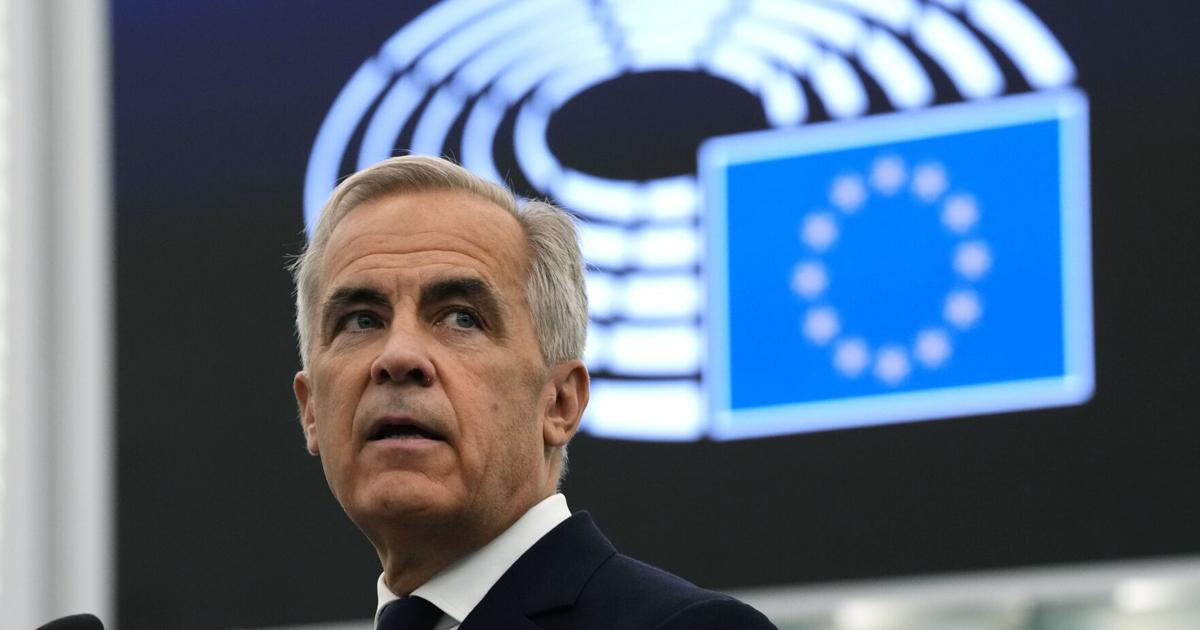
Prime Minister Mark Carney addresses the European Parliament in Strasbourg, France, on Sept. 17, 2026.
It’s always a good idea to dig deeper when a Canadian prime minister waxes poetic in German.
In Mark Carney’s speech Thursday to the European Parliament, he drew on history, economics and even botany to make the case for Canada and Europe building closer, tighter bonds.
And he invoked the iconic German writer Johann Wolfgang von Goethe’s 1809 novel “Die Wahlverwandtschaften (Elective Affinities)” to talk about “different elements that combine because of their inherent attraction.”
Those two elements being referenced in Carney’s speech were vast, energy-and-mineral-rich, tariff-riddled Canada and the 27 member states of the European Union.
If he skipped over the major plot points of Goethe’s book — a tragedy — it was because they would have muddled his overall message.
The story is of the wealthy couple Edward and Charlotte, who invite another couple, Otto and Ottilie, to live with them in a lakeside manor. A double adultery ensues, followed by an out-of-wedlock child.
The baby’s accidental death from drowning leads to Ottilie’s death from guilt, then Edward’s subsequent demise from lover’s grief.
It is a German “Romeo and Juliet” of sorts, one that the Paris Review described as “a meditation on the vanity of our desire to mould reality to our liking.”
Another takeaway is that affinities — in real life and in politics, as in literature — don’t guarantee a happily-ever-after result.
U.S. President Donald Trump’s reaction to the proposal of associate EU membership for Canada was a useful reminder of this.
In brief remarks to reporters, Trump threatened to slap “very serious tariffs” or trade restrictions on the EU if he deems the deepening relationship to be “at all a hostile act.”
“If it’s a good intention,” he added, “that’s fine.”
But an indication of his mood might have come right after Canada’s invitation to associate membership was made, when he signed an executive order to remove Canadian-origin goods and services from the American federal procurement system, following up on a threat made earlier this month.
In his speech on Thursday, Carney again invoked his pet name for Trump’s United States: “hegemon.” He spoke about the “freedoms we must fight for every day,” and predicted that the Canada-Europe alliance could stop dominant powers from interfering in their trade, sovereignty and democracy.
But answering questions after the speech, Carney struck a softer note. “This is a positive thing for the president of the United States,” he said. “A stronger, more resilient, more sovereign Canada will be a more effective partner.”
What little we know about the plans Canada and Europe are cooking up should raise concerns that Trump, or whoever succeeds him, could look upon them much the same way that fate or destiny intervened to kill off the protagonists in Goethe’s work of fiction.
Take just two of the key areas mentioned by Carney and European Commission President Ursula von der Leyen: energy and critical minerals.
Canada, Carney said, can deliver energy to Europe “at huge scale and in every form that the transition requires.” Currently, the U.S. is the major supplier of liquefied natural gas to the continent — a flow Trump threatened to cut off as recently as last spring in one of his fits of anger.
That was the kind of thing Carney referred to when he spoke of the need for the Canada-EU partnership to defend against such “vulnerabilities.”
“Closing these gaps is not possible alone,” he said, “but it’s very achievable collectively.”
On Wednesday, von der Leyen spoke of creating a European critical minerals corporation to “help us obtain and stockpile what we need for electric cars, for chips and batteries, for clean tech and defence and so much more.
“Not only does our industry depend on this but also our independence and our security,” she said.
Carney responded Thursday by positioning Canada as a solution to this problem.
“Canada has deposits of over 34 critical minerals, and we are among the top producers of the 10 most essential for the world’s energy transition,” he said. “Our alliance can help fill Europe’s need for reliable supply.”
That complementarity and geopolitical back-scratching will sit poorly with an American president who prefers being offered exclusive-access deals to competing for what his country also needs if America is to wean itself off an uncertain Chinese supply chain.
The other potential wrinkle in Carney’s political narrative are the hidden details that have yet to be revealed to Parliament or the Canadian public.
It was former New York governor Mario Cuomo who said that one campaigns in poetry and governs in prose.
On the alliance, or associate membership — or whatever they ultimately call Canada’s deal in the making with Europe — Carney needs to start explaining in clear, consistent terms, using plain-spoken English and French, what is concretely on offer for Canadians, and what they must tradeoff for such advantages.
One easy-to-avoid problem has been how to label the new relationship.
Early reports mentioned Canada’s “associate” membership in the EU, prompting denials from the Prime Minister’s Office. Carney himself spoke of an “alliance.” But when von der Leyen’s made the formal offer — and global headlines — on Wednesday, Canada’s EU ambassador-designate, Jonathan Wilkinson, brushed off the question of “nomenclature.”
“At the end of the day, there are lots of different ways you can actually use to describe it,” Wilkinson said.
Carney has promised more details at the next Canada-EU summit in late October. He said there would also be parliamentary debates, committee hearings and, ultimately, a vote on the shape and form of the bridge being built between Ottawa and Brussels.
“At this moment, it’s the beginning of a process,” he said, adding that it “will make Canada more sovereign, more prosperous, more sustainable.”
Breaking news, interactive polls, video, and voice notes. Star stories you’ll want to share, delivered where you’re already chatting. Follow the Star on WhatsApp.
Goethe’s most famous work, “Faust,” is a play about a deal with the devil. The pact that Carney is working up appears, for now, to be acceptable to a Canadian public that has mostly rallied to the prime minister’s side.
But it’s worth keeping a close eye on the details to make sure nothing is lost in translation.
Error! Sorry, there was an error processing your request.
There was a problem with the recaptcha. Please try again.
You may unsubscribe at any time. By signing up, you agree to our terms of use and privacy policy. This site is protected by reCAPTCHA and the Google privacy policy and terms of service apply.
Allan Woods is a Paris-based staff reporter for the Star. He covers global and national affairs. Follow him on X: @WoodsAllan.

