Martin Regg Cohn: Who actually uses Toronto’s bike lanes — and who really benefits from them? - Toronto Star
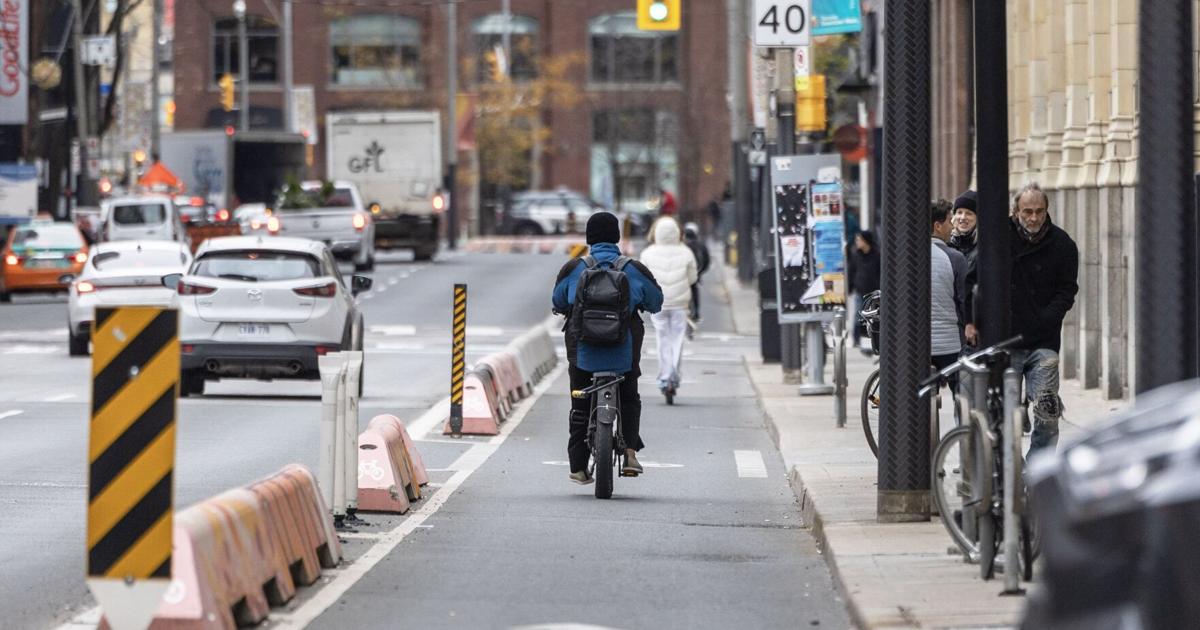
A clear-eyed look at Toronto's major streets suggests that the expected cycling revolution hasn’t happened despite the installation of lanes for bike riders, Martin Regg Cohn writes.
A cyclist uses a bike lane on Richmond Street West in downtown Toronto on Nov. 19, 2024.
Martin Regg Cohn is a Toronto-based columnist focusing on Ontario politics and international affairs for the Star. Follow him on Twitter: @reggcohn.
In the cold light of day, with snow on the streets and ice on the sidewalks, Toronto’s bike lanes have never looked clearer.
Clear of snow most days. Clear of cyclists most times.
To be perfectly clear: by cyclists, I mean people who pedal — not the e-bikers with pretend pedals who don’t.
We rarely stop to think about who really uses them and who doesn’t. In the overheated debate about bike lanes, winter has a way of clearing the air.
These days, it’s hard not to notice that the most steadfast, fastest bikers are e-bikers ferrying food for Uber Eats and competing delivery outfits. Commuters and recreational cyclists, not so much — not in the salty, slushy winter chill.
How did we come to the point where massive public funds are invested in building and maintaining a network of part-time trails used mostly by part-time gig workers? How do we justify the specialized winter crews that plow and salt these mostly empty bike trails while adjoining sidewalks are icy and slippery, and emergency shelters for the unhoused remain underfunded and overcapacity?
Set aside, for the moment, your feelings about Doug Ford. For the premier, all bike lanes lead to the campaign trail — he’s clearly ready to ride the divide and drive a political wedge to win votes.
Park your thoughts, for the moment, about e-bike safety and utility. Let’s focus on facts and stats.
I cheerfully make the most of bike lanes, but I’m a fair-weather rider — I cycle to work most days until the snow and salt set in. Yet even in the best of weather, I see bike lanes on University Avenue and Yonge Street relatively little-used while motor vehicles are stalled in traffic; in the worst of winter, it’s typically e-bike delivery workers who own the trails, sailing past the congestion at high speed and high risk because they are so often unlit and unsafe (despite all the earnest rhetoric about how bike lanes put safety first, pedestrians beware).
Why are taxpayers underwriting a major infrastructure network for a marginal economic activity that exploits the most marginalized workers? Nothing against those e-bikers eking out a living, but an in-depth, undercover investigation by my Star colleague Ghada Alsharif last month revealed the relentless uphill economic climb that workers face, leaving them stuck in dead-end jobs (her hourly waged worked out to a pittance).
Cheap delivery apps helped resuscitate the restaurant industry during the pandemic. But how does it benefit us to subsidize a delivery sector that relies on cheap labour from predominantly recent arrivals to Canada?
Consider the Eglinton Crosstown project that will one day — some day — deliver mass transit across the city. At great expense, we tunnelled the LRT below ground along major segments so as to preserve surface car lanes; Toronto has taken away one lane in each direction for segregated bike lanes.
Did we really spend hundreds of billions of dollars to dig a tunnel just to save space for a bike lane? If we didn’t really need those car lanes, why didn’t we just keep the LRT at grade?
By the time the snows melt, the political rhetoric is destined to heat up on the campaign trail. The premier has targeted bike lanes for removal on major roads like Yonge, University, and a stretch of Bloor Street West in Etobicoke because he believes it’s a vote-winner.
He may be right. As much as I enjoy sailing past the gridlock on my Yonge Street bike lane, which keeps creeping north, it’s painfully clear that city planners misjudged this one.
From what I’ve read, they believe as an article of faith that the inner city must be protected from suburbanites who dare to drive in, as if Toronto is an island in the GTA — and that commuters can glide into town on imaginary mass transit lines that don’t yet exist. They believed that if you build it, they will bike.
Yet the cyclists have not come — not in numbers that would justify the resources in urban planning, municipal spending and provincial bandwidth. Instead, a bizarre statistical debate has broken out among proponents and opponents of bike lanes — which fizzled when the Star’s Robert Benzie revealed that a major provincial-municipal survey ultimately showed only 3.1 per cent of Torontonians commute by bike to work.
The numbers edge higher in some wards, but still not the throngs that many imagine. A clear-eyed look at major arteries suggests that the expected cycling revolution hasn’t happened.
We’ve created a new vector for e-bike delivery services so that hungry diners can order hot food on a cold night within minutes for a few dollars — thanks to the misallocation of municipal money better spent elsewhere. On Monday, we learned that Toronto taxes are going up yet again, this time by 6.9 per cent after a 9.5 per cent hike last year, and a seven per cent rise the year before.
I’m likely in the minority of residents who supports tax hikes in tough economic times to pay for essential services such as health care, education and shelter for those in need. But the cold reality is that subsidizing the marginal economics of e-bike apps for marginalized gig workers isn’t smart spending.
Error! Sorry, there was an error processing your request.
There was a problem with the recaptcha. Please try again.
You may unsubscribe at any time. By signing up, you agree to our terms of use and privacy policy. This site is protected by reCAPTCHA and the Google privacy policy and terms of service apply.
Opinion articles are based on the author’s interpretations and judgments of facts, data and events. More details
Martin Regg Cohn is a Toronto-based columnist focusing on Ontario politics and international affairs for the Star. Follow him on Twitter: @reggcohn.