MAS lays groundwork for AI agents to make payments, manage funds with proposed safeguards - The Business Times
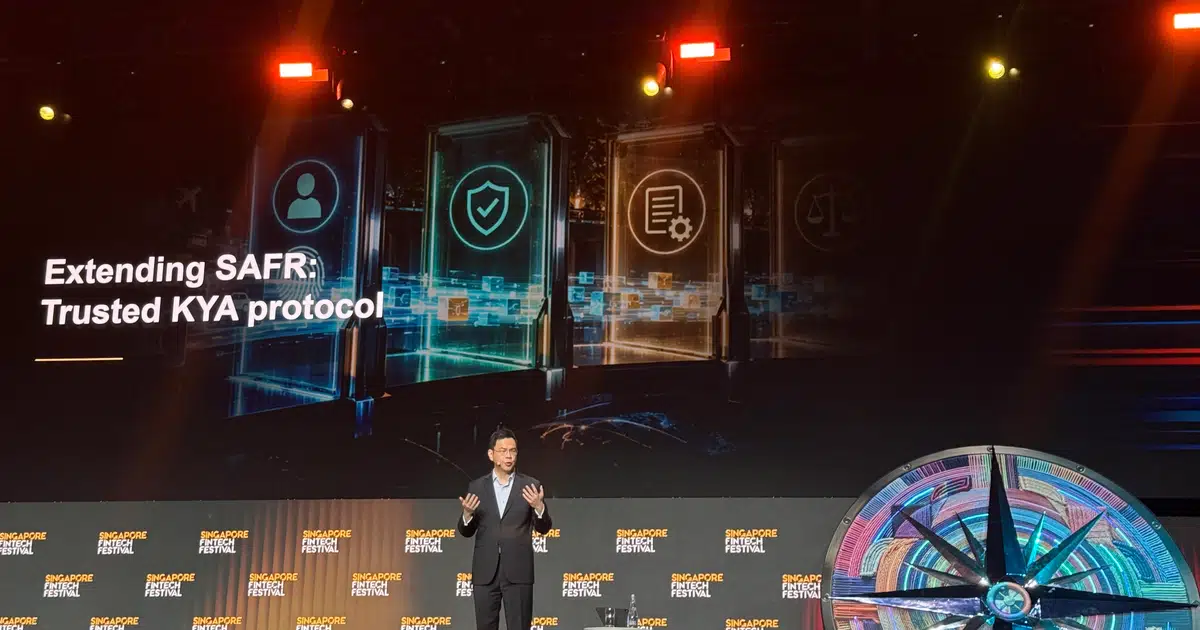
[SINGAPORE] The Monetary Authority of Singapore (MAS) will facilitate the development of a protocol to pave the way for artificial intelligence agents to securely access financial services and carry out transactions on behalf of customers.
The proposed “Know Your Agent” (KYA) protocol will help financial institutions to determine an agent’s identity, authority and mandate before deciding the transactions it can undertake.
This was announced by Chia Der Jiun, MAS managing director, on Thursday (Nov 19) at the Singapore FinTech Festival.
“We are at an early stage of agentic use, but adoption has the potential to scale rapidly, and we should start thinking about the potential impact on financial institutions, business models, markets and the broad economy,” he said.
Some financial institutions are building agent interfaces into their offerings, but many have yet to establish terms or channels for agents to access financial services, he noted.
“Some users are giving agents their login credentials to financial accounts. I would not advise giving personal agents such access, as there is insufficient assurance of safety,” he added.
Against this backdrop, the KYA protocol will facilitate trusted information exchange between customer agents and financial institutions.
“This gives financial institutions the information needed to determine the terms and scope permitted to an agent,” said Chia.
The development of this protocol follows the White Paper titled Safeguards for Agentic Finance at Runtime, published by MAS earlier this year, which contains lessons on how customer agents can transact safely with financial institutions.
MAS will also set up a sandbox with the Future of Finance Institute to bring AI agents and programmable money together and apply them to two use cases – corporate treasury management and payments services.
In corporate treasury, for example, banks could allow AI agents to monitor companies’ liquidity positions and due payments, and decide when and where funds should move.
While the corporate sets the mandate, participating banks set the controls and determine the terms for accepting each agent instruction, said Chia.
“We do not know how quickly agentic transactions will grow, but it is likely that the future will be a mix of the human economy and a new agent economy,” he noted.
“Business models and practices will have to adapt and respond to the new speed and mode of agentic transactions.”
As asset tokenisation gains traction, the industry is eyeing collateral management as a use case, noted Chia.
“Collateral sits at the centre of derivatives, secured funding and liquidity management,” he said, noting that tokenisation enables faster, cheaper and more efficient collateral transfers.
To scale this ecosystem, MAS is updating the Guide on Tokenisation of Capital Markets Products to further clarify regulatory and risk management requirements.
The central bank also issued S$100 million in tokenised MAS Bills on Nov 6. These were settled against Singapore dollar central bank digital currency (CBDC), with DBS, HSBC Singapore, OCBC, Standard Chartered and UOB participating in the issuance auction.
Following this, MAS intends to work with the industry to onboard and tokenise other commonly used collateral, such as foreign government securities and money market funds, said Chia.
The central bank also launched the Guardian Tokenised Collateral Framework on Thursday to standardise operational requirements across the collateral life cycle, including eligibility, custody, valuation, return and enforcement.
Meanwhile, industry players have been taking steps to scale this ecosystem.
For example, OCBC, Standard Chartered and payment infrastructure provider StraitsX announced on Thursday that they have completed a proof of concept exploring how tokenised deposits issued by different banks can be used for payments between financial institutions.
It was developed under MAS’ Project Bloom, a public-private sector collaborative initiative to advance next-generation settlement infrastructure for domestic and cross-border payments and financial transactions.
The proof of concept used StraitsX’s shared settlement infrastructure to achieve end-to-end settlement across OCBC’s and Standard Chartered’s tokenised deposit ecosystems.
On the digital money front, MAS also published the Bloom Field Guide on Thursday, which details practical considerations for deploying digital money in various use cases.
As for settlement infrastructure, Chia noted that as the use of tokenised assets and digital money grows, trusted settlement on CBDC will be needed. “It underpins settlement finality and confidence, especially for large-value settlement,” he said.
MAS has been testing CBDC settlement through the SGD Testnet, which has supported interbank settlement and MAS Bill issuance.
To reposition the SGD Testnet for operational utility, it will be renamed the SG Digital Ledger. Chia said it will support settlement among institutions, tokenised assets, forms of digital money and ledgers.
The extent of its adoption will be driven by market demand, he added.
Decoding Asia newsletter: your guide to navigating Asia in a new global order. Sign up here to get Decoding Asia newsletter. Delivered to your inbox. Free.