Mass shootings have become a deadly cycle we refuse to break - IOL
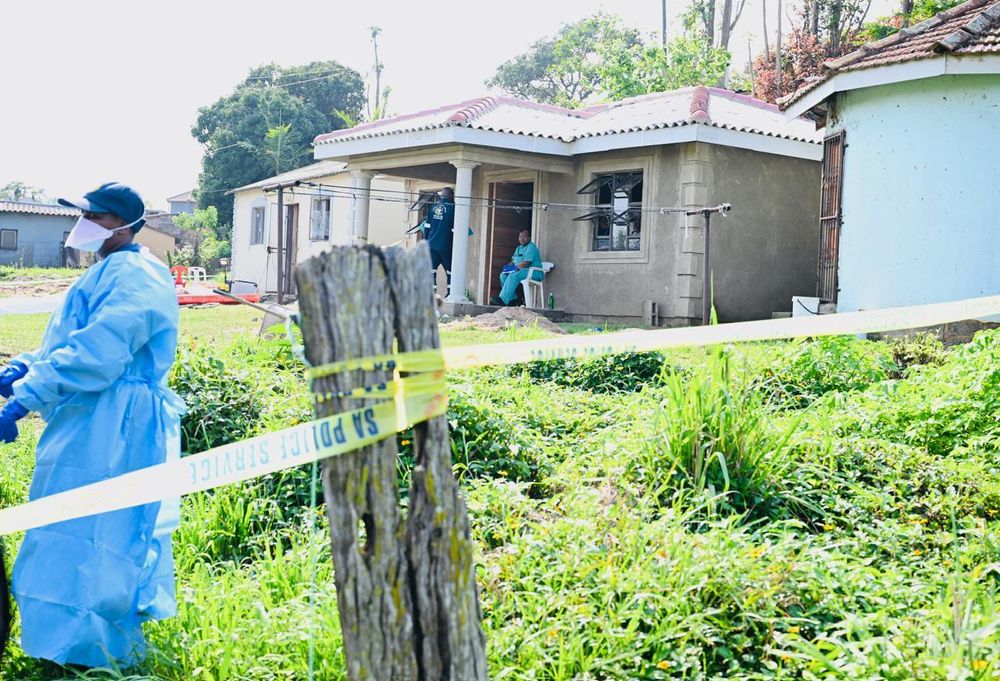
A police tape cordons off the Zulu household in eZiko, near KwaMakhutha, as forensic investigators comb the scene where 11 people, including a pregnant woman, were killed in a mass shooting that left 14 people shot.
South Africa’s mass shootings became a grim feature of the political violence that engulfed the country in the 1980s and early 1990s. But the ushering in of democracy in 1994 did not bring an end to the killings.
One morning on Christmas Day, the quiet, steep-sided valley village of Shobashobane on the KwaZulu-Natal South Coast came under attack as families prepared for Christmas lunch in 1995. Nineteen people were killed, including an infant who was shot in the back while being carried by his mother as she tried to flee. The attackers had surrounded the area in a horseshoe formation and many of the victims were hacked to death.
Fast-forward to the early 2000s and mass shootings continued, their motives shifting from political conflict to taxi-route disputes, family feuds, armed robberies, misunderstandings, gang and drug turf wars, extortion and, more recently, disputes linked to illegal mining.
This week’s shooting in eZiko, just outside KwaMakhutha, south of Durban, in which 14 people were shot and 11 killed, was a painful reminder for the community of another horrific chapter in its history.
On January 21, 1987, 13 people, mostly women and children, were killed in a hail of AK-47 gunfire at the home of a United Democratic Front activist Bheki Ntuli in KwaMakhutha, south of Durban. Ntuli was not home. No one was held legally responsible in court.
Former defence minister Magnus Malan and 19 co-accused were acquitted in the Durban Supreme Court in 1996. The Truth and Reconciliation Commission later granted amnesty to former Inkatha members involved in the raid, which was carried out as part of a covert military operation.
The circumstances and motives behind mass shootings have changed, but the killing has continued.
Every year, South Africa records multiple mass killings across different provinces, with KwaZulu-Natal and the Western Cape frequently among the provinces most affected. South African Police Service figures recorded 442 mass-shooting cases in the Western Cape alone between June 2019 and December 2021, using its definition of three or more people being shot. In 2022, a series of tavern shootings brought the horror into sharp national focus.
Now eZiko has added another tragedy to the list. The motive remains unclear. Among those killed was an expectant mother. A Volkswagen hatchback, reportedly belonging to one of the victims, caught fire after it was riddled with bullets.
Then, as so often happens, the news cycle moves on.
Another tragedy arrives. Another set of victims is named. Another community mourns. Another investigation begins. And before long, the previous massacre is pushed towards the bottom of the public conversation.
The killings in eZiko will eventually be displaced by the next headline, just as they have pushed the Ekurhuleni killings that came before them further down the news cycle. Life will move on for those who were outraged by the attacks.
But for the families of the dead, there will be no moving on so easily. They will be left with unanswered questions while society turns its attention to the next tragedy, momentarily outraged until another headline catches their eyeballs.
That should not be South Africa’s normal.
Selected mass-shooting incidents recorded across South Africa since 2020. Motives are based on police statements and media reports at the time and, in some cases, remain unconfirmed.
Motive: Tavern shooting; suspected gang/extortion activity.
Motive: Suspected gang- or drug-related.
Motive: Tavern shooting; motive unknown.
Motive: Personal vendetta/armed robbery.
Motive: Targeted attack on a suspected criminal where tavern patrons were killed in crossfire.
Motive: Retaliation linked to a witchcraft accusation and gang-related.
Motive: Extortion linked to “bed renting”.
Motive: Tavern shooting; motive unknown.
Motive: Suspected illegal-mining gangs.
Motive: Suspected illegal-mining turf war.
Motive: Undetermined at the time of going to print.