
Matt Elliott: There’s no mystery behind Mayor Olivia Chow’s budget record — there’s just math - Toronto Star
The budget is not kept locked away in some secure facility beneath city hall guarded by the Knights Templar, with a big steel door that can only be opened by a decoder ring given to the mayor. Instead, it’s public — and viewable by anyone nerdy enough to want to wade through a lot of PDFs, writes Matt Elliott.
Matt Elliott is a Toronto-based freelance contributing columnist for the Star. Follow him on Twitter: @GraphicMatt.
Lately, the leading candidates taking on Mayor Olivia Chow in the race for mayor have taken to referring to the city’s budget like it’s some great cosmic mystery. A riddle wrapped in a mystery inside an enigma contained in a very large spreadsheet.
At a debate last week, city councillor Brad Bradford and former federal immigration minister Chris Alexander called for a “line-by-line review” of city spending, something both candidates suggested has not been done in a very long time. Bradford has accused Chow of refusing to even look for savings in the budget.
“I’ll freeze property taxes in year one while independent experts review the budget line by line. Before City Hall asks you for more, let’s find out where your money is going,” Bradford posted last week via his X account.
But this mystery is not actually mysterious. It’s quite clear where the money is going. The budget is not kept locked away in some secure facility beneath city hall guarded by the Knights Templar, with a big steel door that can only be opened by a decoder ring given to the mayor. Instead, it’s public — and viewable by anyone nerdy enough to want to wade through a lot of PDFs.
And speaking as someone who is, in fact, just that nerdy enough, those documents paint a pretty simple picture of how the city’s operating budget has changed under Chow.
The gross budget — which includes provincial and federal funding — grew from $14.1 billion in 2023 (the last budget before she took office) to $16.6 billion in 2026, a $2.5 billion increase.
But beware these numbers: the gross budget accounts for programs funded by other levels of government that the city delivers on their behalf.
The city has no choice in whether to do this stuff, and the money doesn’t come from your property taxes. The increase under Chow, for example, includes a nearly half-billion dollar increase in federal and provincial money spent to support the $10-a-day daycare program, and about $165 million in new money that flows through City Hall to people receiving support programs like Ontario Works and the Ontario Disability Support Program.
This year, the gross budget also includes a whack of cash — approximately $190 million — drawn from a special reserve fund to pay for the World Cup hosting costs. That money won’t be on the city’s books next year.
A better way to review Chow’s spending record is to look at what city hall calls the “net budget.” It measures the amount funded by property taxes, leaving out funding from other governments and user fees. By this measure, the budget increased from $4.9 billion in 2023 to $5.8 billion in 2026.
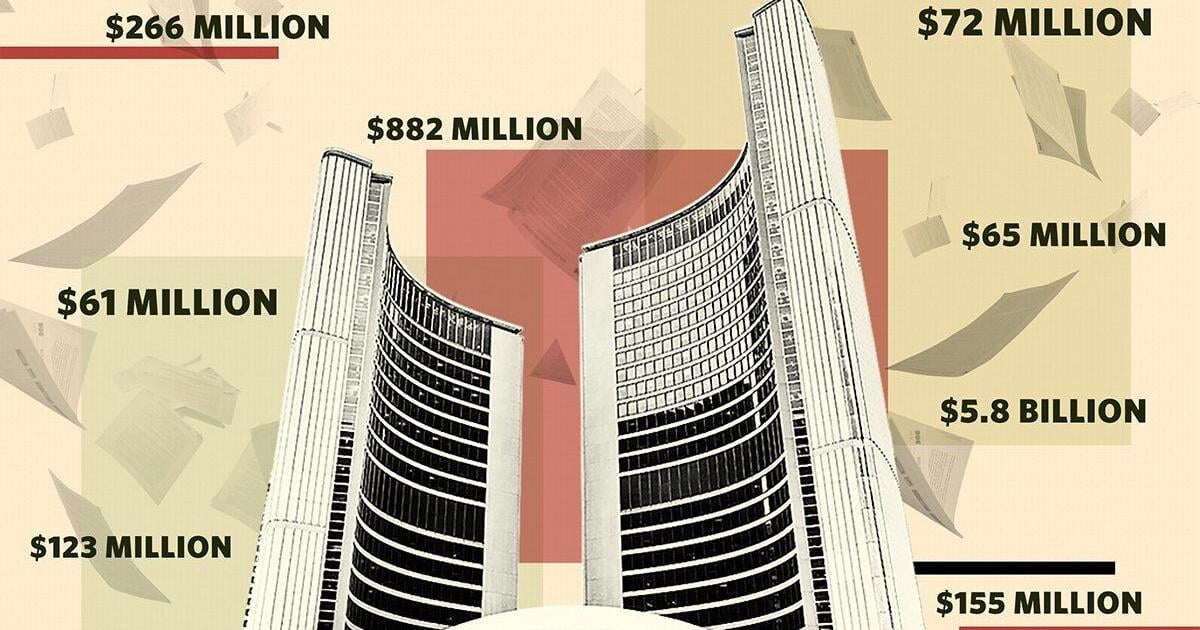
Of that $882 million in new spending under Chow, about 30 per cent, or $266 million, went to an increase in the police budget. No other department got a bigger share of the property tax increase.
Other hefty increases saw $155 million go to the TTC (including the Wheel-Trans service), while the transportation department got $72 million more. Toronto’s paramedics and firefighters got a combined $123 million top-up. The social development department got $65 million. And the library system got $61 million.
In many of those areas, the new budget money was put to obvious use. The library increase paid to keep branches open on Sundays. The social development department used its new money to fund an expansion of the citywide crisis response service that resolves mental health calls without police involvement. And the transportation department is now paying for dozens more traffic agents to direct cars at intersections, and a revamped program that hopes to do a better job of clearing snow.
Candidates are free, of course, to criticize where Chow chose to spend this money — and the effectiveness of the programs the money funds — but the recurring schtick where Bradford and Alexander act like there’s just no way of knowing where city hall is spending its money without hiring some experts is wearing thin.
Breaking news, interactive polls, video, and voice notes. Star stories you’ll want to share, delivered where you’re already chatting. Follow the Star on WhatsApp.
The city has had no shortage of budgetary reviews over the last decade. Bradford was on council for at least two of them: A “value-based outcomes review” in 2019 and an update to the city’s “long-term financial plan” in 2023. In both cases, the outside experts hired to review the books concluded that, while the city should always be conducting audits and looking to make programs more efficient, there’s no reasonable prospect of stumbling across the kind of massive savings you’d need to make a serious dent in the budget, especially when you factor in population growth and inflation.
I get the political appeal of promising voters you’ll be able to uncover big waste and deliver a tax freeze without cutting services, but no mayor in recent history — from Rob Ford to John Tory to Chow — has been able to pull it off. There’s good reason for that. The numbers are the numbers. There’s no mystery here. There’s just math.
Error! Sorry, there was an error processing your request.
There was a problem with the recaptcha. Please try again.
You may unsubscribe at any time. By signing up, you agree to our terms of use and privacy policy. This site is protected by reCAPTCHA and the Google privacy policy and terms of service apply.
Opinion articles are based on the author’s interpretations and judgments of facts, data and events. More details
Matt Elliott is a Toronto-based freelance contributing columnist for the Star. Follow him on Twitter: @GraphicMatt.
