McConnell’s Polio May Make Recovery 7 Times Slower, Expert Says - Newsweek
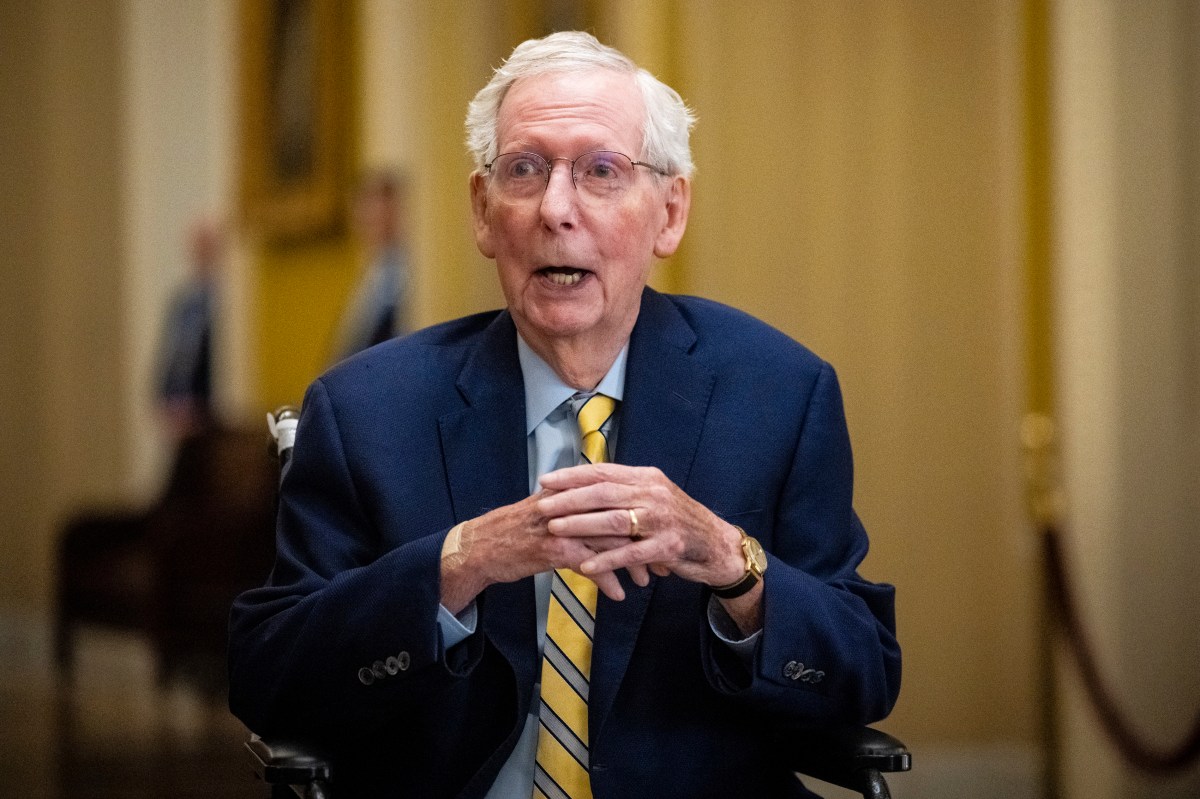
Senator Mitch McConnell's return to the Senate this week marked the end of a roughly three-month absence following a fall, hospitalization and bout of pneumonia—but his recovery may be far from over, an expert warned.
The 84-year-old Kentucky Republican himself pointed to the lingering effects of childhood polio as one reason his recovery has been difficult.
"My recovery has been a long and often frustrating process, and the lingering effects of childhood polio haven't made it any easier," McConnell said in a statement as he returned to the Senate on September 14. He added that he was "still not quite back to 100%" and would continue physical therapy.
Dr. Freddie Maynard, a physician who has worked in post-polio medicine for decades, told Newsweek that the effects of childhood polio can remain throughout a survivor's life—even when someone has spent decades functioning independently. And, he said, the physical toll can become more apparent as polio survivors age.
Newsweek has reached out to McConnell's office for comment via email.
Polio can destroy motor nerve cells that control muscles. Maynard explained that survivors who retain substantial function can compensate for that loss when they are young. But those remaining nerve cells can be subjected to decades of increased demands.
As people age, Maynard said, some polio survivors can begin to lose the ability to compensate for the damage sustained earlier in life.
Some survivors develop post-polio syndrome, a condition associated with new weakness, fatigue and other functional problems years or decades after the original infection. The effects vary considerably from person-to-person. Weakness can affect the legs, arms or other muscle groups, while some survivors have problems involving muscles used for speaking, swallowing or breathing.
"When you start getting older those compensation mechanisms for the other half that wasn't affected by the polio, that pool of nerve cells starts being overused and wearing out," Maynard said.
Over time, he added, that can reduce the body's ability to compensate for the damage that was previously sustained.
An illness, injury or hospitalization can then expose limitations that had previously been manageable. That is particularly important when an older polio survivor spends significant time inactive.
McConnell's office said in July that the senator had experienced several falls during the year that were attributed to his post-polio condition. The congressional Office of the Attending Physician confirmed his rehabilitation was focused on rebuilding strength and reducing the risk of future falls.
Maynard told Newsweek that not only are polio survivors at greater risks of falls, but a fall can have consequences for them beyond the immediate injury. Pain or injury can cause an older polio survivor to become substantially less active for days or weeks. When they attempt to resume normal activity, they may find that they have lost considerably more strength than expected.
In McConnell's case, the June 14 fall led him to lose consciousness, and he later developed a mild case of pneumonia while hospitalized, leading to bed rest and significant rehabilitation.
"Bed rest rapidly leads to deterioration," Maynard said. "That's true for anyone if you put [them] on complete bedrest, but it's more so the older you get. And for [polio] survivors it's even worse. It can be a very slow recovery to get the strength [you] had before you were sick back. Much worse for older polio survivors than for normal people. And it's not easy for normal people.”
For someone who has already lost some motor nerve function, losing additional strength during a period of hospitalization or inactivity can create a difficult cycle: weakness can make movement harder, while less movement can produce further weakness.
Maynard said retrospective research suggested that polio survivors "may take seven times longer than normal people to recover from the disuse atrophy associated with bedrest."
A 1997 study by A. J. McComas, C. Quartly and R. C. Griggs followed polio survivors over two years and found that loss of motor-unit, the specialized nerve cells and the muscle fibers it controls, was occurring more rapidly than in normal aging. Researchers found a 13.4 percent decline in motor-units, around seven times the rate of loss expected in non-disabled subjects in their 60s.
The Post-Polio Health International Handbook on the Late Effects of Poliomyelitis for Physicians and Survivors, also notes that recovery from illness or injury can take substantially longer for polio survivors. Although it says, citing anecdotal evidence from healthcare professionals, "that survivors who are ill or injured may require three to four times the usual recovery period.”
Maynard said an illness or injury can effectively "unmask" physical limitations that a polio survivor had previously been able to compensate for.
In a person in McConnell's position, Maynard said, that could mean someone is out of immediate medical danger while still lacking the stamina they had before the illness.
"You can be medically stable and, at the same time, not be back to your normal endurance," he said.
That distinction may also matter when considering McConnell's return to one of the most demanding workplaces in American politics.
"And that doesn't mean that it's necessarily going to affect his mind or something, but it would affect his endurance," Maynard said, adding that it could also mean that McConnell is "not back to being able to walk like he used to.”
He added that he would not be surprised if someone in that position had difficulty participating fully in "all the demanding meetings and schedules" associated with Senate work.
McConnell's own statements reflect that distinction. Upon his return, he said he was not yet back to 100 percent and that he might not be present for every vote.
"I will do my best to be present for tough votes when our conference needs me," McConnell said this week.
While recovering from his June fall, McConnell's doctors said tests did not find a fracture, stroke, heart attack, tumor, hemorrhage or other major cause for the episode. The senator subsequently spent weeks in rehabilitation receiving intensive physical therapy.
At the end of July, McConnell was still not medically cleared to leave the rehabilitation facility or return to the Senate. His doctors said he was receiving multiple therapy sessions each day designed to rebuild strength and reduce his risk of future falls. His childhood polio was described as "a significant factor" in his mobility.
He was then discharged from rehabilitation in August to continue physical therapy at home.
His prolonged absence from office generated questions from Democrats and Republicans about his health and his ability to continue serving.
Kentucky Governor Andy Beshear, a Democrat, first called for more transparency about McConnell's condition in July. Later that month, the governor escalated his request, calling on McConnell to publicly demonstrate his capacity to serve or resign and asking Senate Majority Leader John Thune to investigate if the senator did not do so.
Republicans publicly disagreed about how much scrutiny McConnell's absence warranted. Some, like Senator Tommy Tuberville of Alabama, called for more information about his condition, while others, like Senator John Kennedy of Louisiana, defended him and urged colleagues to leave him alone.
McConnell's office maintained that he intended to finish his term, which ends early next year.
McConnell finally returned on September 14, arriving at the Capitol in a wheelchair and briefly speaking with reporters before casting his first Senate vote since June. The senator was smiling but speaking slowly and with some difficulty. Press was told they were not allowed to film McConnell speaking.
Two days later, McConnell's return played a role in advancing the Senate Farm Bill. He cast a crucial vote as the Senate Agriculture Committee advanced the legislation 12-11, with Republicans voting together. However, footage from the committee meeting showed that McConnell initially did not respond when the clerk called his name for the procedural vote.
He had to be prompted by colleagues before voting.
The moment echoed a previous incident involving former Democratic Senator Dianne Feinstein in 2023, when she was also prompted by colleagues during a committee vote. Feinstein faced years of public scrutiny over her health and ability to carry out her Senate duties before her death in office in 2023.
McConnell's absence had already affected the Agriculture and Appropriations committees, where Republicans and Democrats were otherwise evenly divided. Without him, Republicans were unable to advance some legislation.
His absence also came at a consequential moment.
The Senate is confronting the December 11 government-funding deadline. McConnell remains chairman of the Senate Rules Committee and holds a senior position on the Appropriations Committee, including the defense appropriations subcommittee. His ability to participate matters not only on the floor but inside committees where legislation can be stopped before it ever reaches a final vote.
However, he has not made a full return to his previous schedule.
On Thursday, he participated in one Senate procedural vote but did not participate in two subsequent votes that afternoon, according to reporting Friday.
The pattern underscores the distinction Maynard described—returning to work does not necessarily mean returning immediately to the physical endurance a person had before a serious illness.
McConnell’s prolonged absence from the Senate prompted questions from Democrats about whether the longtime senator could continue fulfilling his responsibilities, while some conservative commentators and activists questioned his ability to independently participate in Senate business after his return.
McConnell has already announced that he will not seek reelection. His current term ends in January 2027.
Beshear was among the most prominent critics of McConnell’s prolonged absence. In July, after McConnell had been out of public view for weeks, Beshear called on him to “directly and verbally address the people of Kentucky and provide proof of your capacity to serve or resign.”
Ahead of McConnell’s return, Beshear said the senator owed Kentuckians an explanation if he did not come back. “You can’t not show up for work and not call and talk to your boss. And his boss is the people of Kentucky,” he said.
Newsweek has reached out to Beshear's office for further comment via email.
Charles Booker, the Democratic nominee running for McConnell’s Senate seat, also criticized the senator’s absence shortly before his return, saying McConnell had “failed to show up for Kentucky and fulfill the duties he was elected to carry out.”
Republican colleagues, meanwhile, had generally emphasized their desire to see McConnell return.
“We’d love to get him back to where we can have him voting in the Senate, and I hope that will happen here in the not-too-distant future,” Thune said earlier this month.
Despite McConnell's return, scrutiny over his ability to serve has not abated.
After footage of the Farm Bill vote emerged, conservative commentator Nick Sortor shared the clip on X, describing McConnell as a "PUPPET SENATOR" and writing that the senator had to be "TOLD how to vote."
Former Republican Representative Matt Gaetz similarly wrote on X that “Mitch McConnell will be wheeled in and out of the votes needed to stop the Trump agenda.”
Melanie D’Arrigo, a former Democratic congressional candidate, described the episode as “elder abuse” and invoked the movie Weekend at Bernie’s.
However, Maynard cautioned that appearances alone cannot reliably reveal the extent of a polio survivor's underlying neurological or muscular impairment.
Contact Newsweek editors for this story: Samantha Beech and Anthony Murray.