
Meet Deepanshu Shokeen, barefoot candidate who swept DUSU VP contest - The Indian Express
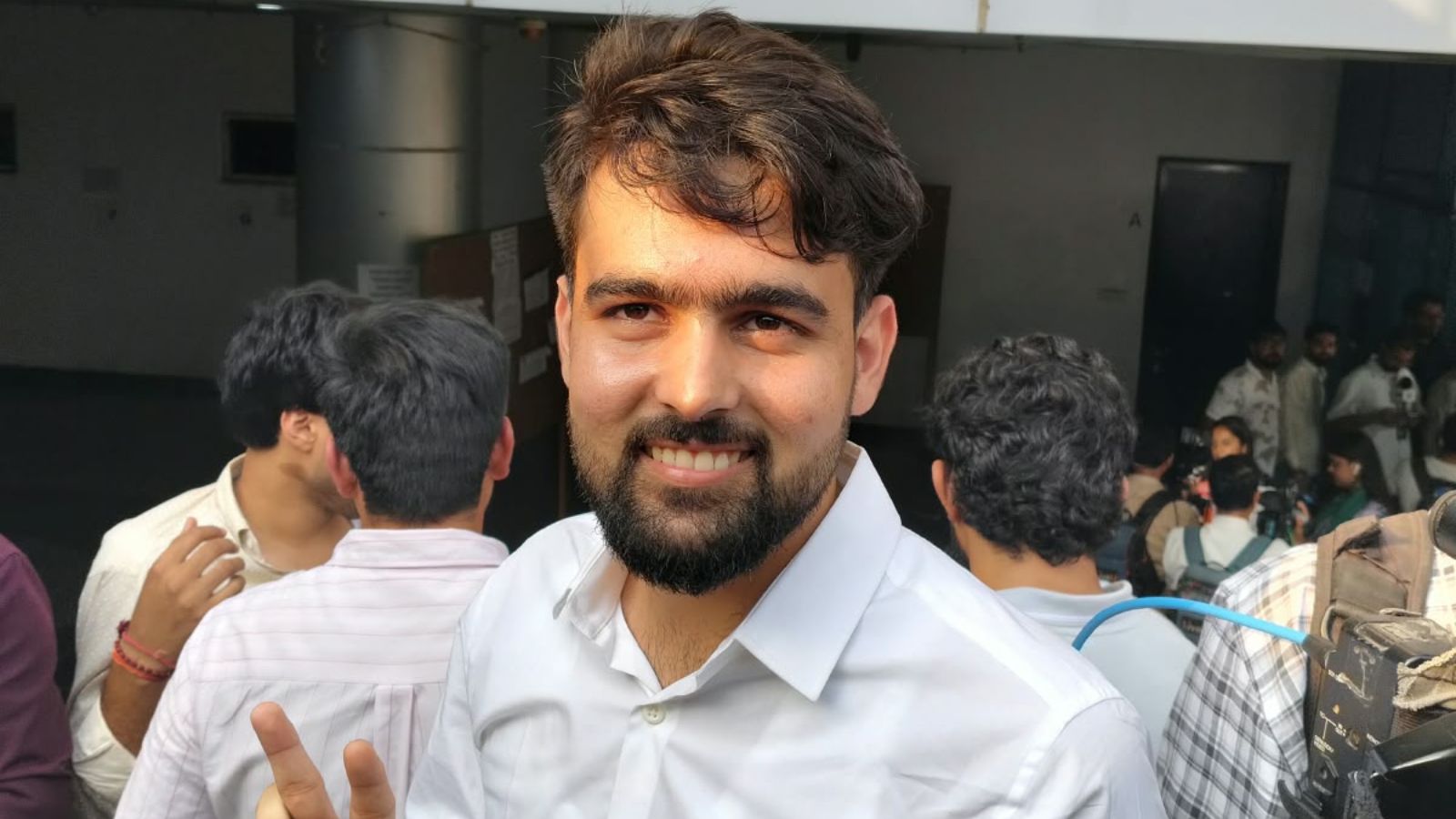
The other candidates for Delhi University Student union (DUSU) polls came with campaign convoys. Deepanshu Shokeen came barefoot.
The 21-year-old, son of a DTC bus conductor and an Anganwadi teacher, had pledged not to wear shoes to highlight students’ housing problems after a PG hostel building collapsed in Satya Niketan, killing seven, five of them DU students.
On Saturday, he had the result to show for it – a 13,705-vote victory in the DUSU vice-presidential contest.
Shokeen polled 30,615 votes, defeating ABVP’s Ishu Maurya, who secured 16,910 votes. NSUI’s Vir Chatrath finished third with 4,313 votes. His victory prevented an ABVP sweep of all four central panel posts.
A resident of Peeragarhi village in West Delhi, Shokeen said his four years as a student shaped his decision to enter student politics. He completed his BA Programme from Shaheed Bhagat Singh College and is now pursuing a Master’s in Buddhist Studies in the Faculty of Arts. He has also been a UPSC aspirant, he said.
Just days before the election, Shokeen had allegedly walked away from the Congress-affiliated NSUI after he was told to contest for the president’s post, sources in NSUI had said. Shokeen, however, had claimed that he was not given a ticket by NSUI.
Shokeen has been active in student politics since 2023 and served as a student representative in his college. He campaigned for NSUI during the 2023 and 2024 elections and sought its organisational ticket in 2025, but was not selected. This year, after allegedly again failing to get a ticket, he decided to contest independently.
“Twenty minutes mein (within 20 minutes)”, he told The Indian Express, recalling how long it took him to make the decision.
NSUI officials told PTI that while Shokeen was initially nominated by the organisation this year, he was later asked to withdraw his nomination. Shokeen had publicly criticised “the organisational shortcomings within NSUI” and questioned the way the candidates were selected.
Shokeen said some students he had approached during the campaign told him that although he had fought a good election, he would not win. The margin, he said, was his answer to them.
Asked whether he might eventually return to NSUI, he did not rule it in or out. “I cannot say anything; I do not know yet what I will do,” he said.
Shokeen looked unfazed amid the counting frenzy. “I expected to win, but not by such a margin. But what lies ahead is the most important thing for me to think about,” he said.
He had pledged not to wear shoes while raising the issue of student accommodation, which became particularly prominent after the September 6 building collapse in Satya Niketan.
“I had promised that I would first sit on a protest,” he said, pointing to his bare feet.
While student housing remained his key electoral issue, the other issues he focussed on included infrastructure, implementation of the National Education Policy, fee hikes and transparency.
His campaign stood out in an election dominated by the large convoys and mobilisation of the major student organisations. Shokeen instead emphasised his direct connect with students, describing those campaigning with him as “genuine students” and pointing to support from students in his neighbourhood, Peeragarhi.
He said he had seen students face the same problems he had faced, prompting him to enter student politics so future batches would not have to go through the same issues.
Shokeen said student politics should not be about electoral politics alone. “It should be for student rights, student voices,” he added.
In an X post on Saturday, Shokeen thanked DU students, saying the victory belonged to students who wanted to raise “real issues” on campus.
For now, he said, his focus was on the work ahead.
Asked about his first priority, he had a one-word answer: “Hostels.”
Sophiya Mathew is a Correspondent at The Indian Express, based in New Delhi. She joined the Delhi bureau in 2024, and has specialization in Integrated Multimedia Journalism from the Asian College of Journalism (ACJ), Chennai. Professional Background Core Beats: Her reporting is primarily focused on the Environment and Education. Specialization: She has gained recognition for her ground-level reporting on the Yamuna floodplains and the socio-economic challenges faced by those living on its banks. She also focuses on the disparities in Delhi's education system, ranging from elite private schools to government institutions and refugee education. Recent Notable Articles (December 2025) Her recent work has been heavily centered on Delhi's severe winter pollution crisis and the government's regulatory responses: 1. The Air Pollution Crisis "A tale of two cities: Delhi govt schools choke in bad air, private classrooms set up air filters" (Dec 20, 2025): A high-impact feature contrasting the "Clean Air Bubbles" in elite schools with the reality of government school students who are exposed to an equivalent of 17 cigarettes a day due to outdoor exposure. "Delhi sees season's worst air day, second worst December AQI in nearly a decade" (Dec 15, 2025): An analytical report on the meteorological patterns trapping pollutants in the NCR. "Delhi bans non-BS VI vehicles from outside: Why curbing vehicular pollution is key" (Dec 17, 2025): Explaining the science behind targeting specific vehicle vintages to lower particulate matter. 2. Enforcement & Regulations "No fuel at pumps in Delhi without valid PUC certificate from December 18" (Dec 17, 2025): Breaking the news on the environment ministry's strict "No PUC, No Fuel" policy. 3. Education Policy "Law to regulate school fee in Delhi risks becoming procedural, say parents" (Dec 13, 2025): Investigating the loopholes in the new Delhi School Education (Transparency in Fixation and Regulation of Fees) Bill, 2025. "Monsoon Session: Private school fee regulation Bill cleared after four-hour debate" (Aug 9, 2025): Covering the legislative passage of the controversial fee hike regulation. Signature Style Sophiya is known for her observational depth. Her reporting often includes vivid details from school corridors, hospital waitlists, or the banks of the Yamuna to illustrate how policy failures affect the city's most vulnerable residents. She is a frequent expert guest on the 3 Things podcast, where she explains the complexities of Delhi’s environmental laws. X (Twitter): @SophiyaMathew1 ... Read More


