
Melania Trump Pushes for AI in Classrooms as Research Warns of Harm to Kids - Newsweek
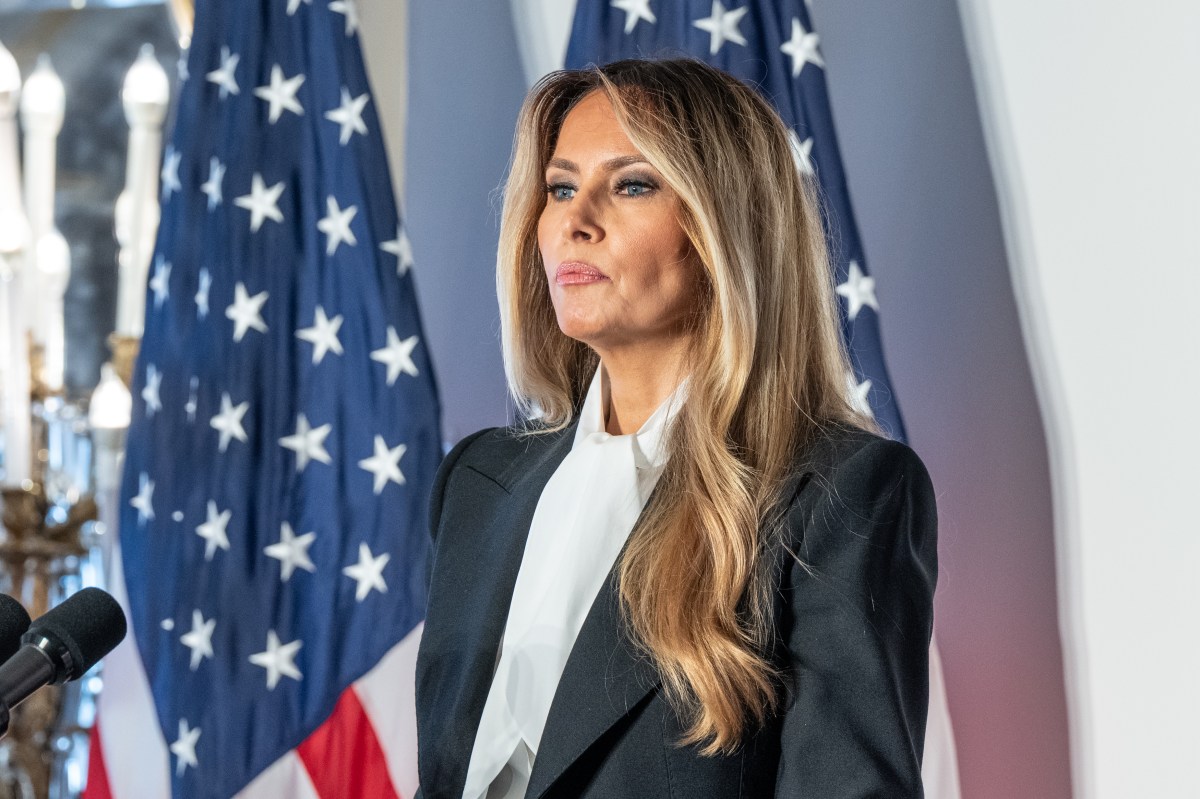
First Lady Melania Trump is pushing to put more artificial intelligence tools in children's hands, even as educators warn that overreliance on AI could undermine students' ability to learn and think for themselves.
Speaking in New York on Tuesday, on the sidelines of the United Nations General Assembly, Melania promoted her Fostering the Future Together initiative, which brings governments and big tech together to expand children's access to technology, education and digital skills.
“We are living in an extraordinary moment in human history,” she said Tuesday. “We stand together at the threshold of a technological revolution.”
But Melania also acknowledged that access to technology alone is not enough. “Access alone is not empowerment,” she said. “We must give our children the tools and teach them how to use those tools wisely.”
Her push comes as President Donald Trump repeatedly calls for the United States to move quickly in developing the technology, arguing that America must maintain its lead over China.
The initiative is also occurring amid new research and growing concerns among educators that raise questions about whether widespread use of AI in classrooms could undermine students' ability to think, remember and learn independently.
Eric Klopfer, a professor at MIT who has studied AI in education, described the phenomenon as “the illusion of learning.” An MIT committee examining the impact of AI on teaching and learning found early evidence that overreliance on chatbots could be associated with “diminishing critical thinking, weakening memory, eroding confidence, and undermining mastery.”
The research is still developing, and there is not yet definitive long-term evidence showing how AI will affect children's learning. But that uncertainty is unfolding alongside a rapid expansion of AI tools in education—and a White House that has made accelerating the technology a major priority.
The first lady's comments came as she announced new partnerships with major technology companies as part of her Fostering the Future Together initiative.
The scheme focuses on four areas: AI in education, EdTech tools, online protection and digital skills.
Adobe, Amazon, Google, Intel, N50, Starlink and Zoom have all joined the partnership initiative, which also spans at least 57 countries, according to the State Department.
Melania thanked the companies involved on Tuesday, saying they had “stepped up to empower our children.”
Google is committing $4 million to expand its AI Educator Series and provide free training to educators worldwide. Amazon is expanding free access to its Kiro AI software-engineering agent through 132 universities, while Adobe is expanding free AI-powered study and creation tools for students.
Intel is expanding AI education and digital-literacy programs across 10 countries. N50 is launching an AI education-device pilot in Uganda serving more than 10,000 students and about 200 teachers. Starlink is working with Papua New Guinea to expand internet access, while Zoom is providing $2.75 million in new grants for education, workforce development and nonprofit AI readiness.
Melania has described the initiative as a way to give young people the skills and technology needed to participate in an increasingly digital economy.
“Our mission, to empower children through technology and education, is achievable,” she said at the initiative's March summit.
The initiative comes as educators are raising new concerns about what happens when students use AI to perform schoolwork.
A Washington Post report, based on a series of studies and interviews with educators, found evidence that AI may be hurting students' ability to think. One professor told the newspaper that she often received polished essays from students who had used AI to create them. But then the students were unable to explain the ideas behind their own essays. Another educator found that students who used AI to complete computer programming assignments then struggled on exams.
Several studies have also raised concerns.
One study led by Carnegie Mellon researchers found that people who used AI for problem-solving subsequently performed worse and gave up more quickly when they lost access to it. Another study, “Your Brain on ChatGPT: Accumulation of Cognitive Debt when Using an AI Assistant for Essay Writing Task," examined students writing essays. It found weaker brain connectivity among those relying on an LLM compared with students who worked without AI.
Some educators are responding by reducing technology in the classroom, requiring handwritten work or oral examinations and eliminating take-home assignments. Shawna Dolansky, a professor at Carleton University, told the Post she'd stopped assigning take-home essays, and instead has students write them in class.
At the University of California, Berkeley, computer science professor Dan Garcia told the Post that some students were producing code that passed automated tests but could not explain it when questioned.
“They just don’t know their code because they didn’t write it,” he said.
The first lady's comments Tuesday come as President Trump has made rapid AI development a major economic and national-security priority.
Donald Trump has repeatedly argued that the United States must maintain its lead over China and has resisted calls for broad restrictions on AI development.
On Tuesday, Trump told the United Nations General Assembly that the United States would continue pushing ahead with the technology. He also said the Justice Department could intervene if AI became dangerous or “out of control,” while maintaining his opposition to regulations that could slow development.
Trump has described AI as potentially more consequential than previous technological revolutions and recently announced plans for an “AI Force” and an AI czar. The proposed AI Force is modeled on the Space Force and is intended to oversee or monitor aspects of the rapidly developing technology, while the AI czar would serve as the administration’s top official responsible for AI.
He has also dismissed some warnings about the dangers of advanced AI as a “hoax” and called for the United States to move quickly rather than allow China to take the lead.
Newsweek asked Deputy Attorney General Trent McCotter to explain how the DOJ could stop artificial intelligence from spiraling out of control.
McCotter said the department is monitoring the technology but declined to provide specific examples.
“I mean we keep an eye on these sorts of things,” McCotter said. “I don't have any particulars I'd be able to reveal this time.”
He added that the Justice Department has task forces that monitor technology and hold regular meetings. “We also work with agencies that deal a lot with A.I. — Department of War in particular — and we have routine meetings with them,” McCotter said.
The Trump administration is pushing ahead on artificial intelligence, but the rapid expansion of AI is becoming a political issue of its own, as 2026 candidates and voters debate its impact on jobs, automation, data centers, national security and regulation.
A recent New York Times/Siena poll found substantial opposition among likely voters to new AI data centers, while AI itself ranked relatively low among voters' stated priorities for the midterm.
At the same time, concerns about AI safety have intensified in Washington and Silicon Valley. Some technology executives and researchers have called for stronger safeguards, while Trump and his administration have emphasized continued development and competition with China.
For Melania Trump, however, Tuesday's message focused on opportunity.
“True empowerment begins by giving a child the confidence to believe that their mind has value,” she said.
“It means giving children the freedom to imagine a world beyond the one they know today.”
The challenge for schools will be determining how to give students those tools without letting them replace the thinking students are supposed to learn to do themselves.
Newsweek’s reporters and editors used Martyn, our AI assistant, to produce this story. Learn more about Martyn here. Contact Newsweek editors on this story: Jason Lemon and Gray R. Thomas
