
Message from the fifth plenum: Continuity - CGTN
By continuing to browse our site you agree to our use of cookies, revised Privacy Policy and Terms of Use. You can change your cookie settings through your browser.
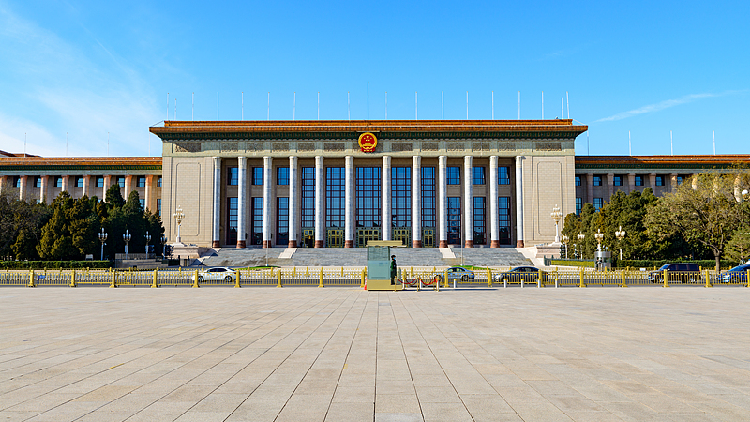
The Great Hall of the People in Beijing, China. /VCG
Editor's note: David W. Ferguson is an author, editor, and retired honorary chief English editor of Foreign Languages Press. The article reflects the author's opinions and not necessarily the views of CGTN.
When I talk about China's political system, I always talk about the "3 Cs" that I consider to be the pillars of its strength – cooperation, consultation and consensus. But there is also a fourth "C" I should add, which is continuity.
Continuity is the attribute that enables China's leadership to engage in the long-term planning, implementation, feedback and adjustment that marks the difference between socialism with Chinese characteristics and other systems.
One of the factors that makes the fifth plenary session of the 20th Central Committee of the Communist Party of China (CPC) so interesting is that it coincided with the delivery of the UK Labour Government's first autumn budget on Wednesday, under its new leader and the new Prime Minister Andy Burnham.
I anticipated that the budget would contain some headline-grabbing initiatives, and I was right. But then they always do, in a system where the need to buy votes at elections is relentlessly driven by tomorrow's media headlines, or next week's, if you are lucky.
Wednesday's grabber was a one-off 100 pounds (nearly $134) cash payment direct into the bank accounts of 20 million households, to help pay their energy bills! Great! Only, changes in fuel costs in January 2027 will increase the average household's fuel costs by 300-400 pounds per year...
The situation in China could not be more different. The resolution adopted on the fifth plenum focuses on persevering with full and rigorous Party self-governance. This is not a new headline-grabbing initiative. It is the continuation of a strategy that has now been in place for several years. Two of the main arms of this strategy are the anti-corruption campaign to maintain integrity and an intensive Party-wide education program for members and officials.
I recently completed a six-week trip that followed part of the Red Army’s Long March route. I visited many important sites where dramatic events had unfolded. But the thing that struck me most was an apparently minor phenomenon that grew slowly on me as my understanding grew deeper.
In Guizhou Province in southwest China, we saw some examples of the slogans the Red Army used to write on the walls of the villages they passed through. From a contemporary perspective, they do not appear to contain any profound or significant messages. But then I began to consider them from the perspective of the villagers to whom they were addressed.
These were poor rural people, with little or no education, who lived lives of great hardship. What was their experience of an army, other than as a tool of their oppressors – the local landlord or warlord – who stole their provisions and caused them hardship?
And now these villagers were presented with a message of the army and the people as one, by soldiers who treated them like human beings and paid for what they needed. This was a radical and revolutionary idea that gave them a completely new vision of how the world could be. That is the importance of these slogans. That is the importance of integrity.
The fifth plenary session of the 20th Communist Party of China (CPC) Central Committee, presided over by the Political Bureau of the CPC Central Committee, is held in Beijing, China. The fifth plenum was held from October 26 to 29, 2026. /Xinhua
And the slogans were not only spoken – they were written. In any poor society, education is prized as a key to the door leading from poverty to prosperity, one that would have been all but unattainable to the vast majority of these villagers. Yet now were confronted with a phenomenon that must have seemed like sorcery – an army of ordinary peasants exactly like themselves, but who could read and write. Again, this commitment to education must have been one that challenged everything the villagers had ever known, and gave them a completely new vision of what the world could be. That is the importance of education.
I believe that integrity and education explain why the people responded with their wholehearted support, why they provisioned the Red Army at the cost of their own hardship, and why they enlisted in their hundreds and thousands. And this is what sustained the Red Army through its endless months of hardship, and helped it to make it through to the end.
It is a cliché, but there is substance to it, and it is particularly relevant to China in the new era. The generation who actually fought in the revolutionary wars is disappearing, and the generations who experienced the hard times in the early days of the People's Republic of China, founded in 1949, are growing older. Many young Chinese have never known true hardship. It is vitally important that they do not lose sight of the ideals and convictions that enabled their forebears to give them the good times they enjoy, and to this end, Party members and officials must show the way and lead by example. This is why integrity matters so much.
In both its domestic and external environments, China is now sailing in uncharted waters. The world is facing change on a scale unseen in a century. The new quality productive forces – technology; artificial intelligence; automation – should bring unprecedented prosperity, but they will not do so without creating massive upheaval. Entire industries and fields of work could – indeed will – disappear. Those whose current livelihoods depend on these industries cannot be left by the wayside, hungry have-nots, while the more fortunate enjoy all the benefits.
But rebuilding society and the economy, to ensure that the fruits of progress are enjoyed by all, will be no easy feat in times of rapid and constant change. It will be a massive undertaking that will challenge China's governance capabilities to their limits. New and young officials will have to acquire their skills in the most demanding of circumstances – essentially learning how to set a sail in the eye of a storm – and even the most experienced officials will face problems they have never seen before that will require radically different approaches and new solutions. That is why education matters so much.
Integrity and education. Vital to China's future development. Key to full and rigorous Party self-governance. Support to the continuity that is one of the pillars of strength in China's governance system.
(If you want to contribute and have specific expertise, please contact us at opinions@cgtn.com. Follow @thouse_opinions on X to discover the latest commentaries in the CGTN Opinion Section.)


