Mike Rogers Faces Tougher Senate Battle in Michigan Than His 2024 Near-Miss - Newsweek
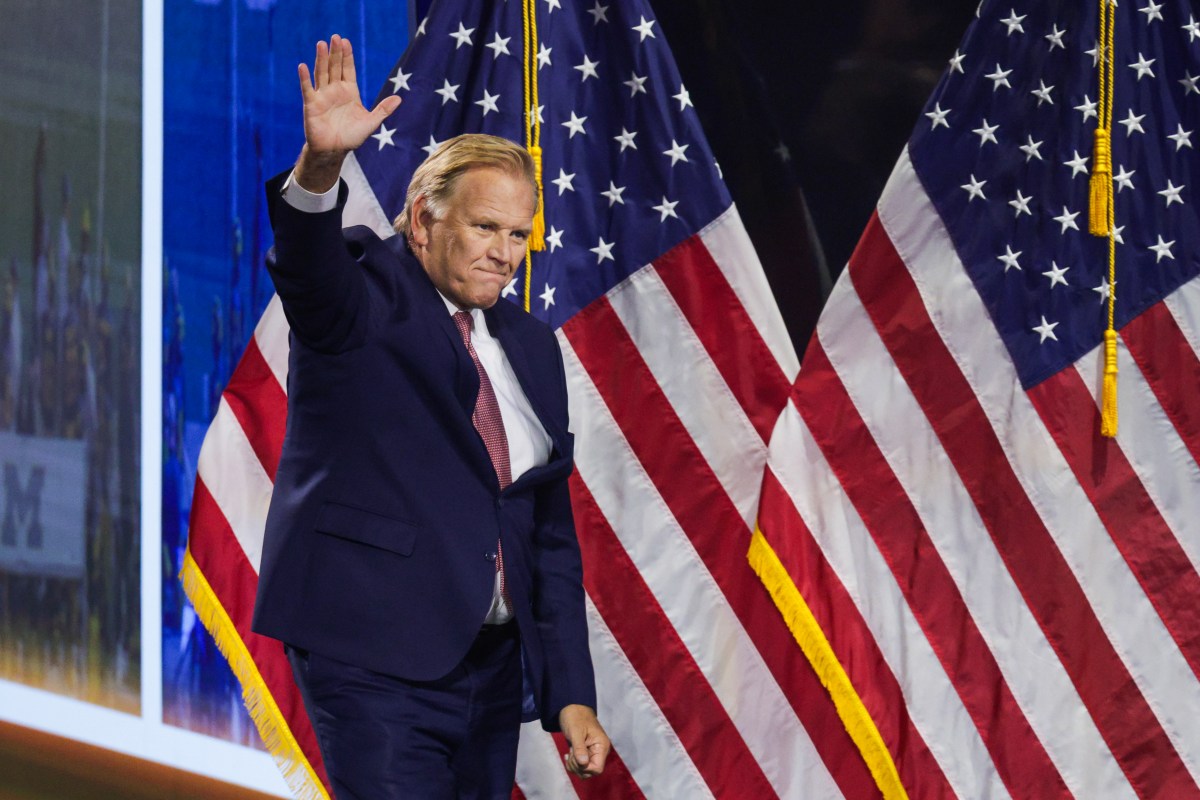
Republican U.S. Senate nominee Mike Rogers of Michigan came within less than 20,000 votes of flipping a Senate seat two years ago. But in his second consecutive bid for the upper chamber, his odds of finally winning it look worse than ever.
The former congressman faces a competitive race against progressive Democrat Abdul El-Sayed, who surprised many by winning the Democratic nomination and has since consistently led Rogers in public polling.
FiftyPlusOne puts the race at 47.9 percent for El-Sayed and 44.3 percent for Rogers, while the 270toWin average shows a slightly wider 4-point gap, 48.4 percent to 44.4 percent.
The numbers point to a tougher climb for Rogers, who chaired the House Intelligence Committee before leaving Congress in 2015. The race for the seat being vacated by retiring Democratic Senator Gary Peters has been widely viewed as a key contest for both parties as they vie for control of the Senate.
Rogers' 2024 race against Elissa Slotkin, now Michigan's junior senator and a Democrat, was among the closest Senate contests in the country. Slotkin won by less than half a percentage point, even as President Donald Trump carried the state at the top of the ticket.
That result established Rogers as a credible candidate in a state where Republicans have struggled to win Senate races. Party leaders recruited him to run again, betting his name recognition and narrow loss would give him a head start in an open-seat race.
The early numbers have not delivered that head start. Most September polls showed Rogers trailing El-Sayed, though individual surveys varied widely. At one end, El-Sayed led by 7 points. At the other, Rogers held a small advantage.
The spread reflects a race that pollsters are still struggling to pin down. It also reflects a national environment that has shifted since 2024. Rogers ran two years ago alongside a Republican presidential nominee who won Michigan. This year, he is running in a midterm with a Republican in the White House in a setting that has historically favored the party out of power.
Jim Kessler of the center-left think tank Third Way told Newsweek that Democrats are heading into what is "shaping up to be a blue wave" in November.
He cautioned, however, that a favorable climate does not settle a race in a state as closely divided as Michigan.
"El-Sayed still has work to do to win the decisive middle in a swing state like Michigan," Kessler said.
While polling has been underwhelming for Republicans this cycle, with many candidates carrying the weight of a deeply unpopular administration, El-Sayed's primary result also gives Republicans a reason to see an opening in numbers that otherwise favor Democrats.
Several late primary polls showed El-Sayed approaching or topping 50 percent and leading Michigan Representative Haley Stevens by double digits. While he won the nomination over the moderate Democrat, his final margin fell short of what those surveys had projected.
El-Sayed won by about 1 percentage point, 48.5 percent to 47.5 percent, a margin of roughly 14,900 votes.
The gap between the polls and the result does not translate neatly into the general election. Primary electorates are smaller and less predictable than November turnout, and pollsters have a harder time modeling who will actually show up. A miss in August can come from turnout assumptions that have little bearing on a statewide general election.
Still, the pattern carries weight for a candidate whose lead rests on a few points. If general-election surveys are overstating El-Sayed's support by a margin similar to the primary miss, Rogers would be running roughly even rather than several points back.
Michigan also has its own history with polling errors. Surveys in recent statewide cycles have at times underestimated Republican support, a concern that hangs over any modest Democratic lead in the state.
"The primary is one set of voters and the general is another," Kessler said.
El-Sayed built his primary campaign around progressive positions, including support for Medicare for All, and drew backing from the party's left wing. Those positions energized Democratic primary voters, but the general election will test whether he can also appeal to moderates. Former President Barack Obama and ex-Vice President Kamala Harris have both publicly endorsed his campaign.
Republicans have tried to make that case directly, casting El-Sayed as too far left for a state that voted for Trump twice by highlighting his association with left-wing streamer Hasan Piker. Democrats, for their part, are expected to tie Rogers to the Trump administration and national Republican positions that poll poorly in the state.
Marist's September 24 to 27 survey of 1,235 registered voters found 41 percent of Michigan voters approve of the job Trump is doing. The same poll found 42 percent say their congressional vote is mainly a vote against Trump.
Michigan has been competitive at the presidential level for most of the last decade, but Senate races have gone a different way. Republicans have not won a Senate seat in the state since 1994.
Rogers' 2024 campaign came closer than any Republican effort in years. His narrow loss showed he could hold together the coalition Trump built in the state while staying competitive in the suburbs around Detroit and Grand Rapids.
Reassembling that coalition without Trump on the ballot is a separate challenge. Midterm turnout tends to be lower and more dependent on enthusiasm, and the party holding the White House often struggles to motivate its own voters. Many of the lower-propensity voters who turned out for Trump in 2024 may not return in a midterm year.
The current numbers suggest Rogers is starting several points behind rather than close to even. That is a weaker position on paper than the one that produced his near-miss.
The race nonetheless remains within reach for Republicans. A 3- or 4-point lead in a state with a recent record of polling misses gives El-Sayed an advantage, but a thin one. A modest, consistent error in the Democratic direction, of the kind seen in his own primary, would erase most of it.
Fundraising gives El-Sayed a modest edge in total receipts, though the picture is more mixed when it comes to money available to spend.
El-Sayed has raised about $14.5 million over the course of the campaign, compared with roughly $10.9 million for Rogers.
Rogers, however, held more cash in mid-July filings. He reported approximately $4.47 million on hand, while El-Sayed had about $2.55 million after spending heavily in a crowded and expensive Democratic primary.
With four weeks left before Election Day, both campaigns and their allies are treating Michigan as one of the few states that could determine which party controls the Senate next year. The polls will show whether El-Sayed's lead holds as the race moves into its final stretch, or whether the warning from August winds up applying in November as well.
Newsweek’s reporters and editors used Martyn, our AI assistant, to produce this story. Learn more about Martyn here. Contact Newsweek editors on this story: Jason Lemon and Edward T. Cummins