Minara chamber president urges investment in skills, technology and young people - IOL
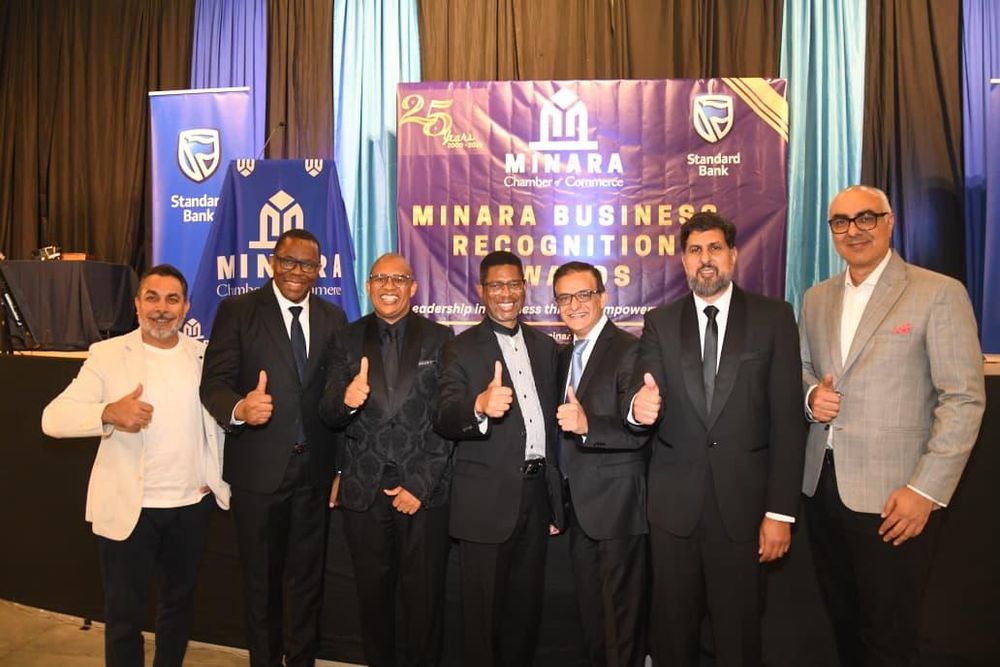
The 2026 Minara Business Recognition Awards.
Minara Chamber of Commerce president Ebrahim Patel has called for stronger collaboration between government and business to boost investment, create jobs and build a resilient South African economy.
Speaking at the 2026 Minara Business Recognition Awards, Patel highlighted the impact of geopolitical tensions, artificial intelligence and youth unemployment, while pointing to KwaZulu-Natal’s R124 billion in investment pledges as an opportunity to drive economic growth and job creation.
Tonight, we celebrate the achievements of enterprises and individuals. More importantly, we celebrate what those achievements represent: the courage to recognise opportunity, the conviction to invest, the resilience to navigate uncertainty, and the leadership to create value for others and contribute to our economy.
We meet at a difficult moment in a world defined by extraordinary uncertainty. The relationship between economic power, technological capability and human capital is changing rapidly. Geopolitics is reshaping trade, technology and artificial intelligence are redefining productivity, and economic uncertainty is forcing governments, businesses and societies to reconsider what resilience truly means.
These are not separate challenges. They are interconnected forces that are redefining our world—and they require a considered and collective response.
Across Europe, high fuel prices, the rising cost of living, housing shortages and pressure on public services have led to social unrest. These are the very pressures felt by our own citizens. What is our strategy to respond to these challenges?
In Durban, recent unrest has affected businesses, communities and investor confidence, while the images circulating internationally have sent concerning signals to investors and trading partners.
As the local government elections approach, there is understandable anticipation and anxiety within the business community. Whatever the electoral outcome, our priorities must remain clear: effective governance, accountability and a constructive partnership between government and business. Our economy cannot afford prolonged uncertainty or delays in implementing the commitments made in election promises.
Government, business, labour and civil society must work together to restore confidence, strengthen social cohesion, widen economic participation and create conditions in which investment can flourish.
At the global level, geopolitical tensions continue to reshape global markets. Trade is increasingly influenced by strategic rivalry, national security, industrial policy and geopolitical alignment The escalating conflict involving the United States and Iran has pushed inflation higher and increased borrowing costs for businesses and consumers alike.
For South African businesses already operating under pressure, the consequences are substantial. For households and consumers, it is financially devastating.
Yet history teaches us that uncertainty is also the environment in which leadership is tested. It reminds us of an important truth: that in an interconnected world the nations and businesses that emerge stronger are not those that avoid disruption but those that adapt with speed, discipline and purpose.
South Africa has overcome difficult chapters before. We have demonstrated the capacity to rebuild, to innovate and to find common purpose when the circumstances demanded it.
We must draw on that same capacity now.
Durban remains one of Africa’s great commercial gateways—a city of enterprise and extraordinary potential. KZN remains a province of immense opportunity, as demonstrated by the R124 Billion in investment pledges received by Premier Thami Ntuli and MEC Musa Zondi during KZN Investment Week. Those investments will create 330 000 jobs.
South Africa possesses significant industrial, financial, agricultural and commercial capabilities, supported by a people whose determination remains one of our greatest assets.
As the Chair of SADC, South Africa leads a regional bloc of 16 countries, 430 million people and almost 1trillioninGDPwith44%comingfromSAalone.WithaGDPofUS489 Billion we are the largest economy on the continent. Yet our economic growth lags far behind that of smaller economies in SADC.
Through our geographic position, regional integration and stronger trade partnerships, we can connect South African enterprise to a much wider market. Our task is to convert these strengths into stronger growth, greater investment and more meaningful employment.
To do so, we need reliable logistics, effective governance, social stability and an unwavering commitment to excellence.
At Minara, we recognise our responsibility to help build the economy. Our collaboration with Trade & Investment KwaZulu-Natal and the International Trade Council forms part of that broader ambition: connecting businesses with markets, expanding capability, encouraging investment and positioning South Africa as a destination for enterprise and international opportunity.
The awarding of the 2026 Nobel Peace Prize to Judge Navi Pillay is a moment of profound national pride. Her achievement is especially significant at a time when international institutions, the rule of law and the protection of human dignity face considerable pressure.
It is a powerful reminder that South Africa's contribution to the world must also be measured in the values we uphold, the institutions we strengthen and the leadership we provide. That message matters immensely.
The second major shift is artificial intelligence. We have become accustomed to asking whether AI will replace people. A more important question is this: what happens to competition when AI and advanced technology become increasingly accessible to businesses of very different sizes?
If we want to benefit from AI, we must equip more South Africans to use it, build with it and create value through it. That requires investment in skills, systems and management capability.
This brings us to an issue we cannot afford to ignore: the employment paradox created by AI.
South Africa's youth unemployment crisis is not merely a social concern. It is an economic constraint, a threat to future demand and a challenge to the sustainability of our society.
Our young people are entering an economy undergoing profound change. They face the realities of unemployment, intense competition and uncertainty about the future of work.
Now consider the collision between this reality and the rapid adoption of artificial intelligence.
Many young people are struggling to secure their first opportunity to work at precisely the moment when automation may alter some of the traditional entry-level roles through which experience is acquired.
We could find ourselves in a situation where businesses increasingly demand experience, technology reduces certain pathways into employment, and young people are expected to develop skills for jobs that have not yet fully emerged.
That is not a sustainable economic model.
We must give them something better than empty promises: education, relevant skills, access to technology, pathways into employment and the opportunity to build enterprises of their own.
My message to business leaders is that youth inclusion is an investment in the skills, purchasing power, entrepreneurship and social stability on which future markets depend. Young people are potential innovators, entrepreneurs, customers and owners of the businesses that will shape our economy.
The late A. P. J. Abdul Kalam observed that purposeful learning leads to creativity, knowledge and economic flourishing. A nation's human potential becomes an economic asset only when it is developed and put to productive use.
Ladies and gentlemen, these three forces— Geopolitical change, artificial intelligence and the future of our young people converge on one fundamental: In a changed world, how do we build a more competitive, inclusive and resilient economy?
We must decide whether the next phase of economic transformation will simply happen to South Africa, or whether South African businesses will actively participate in—and lead—it. We must determine how intelligently we invest, how seriously we develop talent and how boldly we pursue new markets.
Tonight, as we celebrate the achievements of our finalists, we recognise precisely those qualities. To every finalist of the 2026 Minara Business Recognition Awards: congratulations. Your achievements demonstrate what is possible when vision is matched by hard work, ambition is supported by integrity, and resilience is sustained by purpose.
May your success inspire others. May your enterprises continue to grow. And may we, collectively, help to build our economy.
Let us leave this evening with a clear understanding: the challenges before us are substantial, but so is the opportunity to shape our future. We have a country worth building, a generation worth investing in and a future worth working towards.
That is the responsibility of leadership—and it is an opportunity worthy of the ambition of South African business.
Ebrahim Patel is the President of The Minara Chamber of Commerce.
The views expressed do not necessarily reflect those of IOL or sundaytribune.co.za