Mitch McConnell Absent for 3 Months as Senate Set to Reconvene This Week - Newsweek
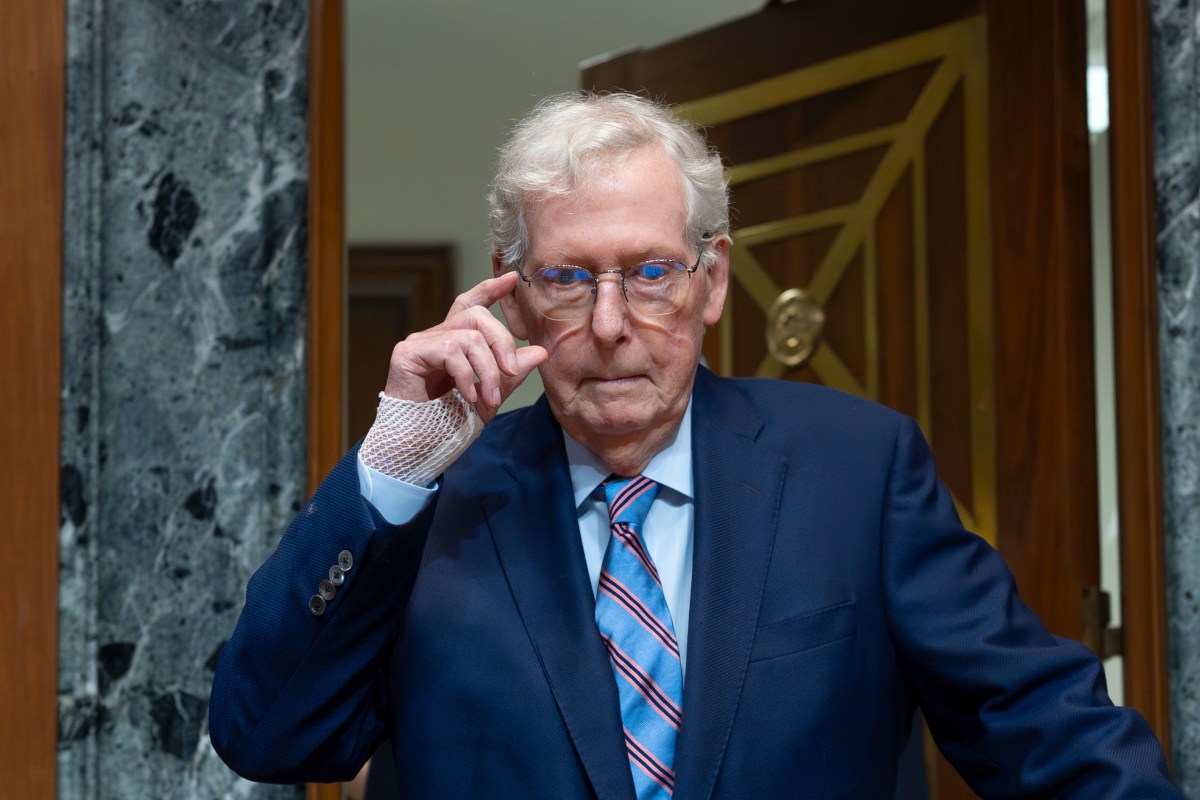
Three months after falling at his home, the timing of Senator Mitch McConnell's return to Congress remains uncertain as lawmakers prepare to reassemble in Washington.
Staff for McConnell, 84, whose seventh and final term ends in January, declined to provide an update on the Kentucky Republican's possible return on Friday, referring Newsweek to a statement last month saying he would continue recovering at home after being discharged from a rehabilitation center.
"No additional guidance or announcements," McConnell spokesman David Popp wrote.
McConnell's office previously announced he had been discharged on August 6, some 53 days after falling at his Washington home, where emergency personnel responded after receiving a 911 call regarding an unconscious person.
"Elaine and I are grateful for the many well wishes and support from friends, colleagues, and Kentuckians, and for the attentive care I’ve received from excellent doctors, nurses, therapists, and hospital staff," the lawmaker's statement said last month. "On the advice of my doctors, I’ll maintain an intensive regimen of physical therapy from home during the state work period, and I'll continue to engage with my staff and colleagues on important Senate business."
Staff for Senate Majority Leader John Thune, who has said that he has stayed in contact with McConnell throughout his three-month absence, also declined to comment Friday on his possible return, referring inquiries to McConnell's office.
Kentucky Governor Andy Beshear, who has criticized McConnell for a lack of clarity surrounding his condition, said he's received "zero communication" from the state's senior senator as of Friday.
"Absolutely none," Beshear said in an interview with Newsweek's Alex J. Rouhandeh. "We have had zero communication, but it's not that there's been zero direct communication with me. It's that there's been zero direct communication with the people of Kentucky. The people of Kentucky are his boss, and any of your viewers or readers who were gone from work for three months would owe a direct explanation, would have to get on the phone, would have to show up. That's all we're asking of Mitch McConnell. And if he's not willing to do it, he should resign."
Beshear, a Democrat elected to a second term in 2023, criticized McConnell and his Republican colleagues for letting the extended absence continue without a full explanation to voters.
"This is on John Thune. John Thune, as the Republican leader of the Senate, has a duty to make sure that every single one of the Senate has the capacity to serve," the governor said. "To my knowledge, he hasn't gone to see Mitch directly. He should do that, and if Mitch does not have the capacity, he ought to declare that vacancy, and then we can take steps."
Citing unnamed GOP leadership sources, Punchbowl News reported Thursday that Senate Republicans were "tentatively preparing" for McConnell to return to Congress next week, ending the longest absence of his 41-year career as lawmakers wrap up a five-week summer recess.
McConnell, who has been absent from the Senate since he was hospitalized on June 14 following a fall at his Washington, D.C., home, later disclosed that he had briefly lost consciousness and developed a mild case of pneumonia while hospitalized.
He subsequently spent weeks in a rehabilitation facility before being discharged on August 6. McConnell's statement said that he would continue an intensive physical therapy regimen at home and remain engaged with his staff and colleagues on Senate business.
But three months after his fall, McConnell has still not returned to the Senate floor, and his office has not publicly confirmed that he will be back when senators reconvene Monday afternoon.
The veteran lawmaker's prolonged absence has raised questions about when he will resume his full Senate duties, how many votes he has missed and why he continues to receive his congressional salary while away from the Capitol.
Beshear said the lack of transparency regarding the situation reflects poorly upon the state of government and creates distrust between the American people and their elected leaders.
"It means the Senate and Congress under Republican leadership is broken, absolutely broken," he said. "They don't think that they work for the American people—and they do."
The immediate question is whether McConnell will be back on Capitol Hill on Monday.
The Senate's official schedule shows the chamber is set to reconvene at 3 p.m. on September 14 after its five-week summer recess.
McConnell's staff previously said returning with his colleagues was a goal, but his office has not publicly confirmed a return date. That leaves open the possibility that the senator could remain away as the Senate begins a busy stretch of legislative business.
If McConnell does return, another question is how much of his Senate workload he can resume. He remains the chairman of the Senate Rules Committee, and his absence has also affected his role on the Senate Appropriations Committee. His ability to attend meetings, participate in negotiations and cast votes could become particularly important as lawmakers approach major legislative deadlines.
The Senate has no formal mechanism that automatically removes a senator from office after a set period of illness. Under Senate Rule VI, senators are not supposed to absent themselves from Senate service without leave.
That is different from a conventional workplace attendance policy. No rule says a senator's paid sick leave expires after a certain number of days and their salary automatically stops.
McConnell continues to receive the standard Senate salary of $174,000 a year.
The Senate's official salary records show that rank-and-file senators have received $174,000 annually since 2009, including in 2026.
Using that annual salary, McConnell's compensation works out to roughly $476.71 per day. From June 14 through September 14—92 days—his salary attributable to that period is approximately $43,858.
That figure is an estimate based on the annual salary and calendar days; it does not represent an additional payment triggered by his absence. McConnell receives his salary as a sitting senator regardless of whether the Senate is in session.
There is also an important distinction between a senator and a typical congressional employee. Members of Congress are not covered by the same formal leave system that governs many federal employees. A 1995 Government Accountability Office review noted that members of Congress and most congressional staff were not under a formal leave system.
McConnell's last recorded Senate vote came on June 11, three days before he was hospitalized.
He subsequently missed every Senate roll-call vote through the chamber's August 8 adjournment. By early September, reports put the number of missed roll-call votes at 60. Because the Senate was then in its five-week recess, that number had not increased by September 11.
The missed votes have included significant legislation and nominations.
McConnell was absent for a June vote on an Iran war-powers resolution, as well as votes involving housing legislation and executive-branch nominations. He also missed the Senate's August 8 vote confirming Todd Blanche as attorney general. The nomination passed 50-49, with McConnell among the senators who did not vote.
His absence has therefore not been limited to routine or symbolic votes. In a Senate where Republicans hold a narrow majority, an absent Republican can matter in closely divided votes, particularly when other members are also unavailable.
McConnell's absence also comes as the Senate prepares for a new round of consequential votes. The chamber's schedule includes a procedural vote on a judicial nomination when senators return Monday and a key vote involving digital-asset legislation on Tuesday.
June 11: McConnell casts his last recorded vote in the Senate before his extended absence begins.
June 14: McConnell is hospitalized after suffering a fall at his Washington, D.C., home. The incident leaves him unconscious for a period of time and begins what becomes a three-month absence from the Senate.
Late June: McConnell remains out of public view as he recovers from the fall. His office provides limited information about his condition, while Senate colleagues say they remain in contact with him.
July 12: McConnell breaks his silence about his health, announcing that a mobility-related fall had "landed me in the hospital." He added that he was briefly unconscious and later developed "a mild case of pneumonia."
McConnell also addresses speculation about his ability to return to work, saying that, on his doctors' advice, he would not yet return to the Senate floor to vote.
"But rest assured that, in the meantime, I'm not taking a break from the Senate business that matters to you," he said.
He says he has moved from hospital care to a rehabilitation center, where he will continue working to regain his strength.
July: As McConnell remains in rehabilitation, questions grow about when he will be able to return to Capitol Hill. His prolonged absence means he misses Senate votes while continuing to work with staff and communicate with some colleagues.
During this period, Republican leaders and allies publicly offer reassurances about McConnell's condition. Senate Majority Leader John Thune, Senate Whip John Barrasso and former McConnell adviser Scott Jennings are among those who say they have spoken with him.
July 27: The Capitol physician's office says McConnell has not yet been medically cleared to leave his rehabilitation facility, adding to uncertainty over when he will return to Washington.
McConnell said he is continuing intensive physical therapy and working toward a return.
"I'm still working hard to get back to my full schedule of work in the Senate and in Kentucky," he said in a statement, adding that he is keeping up with "intense physical therapy" on his doctors' orders.
McConnell has been away from the Senate for more than six weeks, with no firm timetable announced for his return.
Early August: McConnell remains in rehabilitation after more than seven weeks away from the Senate. He has not made a public appearance during his recovery, and his office has released only limited images and statements.
August 6: McConnell is discharged from rehabilitation and returns home. In a statement released by his office, he says he will continue an intensive regimen of physical therapy and remain engaged with Senate business while recovering.
His discharge marks a significant step in his recovery, but it does not come with a firm date for his return to the Capitol.
August 8: The Senate takes its final votes before beginning its five-week summer recess. McConnell remains absent. By this point, he has missed more than 60 recorded roll-call votes during his absence, according to reporting tracking his Senate attendance.
The recess temporarily removes the immediate question of whether McConnell can attend floor votes, but attention turns to whether he will be ready when senators return in September.
August 14: Two months after his fall, McConnell remains largely out of public view. Reporting notes that he has not appeared publicly since the incident, although his office says he is recovering at home and continuing physical therapy.
The lack of public appearances is drawing greater scrutiny from some Kentucky officials and political figures, who call for more information about McConnell's health and ability to serve.
Late August: McConnell continues recovering at home during the Senate's recess. His office does not announce a definitive date for his return to Capitol Hill.
The senator remains a sitting member of the Senate and continues to receive his congressional salary despite his absence.
September 3: Representative James Comer, a Kentucky Republican, says he has spoken with McConnell's staff and that their goal is for the senator to return when the Senate reconvenes on September 14. Comer says he expects McConnell to be back.
McConnell's office, however, does not publicly confirm that he will return on that date.
The comments provide the clearest indication yet that McConnell could return to Washington after the summer recess, but uncertainty remains over his exact plans.
September 10: Senate Republicans are reportedly preparing for McConnell to return to the Capitol when the Senate's September work period begins. Punchbowl News reports that GOP leadership sources believe he could return, although his final plans remain unclear.
The report comes just days before the Senate is scheduled to resume work.
September 11: McConnell's office has still not publicly confirmed that he will appear on the Senate floor when lawmakers return. The uncertainty persists even as Republican senators prepare for the new work period.
By this point, McConnell has been away from the Senate for nearly three months.
September 14: The Senate is scheduled to reconvene in Washington, exactly three months after McConnell's June 14 fall.
McConnell has said he intends to complete his Senate term, which ends in January, and has continued to communicate with staff and colleagues during his recovery. He has not, however, publicly committed to appearing on the Senate floor when the chamber returns Monday.
If he does not return, his absence is likely to renew questions about his health and his ability to carry out the duties of his office—but it would not automatically force him to resign.
There is no rule requiring a senator to leave office after being absent for a certain number of days because of illness.
The Senate's rules do address attendance. Senate Rule VI states that a senator should not absent themselves from Senate service without leave. But the rule does not establish a fixed period after which an illness-related absence results in removal from office.
McConnell, however, has already missed more than 60 roll-call votes during his absence. Each additional day he remains away could mean more missed votes and less direct participation in committee meetings, negotiations and other Senate business.
His absence could be particularly consequential when Republicans face closely divided votes. The GOP holds a narrow Senate majority, meaning the absence of even one senator can matter when the party needs to keep its members unified.
If McConnell continues to serve as a senator, Kentucky has no authority to appoint someone to vote in his place simply because he is absent. His Senate seat remains his until he leaves office. The situation would change if McConnell resigned or otherwise created a vacancy before his term ends in January 2027.
Under the 17th Amendment, when a Senate vacancy occurs, the governor may make a temporary appointment if state law allows it, with the state legislature directing how vacancies are filled. However, Kentucky is one of five states that requires Senate seats to be filled strictly through a special election.
Under a 2024 Kentucky law, when a U.S. Senate seat becomes vacant, the governor must issue a proclamation calling a special election to fill the seat, as opposed to directly selecting an appointee. However, if a vacancy happens within roughly two months of a regularly scheduled general election, the seat is likely to remain vacant until the next senator takes office.
McConnell's current Senate term is scheduled to end January 3, 2027.
Contact Newsweek editors on this story: Samantha Beech, Sam Wilson and Anthony Murray.