Mitch McConnell Returns to Senate After 3-Month Absence from Fall
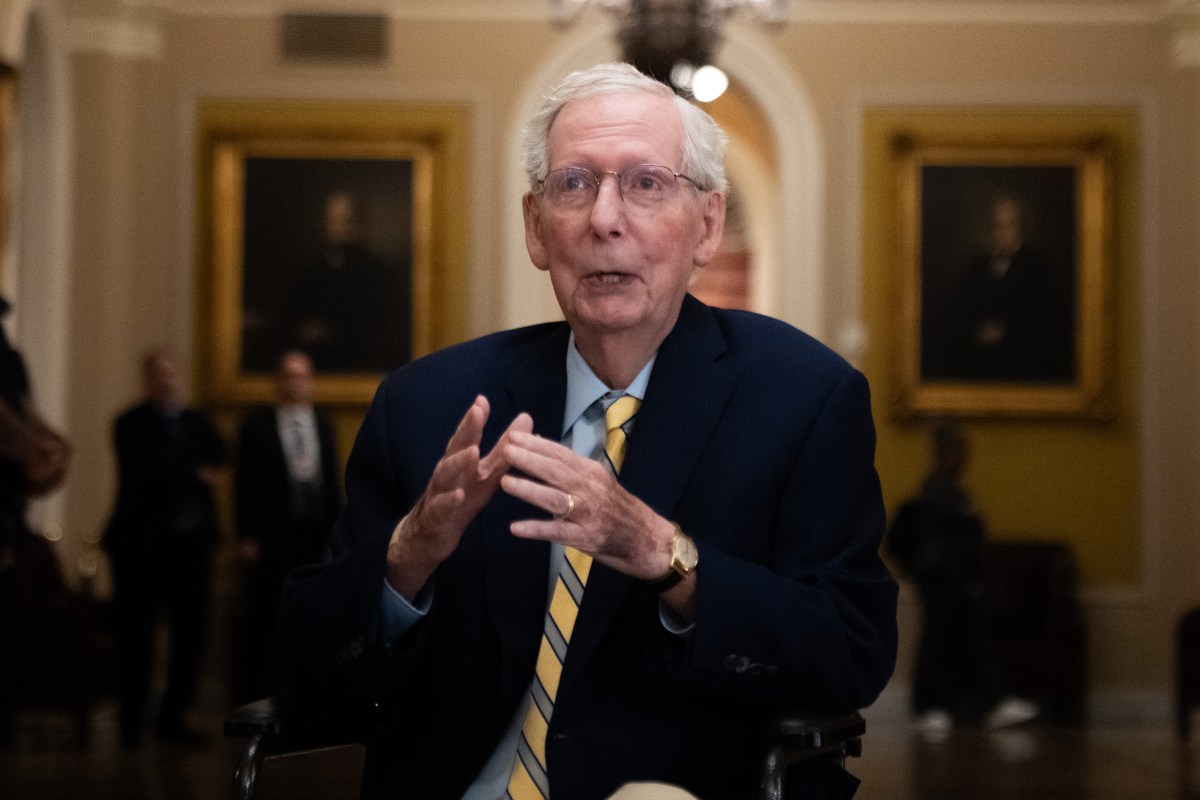
Senator Mitch McConnell returned to Congress on Monday following a fall at his home that led to an extended absence.
The 84-year-old lawmaker released a statement late Monday afternoon confirming his return.
"Today, I’ll cast my first Senate vote since I took a bad fall back in June. I’m really looking forward to being back on the Senate floor and seeing my colleagues," McConnell's office said in a statement obtained by Newsweek. "My recovery has been a long and often frustrating process, and the lingering effects of childhood polio haven’t made it any easier. I’m still not quite back to 100%, but I’ve assured Leader Thune that, as I continue with physical therapy on the advice of my doctors, I will do my best to be present for tough votes when our conference needs me."
McConnell's statement concluded: "Elaine and I are very grateful for all the continued well wishes from our fellow Kentuckians, and I’m glad to get back to more of business as usual on their behalf this month."
McConnell later told reporters he was surprised by the amount of interest in his return.
"I must admit, after two years, two decades, actually dodging your questions, I wasn't sure how many of you would be here today, but I'm glad to see you," he said. "Time to get back to work, finish the job for this Congress. I'm here to work on the farm bill ... As I think you know, I have an ongoing issue in NATO and backing up our good friends who are totally in the fight against the Russians."
McConnell, whose seventh and final term ends in January, had previously been expected to return to the Capitol on Wednesday, several sources close to the matter told Politico.
Staff for the 84-year-old Kentucky Republican previously told fellow senior GOP lawmakers that he intends to return to Congress that day for a committee vote on the farm bill, which previously stalled amid his absence, sources told the outlet.
Charles Booker, a Democrat running against Republican Representative Andy Barr for McConnell's seat, criticized the former GOP leader for his continued absence prior to his return on Monday.
"After 92 days of unnecessary silence and uncertainty, Mitch McConnell was wheeled back into the Senate chambers as if nothing happened," Booker told Newsweek in a statement. "If anyone else was a no-call, no-show for over three months, they wouldn't have a job to return to."
Booker accused McConnell of showing "disregard" for Kentucky voters by not providing regular updates on his health.
"As senator, I will never turn my back on Kentucky and I will always show up for our commonwealth," Booker said.
McConnell's office had declined on Friday to provide an update on the timing of the lawmaker's possible return, referring Newsweek to a statement last month saying he would continue recovering at home after being discharged from a rehabilitation center.
McConnell's office previously announced he had been discharged on August 6, 53 days after falling at his Washington home, where emergency personnel responded after receiving a 911 call regarding an unconscious person.
"Elaine and I are grateful for the many well wishes and support from friends, colleagues, and Kentuckians, and for the attentive care I’ve received from excellent doctors, nurses, therapists, and hospital staff," McConnell's August statement said. "On the advice of my doctors, I’ll maintain an intensive regimen of physical therapy from home during the state work period, and I'll continue to engage with my staff and colleagues on important Senate business."
Lawmakers returned to the Capitol on Monday following a five-week summer recess. McConnell, who has been absent from the Senate since he was hospitalized on June 14, later disclosed he briefly lost consciousness and developed a mild case of pneumonia while hospitalized.
Kentucky Governor Andy Beshear, who has criticized McConnell for a lack of clarity surrounding his condition, said he had received "zero communication" from the state's senior senator as of Friday.
"Absolutely none," Beshear told Newsweek last week. "We have had zero communication, but it's not that there's been zero direct communication with me. It's that there's been zero direct communication with the people of Kentucky. The people of Kentucky are his boss, and any of your viewers or readers who were gone from work for three months would owe a direct explanation, would have to get on the phone, would have to show up. That's all we're asking of Mitch McConnell. And if he's not willing to do it, he should resign."
Beshear also criticized McConnell and Senate Majority Leader John Thune for allowing the extended absence to continue without a full explanation to voters.
"This is on John Thune," Beshear said on Friday. "John Thune, as the Republican leader of the Senate, has a duty to make sure that every single one of the Senate has the capacity to serve. To my knowledge, he hasn't gone to see Mitch directly. He should do that, and if Mitch does not have the capacity, he ought to declare that vacancy, and then we can take steps."
Staff for Thune, who said he has stayed in contact with McConnell throughout his prolonged absence, have declined to comment on the timing of any possible return, referring inquiries last week to McConnell's office. Inquiries sent Monday were not immediately returned.
Senator Tommy Tuberville, a Republican representing Alabama, said he had not heard from McConnell’s office since June.
"We should’ve all been briefed on it, but that's up to the leadership," Tuberville told TMZ on Monday. "I think we'll find out more today."
McConnell said he planned to return to the Senate on Monday as lawmakers reconvened in Washington after a five-week summer recess.
The 84-year-old Kentucky Republican had been absent from the Senate for three months, following his June 14 hospitalization after a fall at his Washington, D.C., home. McConnell was later moved to a rehabilitation facility before returning home in August to continue his recovery and physical therapy.
Representative James Comer, a Kentucky Republican, had said earlier this month that McConnell's staff viewed September 14 as a target for his return. McConnell's office, however, never publicly confirmed that he would be back on Monday.
Citing unnamed GOP leadership sources, Punchbowl News reported last week that Senate Republicans were "tentatively preparing" for McConnell to return as Congress reconvened this week, ending the longest absence of his 41-year career.
According to Politico, McConnell's aides previously told Senate Republican leadership that he was expected to return to Capitol Hill by Wednesday.
McConnell has continued to receive his Senate salary while away from Capitol Hill, meaning he has earned nearly $45,000 during his absence.
The Kentucky Republican, who has served in the Senate since 1985, is paid the standard annual salary for rank-and-file senators: $174,000. The figure has remained unchanged since 2009, according to the U.S. Senate's historical salary records.
That compensation is tied to his position as a sitting member of the Senate, not the number of days he physically spends at the Capitol. The Constitution provides that members of Congress receive compensation for their service, and Congress sets congressional salaries by law.
At $174,000 a year, McConnell's salary works out to about $476.71 per day when you divide the annual figure by 365 days. Based on the 94-day period covered in this story, that amounts to approximately $44,811 in salary while he has been away from the Senate. That figure will keep rising as long as McConnell remains a sitting senator and continues receiving his salary. His absence therefore has not paused his congressional compensation.
McConnell is not the only person whose Senate employment continues while he is away. His congressional office remains staffed, with employees continuing legislative, constituent-service, and administrative work during his absence. The latest available salary data cited for his office show that his staff collectively received nearly $4 million over a 12-month period.
McConnell was hospitalized on June 14 after suffering a fall at his Washington, D.C., home. He later disclosed that he had been briefly unconscious and developed a mild case of pneumonia while hospitalized. Doctors subsequently moved him to a rehabilitation facility, where he underwent physical therapy.
On August 6, McConnell announced that he had been discharged from rehabilitation and was continuing his recovery at home. He said he would follow an intensive physical-therapy regimen and remain engaged with his staff and colleagues on Senate business.
McConnell was spotted outside of his Washington home on Monday afternoon alongside several police officers, video shows. He had previously not been seen in public since June 11, three days before his hospitalization, and his office has released only two photographs of him since his hospitalization, including images intended to provide an update on his condition.
Instead, the Republican has communicated through written statements, including his July 12 announcement about his fall, his August 6 update after leaving rehabilitation, and the new September 14 update about his intention to vote.
The lack of a public appearance has fueled questions from both political figures and commentators about his health and ability to resume his Senate duties. McConnell's office has maintained that he remains engaged in Senate business while recovering.
June 11: McConnell casts his last recorded vote in the Senate before his extended absence begins.
June 14: McConnell is hospitalized after suffering a fall at his Washington, D.C., home. The incident leaves him unconscious for a period of time and begins what becomes a three-month absence from the Senate.
Late June: McConnell remains out of public view as he recovers from the fall. His office provides limited information about his condition, while Senate colleagues say they remain in contact with him.
July 12: McConnell breaks his silence about his health, announcing that a mobility-related fall had "landed me in the hospital." He added that he was briefly unconscious and later developed "a mild case of pneumonia."
McConnell also addresses speculation about his ability to return to work, saying that, on his doctors' advice, he would not yet return to the Senate floor to vote.
"But rest assured that, in the meantime, I'm not taking a break from the Senate business that matters to you," he said.
He says he has moved from hospital care to a rehabilitation center, where he will continue working to regain his strength.
July: As McConnell remains in rehabilitation, questions grow about when he will be able to return to Capitol Hill. His prolonged absence means he misses Senate votes while continuing to work with staff and communicate with some colleagues.
During this period, Republican leaders and allies publicly offer reassurances about McConnell's condition. Senate Majority Leader John Thune, Senate Whip John Barrasso and former McConnell adviser Scott Jennings are among those who say they have spoken with him.
July 27: The Capitol physician's office says McConnell has not yet been medically cleared to leave his rehabilitation facility, adding to uncertainty over when he will return to Washington.
McConnell said he is continuing intensive physical therapy and working toward a return.
"I'm still working hard to get back to my full schedule of work in the Senate and in Kentucky," he said in a statement, adding that he is keeping up with "intense physical therapy" on his doctors' orders.
McConnell has been away from the Senate for more than six weeks, with no firm timetable announced for his return.
Early August: McConnell remains in rehabilitation after more than seven weeks away from the Senate. He has not made a public appearance during his recovery, and his office has released only limited images and statements.
August 6: McConnell is discharged from rehabilitation and returns home. In a statement released by his office, he says he will continue an intensive regimen of physical therapy and remain engaged with Senate business while recovering.
His discharge marks a significant step in his recovery, but it does not come with a firm date for his return to the Capitol.
August 8: The Senate takes its final votes before beginning its five-week summer recess. McConnell remains absent. By this point, he has missed more than 60 recorded roll-call votes during his absence, according to reporting tracking his Senate attendance.
The recess temporarily removes the immediate question of whether McConnell can attend floor votes, but attention turns to whether he will be ready when senators return in September.
August 14: Two months after his fall, McConnell remains largely out of public view. Reporting notes that he has not appeared publicly since the incident, although his office says he is recovering at home and continuing physical therapy.
The lack of public appearances is drawing greater scrutiny from some Kentucky officials and political figures, who call for more information about McConnell's health and ability to serve.
Late August: McConnell continues recovering at home during the Senate's recess. His office does not announce a definitive date for his return to Capitol Hill.
The senator remains a sitting member of the Senate and continues to receive his congressional salary despite his absence.
September 3: Representative James Comer, a Kentucky Republican, says he has spoken with McConnell's staff and that their goal is for the senator to return when the Senate reconvenes on September 14. Comer says he expects McConnell to be back.
McConnell's office, however, does not publicly confirm that he will return on that date.
The comments provide the clearest indication yet that McConnell could return to Washington after the summer recess, but uncertainty remains over his exact plans.
September 10: Senate Republicans are reportedly preparing for McConnell to return to the Capitol when the Senate's September work period begins. Punchbowl News reports that GOP leadership sources believe he could return, although his final plans remain unclear.
The report comes just days before the Senate is scheduled to resume work.
September 11: McConnell's office has still not publicly confirmed that he will appear on the Senate floor when lawmakers return. The uncertainty persists even as Republican senators prepare for the new work period.
September 14: The Senate reconvenes in Washington after its five-week summer recess, but McConnell does not return to the chamber, extending his absence to three months. His office releases a statement saying that he will cast his first Senate vote since June.
McConnell's return to the Senate could bring renewed scrutiny over whether he is able to resume his duties after three months away from Capitol Hill.
Democrats, including Beshear, have made the most direct calls for McConnell to step down. Beshear has repeatedly called on McConnell to provide greater clarity about his health and ability to serve, saying the senator should demonstrate that he can fulfill his responsibilities or resign. Beshear has also said he would consider options for filling the seat if a vacancy occurs before McConnell's term ends.
Republicans have generally been more supportive of McConnell remaining in office, but his prolonged absence has also raised concerns within the GOP. His absence has reduced the number of Republicans available for votes in a Senate where the party holds a narrow majority, creating complications when legislation requires near-unanimous Republican support. Republican lawmakers have previously expressed concern about how his absence affects the Senate's ability to move legislation.
There has also been criticism from conservative commentators. Joe Concha, a Fox News contributor, publicly urged McConnell to return to Capitol Hill in September or resign, adding to the pressure surrounding the senator's prolonged absence.
Still, no public indication suggests Senate Republican leadership is seeking to force McConnell from office. Senate Republicans have instead been preparing for his return, while McConnell's office has maintained that he remains engaged with staff and colleagues as he recovers.
The issue could become more prominent if McConnell returns but cannot resume a regular schedule of voting and Senate work. He has already missed roughly 60 roll-call votes since his last recorded vote on June 11.
McConnell has also already announced that he will not seek reelection in 2026 and plans to serve out his current term, which ends in January 2027.
Contact Newsweek editors on this story: Samantha Beech and Sam Wilson.