Modi Calls BRICS ‘Ecosystem Of Solutions’, China To Host Next Summit - ABP Live English

Despite significant disagreements regarding the ongoing conflicts in Iran and Ukraine, the 11-member BRICS group managed to unite in calling for an end to hostilities in the Middle East. They condemned the recent US-Israel strikes on Iran, which have put all Gulf nations at risk. The New Delhi Declaration, adopted on the first day of the two-day summit held in the Indian capital, strongly criticised Israel for its actions in Gaza and denounced the United States for sparking a global trade war.
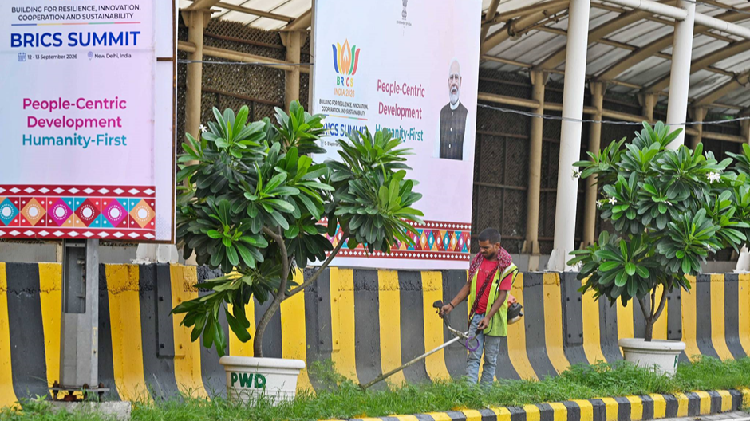
The Summit, which was held at a time when the world is facing two raging wars disrupting lives and livelihoods, was able to bring together leaders from China, Russia, Iran, and the United Arab Emirates (UAE), among other member countries under one roof under India’s chairmanship.
“We do not stand against anyone; instead, we aim to progress by bringing everyone along,” said Prime Minister Narendra Modi on the opening day of the two-day summit that was held from September 12-13. Modi strongly urged that the Global South must transition from being a "rule-taker" to a "rule-shaper".
He concluded the gathering on Sunday declaring that the alliance has now developed into an “ecosystem of solutions” suggesting that all BRICS members have managed to set aside their differences and are open to discussing a united path forward.
The summit in New Delhi witnessed attendance from Chinese President Xi Jinping, Russian President Vladimir Putin, Iranian President Masoud Pezeshkian, UAE Crown Prince Sheikh Khaled bin Mohamed bin Zayed Al Nahyan, South African President Cyril Ramaphosa and the President of Egypt Abdel Fattah El-Sisi, among others.
BRICS was formalised during the BRIC Foreign Ministers’ Meeting held on the margins of the United Nations General Assembly in New York in September 2006. The first BRIC Summit was held in Yekaterinburg, Russia on June 16, 2009. Today BRICS has 11 major emerging and developing economies: Brazil, China, Egypt, Ethiopia, Indonesia, India, Iran, Russia, Saudi Arabia, South Africa, United Arab Emirates (UAE). The BRICS Partner countries are: Belarus, Bolivia, Cuba, Kazakhstan, Malaysia, Nigeria, Thailand, Uganda, Uzbekistan, and Vietnam.
During the summit, India also resisted attempts to turn the grouping into an “anti-West” bloc – something that the United States had been stating. During the last year’s BRICS Summit that was held in Rio de Janeiro, Brazil, US President Donald Trump threatened to impose an extra 10 per cent tariff on all BRICS countries while calling the bloc to be “anti-American”.
While the New Delhi declaration – 45-page document with 140 points – criticised Trump and his tariff war, the member countries stayed away from any such discussions on de-dollarisation or a common BRICS currency even as it remained focussed on adopting measures using national currencies.
Discussions were held on issues concerning national-currency settlements, faster cross-border payments, resilient supply chains, digital public infrastructure, health, food and energy security, and reform of the UN, IMF and World Bank.
“India scored a significant diplomatic success in securing a unanimous New Delhi Declaration despite sharp differences between Iran and the UAE over West Asia. Consensus was preserved, but only through carefully generalised language. In this, BRICS’s value and its limitation was exposed: it can keep difficult conversations alive and affirm broad principles, but it struggles to assign responsibility or organise collective action when there is the occasional collision of the interests of its members,” said Nirupama Rao Menon, former Foreign Secretary and Ambassador of India to the United States.
Akshay Mathur, Senior Director, ASPI Delhi, said, “Questions about the group's cohesiveness are natural given the group's broad-based agenda, geopolitical rivalries within, and strategic relations with the West. Yet, BRICS’ 20-year history has demonstrated the group's durability. The progress, albeit slow for the advocates of the group, has been steady, palpable, and measurable. The four hundred meetings in 2026, covering over thirty ministerial summits, show breadth of work in 2026.”
“However, the depth is visible in the systems-level inter-operability being established by central banks for payment, clearing and settlement, including for digital currencies, and the promise of new financial instruments such as multilateral guarantees being explored by New Development Bank to mobilise private capital,” added Mathur.
China, which assumed the Presidency of the BRICS, called for a “greater BRICS cooperation.”
“These are 20 years of fruitful outcomes. BRICS has realised a historic expansion, and now has a comprehensive, multifaceted cooperation structure with ever deepening cooperation in trade, investment, finance and technology, among others. It has entered a new stage of high-quality development of greater BRICS cooperation,” said Chinese President Xi Jinping.
Xi also said, “Today, changes unseen in a century are accelerating across the world. The Global South is gaining strength, and the trend toward a multipolar world is unstoppable. At the same time, unilateralism and power politics are surging against the tide, lashing at multilateralism and the international order.”
He added, “BRICS must stand firmly on the right side of history, strive to be a pioneer of our times, steer the international order in a direction that is more just and equitable, and work together to build a community with a shared future for humanity.”
Modi also held a bilateral meeting with Xi on the sidelines of the Summit where both leaders discussed matters related to the disputed border between both countries and sought to maintain “peace and tranquility” in the border areas.
Under the New Delhi Declaration, leaders expressed “firm opposition” and “grave concern” to the forced displacement of Palestinians and the ongoing violence in Gaza.
“We reaffirm that a just and lasting solution to the Israeli-Palestinian conflict can only be achieved by peaceful means and depends on the fulfilment of the legitimate rights of the Palestinian people, including the rights to self-determination and return,” stated the Declaration.
Slamming Israel for its actions, the BRICS leaders said, “We reject any unilateral measures that seek to alter the legal and historical status of occupied Jerusalem.”
Without naming the United States, the leaders unanimously condemned the tariff measures undertaken under the Donald Trump administration.
“We voice serious concerns about the rise of unilateral tariff and non-tariff measures which distort trade and are inconsistent with WTO rules. We will work together to enhance the WTO’s responsiveness to trade disruptions and the needs and priorities of emerging markets and developing economies (EMDEs), as well as advance discussions on outstanding issues, and support balanced, inclusive and concrete outcomes that strengthen the multilateral trading system and enable it to better address evolving global challenges,” said the New Delhi Declaration.
The BRICS leaders also called for a “multipolar world” even as it sought to bring larger coherence amongst all the member countries.
“We agree that, in the context of the contemporary realities of the multipolar world, it is crucial that developing countries strengthen their efforts to promote dialogue and consultations for more just and equitable global governance and mutually beneficial relations among nations. We acknowledge that multipolarity can expand opportunities for EMDCs to develop their constructive potential and enjoy universally beneficial, inclusive, sustainable and equitable economic globalisation and cooperation,” the declaration added.
Nayanima Basu is a senior independent journalist.
Nayanima Basu is an independent journalist writing on international relations and strategic affairs for ABP Live English. Basu is also the author of 'The Fall of Kabul: Despatches From Chaos'.
We use cookies to improve your experience, analyze traffic, and personalize content. By clicking "Allow All Cookies", you agree to our use of cookies.