
Most people in S'pore find govt digital services as good or better than private sector services: Josephine Teo - Mothership
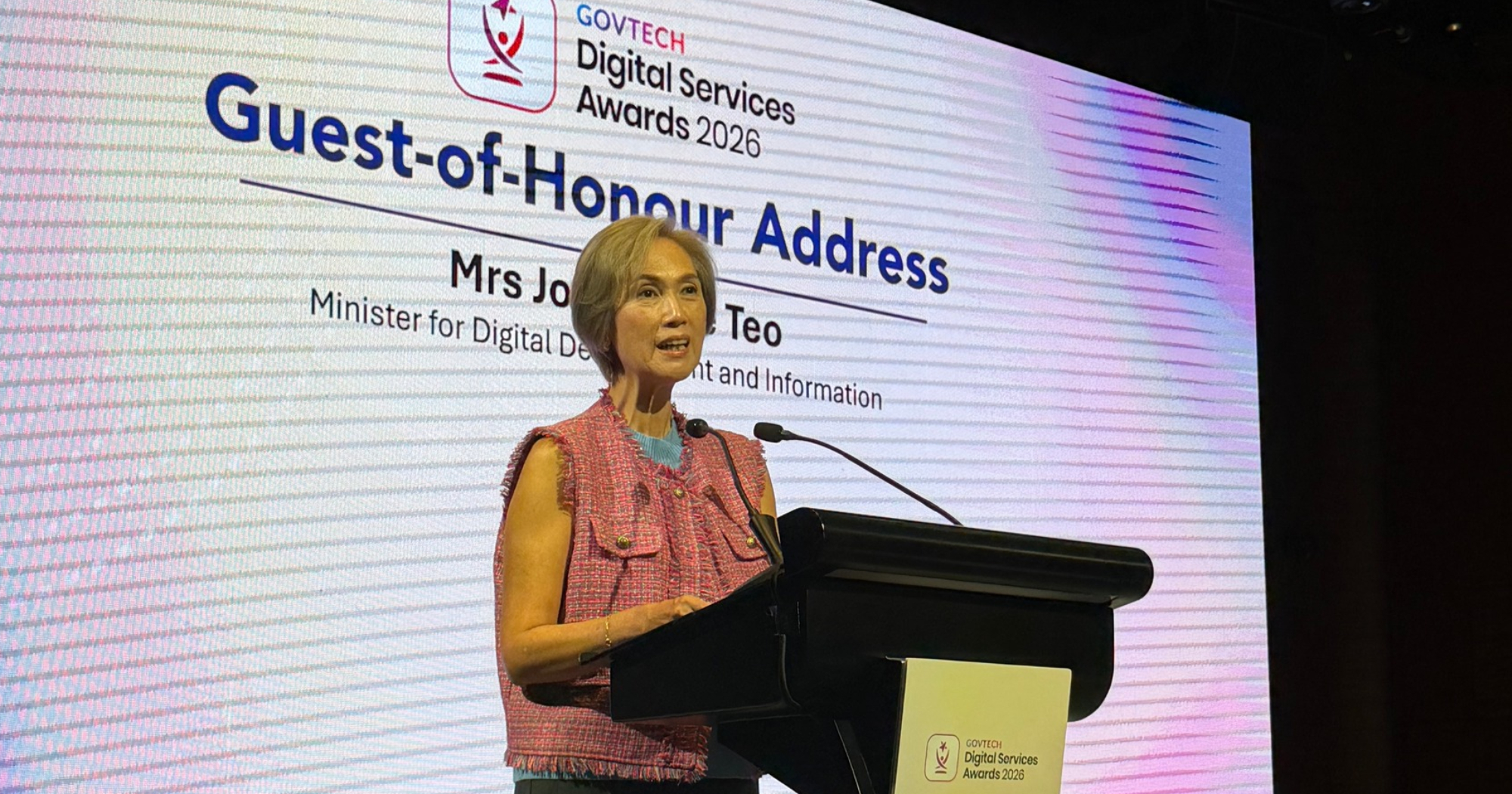
Minister for Digital Development and Information Josephine Teo delivered her speech on Nov. 20.
Singapore's public sector should use artificial intelligence (AI) to deliver better services for citizens and businesses, and to help public officers engage in more meaningful work, said Minister for Digital Development and Information Josephine Teo on Nov. 20 at the Government Technology Agency of Singapore's (GovTech Singapore) Digital Services Awards (DSA) 2026.
The ceremony recognises digital services delivered by public agencies and industry organisations, as well as citizens who had helped agencies improve those services, a Nov. 20 GovTech media release said.
In her speech, Teo pointed out that the Public Service Division launched a systematic effort about six months ago to use AI to transform how the public service works to benefit citizens and businesses.
She noted that her counterparts overseas expressed their admiration for the Singapore government's digital transformation during international engagements.
However, she told them that Singapore is no longer unique in making the vast majority of transactions with public agencies available digitally.
"A harder goal to sustain is to keep up the levels of public satisfaction with these services, particularly as the quality of services that members of the public experience elsewhere continues to improve," Teo said.
"We are therefore humbled to find that most people in Singapore still consider government digital services as good as or better than private sector services."
She added that organisations everywhere will naturally aim to raise their service standards further in the face of AI.
Teo also highlighted how every public officer is provided with access to frontier AI tools, invested in shared platforms and funding.
She also said the establishment of AI governance framework, as well as the recent launch of the Institute of Digital Government are "to strengthen our capabilities".
Teo said: "Today, well over half of our 150,000 public officers use AI tools in their work at least once a month."
"It should not be long before every public officer regularly uses AI for work, in the same way they use email and other IT tools."
Teo, with the help of a colleague, also has an AI agent that scans thousands of news articles globally every day to deliver a personalised update at 7am every morning.
However, while individual uses of AI for personal productivity should be encouraged, they are far from enough, she said.
"We believe there are many more opportunities to broaden and deepen the impact of AI on public service delivery," Teo added.
She emphasised that the early results of the systematic effort are encouraging.
It allows websites that previously took three to six months to be developed to now be launched in as short as two days.
Teo also mentioned that an AI-powered scanning system is capable of proactively disrupting more than 20,000 potentially malicious websites every month.
Separately the CPF Board has redesigned its contact centre to use more AI and automation.
Teo also explained that under its New Clearance Concept, the Immigration and Checkpoints Authority (ICA) has integrated AI, automation and biometrics to rework the entire clearance journey.
Travellers will be able to clear immigration without leaving their vehicles under its upcoming Automated Passenger Clearance System for cars, or APCS@Car.
The new concept will also allow an officer to remotely supervise multiple clearance lanes, switching to automated, exception-based clearance.
It is a shift from manpower-intensive face-to-face checks with each traveller, Teo said.
She also shared two priorities, where the first is "the focus on redesigning how we work, not just automating individual tasks".
The second is making it easier for agencies to use AI responsibly, without compromising public trust.
In placing the right safeguards in place, Teo talked about how people should be confident that their personal information is protected and can seek human assistance when needed.
Officers should remain accountable for decisions affecting them, she added.
These safeguards should be proportionate to the risks and agencies should be able to move quickly on lower-risk uses, while applications with greater consequences receive closer scrutiny, she said.
"As AI agents become more capable, we must also be clear about when human approval will be required," Teo added.
This year's awards, under the theme of "Engage, Empower, Evolve", highlighted three important aspects, the release wrote.
They include understanding the needs of citizens, involving them in service design and continuing to improve digital experiences as expectations change.
The Best User Engagement category, which DSA 2026 also introduced, recognises agencies that use user feedback to shape and improve government websites.
According to the release, the Discover Portal by National Youth Council (NYC) was awarded the inaugural Best User Engagement award.
Over 2,100 youths participated in the portal's development and helped shape its content, design and structure by sharing insights.
The portal uses an AI-powered Career Archetype Quiz to offer youths a personalised experience, according to the release.
The quiz matches users to one of 22 archetypes, when then inform the homepage, recommendations, events and mentor suggestions they see.
In addition, the release said an earlier survey of 450 members of the public in April 2026 found that 92 per cent rated government digital services as good as or better than those offered by the private sector.
Respondents indicated that they wished for a more seamless and consistent experience across government agencies, in the hopes of having an easier time finding required information and services without navigating multiple websites.
Based on survey results, 50.9 per cent of respondents trusted AI to provide useful information and 87.6 per cent were somewhat comfortable using AI-powered government chat services.
Being able to access a human officer would increase trust in AI-powered government services, nearly 70 per cent of respondents stated.
"Ultimately, Singaporeans should experience not just faster or more efficient services, but better care and greater confidence in government," Teo said.
"This is what AI transformation in the Public Service should aim to deliver."

