‘Moving at light speed’: Plug-in solar and batteries are coming to Australia
Households could soon be able to buy plug-in solar panels and batteries for energy storage as part of reforms that will broaden access to solar for renters and apartment dwellers.
Climate Change and Energy Minister Chris Bowen said all states and territories had agreed to look at how plug-in solar and batteries could work in Australia to give apartment dwellers and renters more control over their bills.
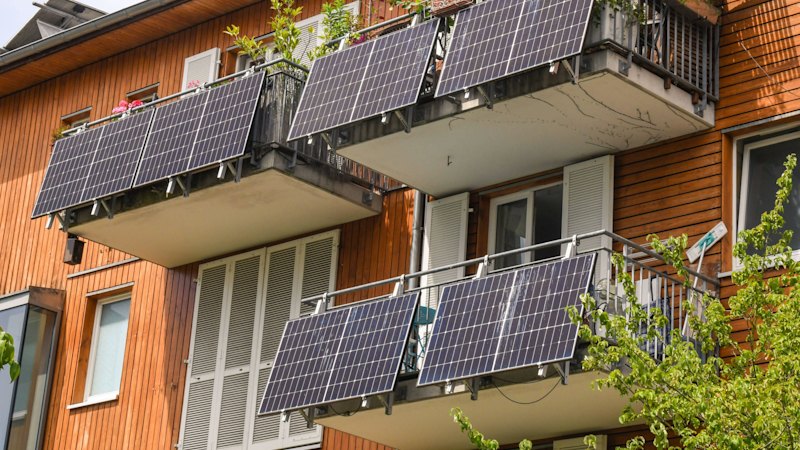
Portable solar panels on apartment balconies in Freiburg, Germany.Alamy“A third of Australians have a solar panel on their roofs. It’s more popular than the backyard pool,” Bowen said.
“Now we’re taking the next step, by looking at how even more Australians can take advantage of free, abundant sunshine to cut their energy bills - even if they don’t have a roof.”
As reported previously by this masthead, plug-in solar allows consumers to buy panels for about $500 each. The panels hang in an outdoor area and plug into a socket to power any appliances, charge a battery or feed into the grid. The devices do not need to be installed by an electrician, and owners can take them when they move homes.
The technology is widely used in Germany and being increasingly used in other European countries such as France and Spain, as well as in many US states; it was also recently legalised in Britain. It is currently unlawful in Australia because of compliance with safety standards, although the market is growing anyway and a number of online retailers already sell systems here.
Tyler Peck, 24, rents an older home in Melbourne and could use plug-in solar to help lower his heating bills in winter.Justin McManusThe federal and state climate change and energy ministers agreed on Friday to progress legal and regulatory reforms that would enable widespread adoption in Australia, with a key deadline by mid-2027. New Zealand is separately working to enable plug-in solar.
Glen Morris, director of Smart Energy Lab and a member of the Solar Standards Committee, said Australia had been lagging but was now moving at light speed given it usually took years to develop new standards.
“It went from zero to 100 in one day.” Morris said. “I was prepared for a very long campaign to get it through … but obviously, when there’s political will, things can move a bit faster.”
The main change required was an amendment to the Australian standard for inverter systems, which could be fast-tracked by copying international standards, he said.
“The products designed for the European market already have the safety features we like – it’s important that we don’t turn it into a very complex process, so that it can be done swiftly.
“To some extent, the horse has bolted because people can buy these and the only thing stopping them plugging it in is that it’s illegal. But it’s not very obvious – certainly if you don’t have solar panels and just have a plug-in battery system, no one would know.”
The plug-in panel technology is often called “balcony solar”, and panels hanging vertically off balcony railings are a common sight in Germany. However, Francis Vierboom, chief executive of Rewiring Australia, said the panels would be most useful in backyards in the Australian context.
“The sun is a lot lower in the sky in northern Europe, and solar that’s actually on sideways on your balcony is going to generate more energy than it does in Australia, where the sun is a bit higher in the sky because we are closer to the equator,” Vierboom said.
The real game changer for apartment dwellers could be the portable “suitcase batteries” because the panels require outside space, but the batteries work even without any kind of solar, Vierboom said. In that scenario, a battery would charge up from the cheap daytime energy available on the grid, including three hours of free power available in the middle of the day on some plans, and then a household could use that energy in the evening peak.
“The less we all lean on the grid in that evening peak, the cheaper the energy system stays, and the more we can be using solar energy instead of fossil fuel generators in the evening,” Vierboom said.
Governments may need to look at strata law and tenancy law to consider whether owners’ corporations, strata managers and landlords could block plug-in solar and under what circumstances.
Solar Citizens, a group that advocates for consumers to gain from renewable energy, has been lobbying Bowen to push for plug-in solar. Chief executive Heidi Lee Douglas said the group would push for a clear timeline with a target deadline of July 1 next year, and to ensure renters, apartment dwellers and low-income households could benefit.
“Renters shouldn’t be locked out of cheaper, cleaner energy simply because they don’t own the roof over their heads,” Douglas said. “They should have a fair right to request solar, batteries and energy-efficiency upgrades, and landlords shouldn’t be able to unreasonably say no.”
Tyler Peck, 24, rents an older home with his partner in Preston in Melbourne. While the home is affordable and close to transport, it is poorly insulated and the heating bills are high.
Peck would like to have plug-in solar set up on his porch, which gets good sunlight, and says he is equally motivated by the electricity savings and the environmental benefit. But he would definitely wait for the official green light, rather than buying any of the systems already on the market.
“With all the [public service announcements] that went out a while ago about dodgy scooter or e-bike batteries being fire hazards, I’m just very cautious about anything that isn’t official,” Peck said.
An 800-watt system with two panels would cost $450 to $850 based on German prices, which gives it a two to four-year payback with a 25-year warranty, Morris, of Smart Energy Lab, said. Adding a 1.6-2Kwh battery would be a combined cost of $1100-$1300, with a five to eight-year payback and batteries rated for 15 to 20 years of daily use.
Morris said Australian prices would probably start higher than Germany and eventually fall.
Bowen said on Saturday that if plug-in solar met safety standards, it would be automatically covered by the government’s existing rebates, the Cheaper Home Battery policy and the Small-scale Renewable Energy Scheme for solar panels, adding “but we’ll work those details through”.
However, Vierboom said the government should consider a change to legislation, since the Cheaper Home Batteries program does not cover small batteries, or the installation of batteries without solar, and the rebates for panels required installation by an accredited electrician.
Morris said he had been testing a small panel tilted 75 degrees from horizontal – only 15 degrees off being vertical – similar to how it was used in Germany. But to get a decent return on investment in Australia, it should be tilted more horizontally – from 37 degrees in Melbourne to 32 degrees in Queensland, with Sydney in the middle. On a balcony, “it would stick out a bit more, providing a bit more shade for your neighbour below”, Morris said.
Karin Aubrey will get a shared solar system on the roof of her apartment building in the Sydney beachside suburb of Maroubra in October. The building received a Solar for Apartment Residents grant from the NSW government to reduce the cost, and will use the Allume SolShare 2 technology to fairly split the solar power between apartments.
Karin Aubrey is getting shared solar on her Sydney apartment block but supports plug-in solar as an option in the market.Wolter PeetersAubrey is happy about the panels and the grant, but said it took more than a year of advocacy to get everyone in the owners’ corporation on board given the cost of the panels and electrical rewiring required. She would like to add shared batteries in future, which the Allume technology allows, but in an old building that gets damaged by salt spray, “there are always competing needs”.
Aubrey saw plug-in solar in action on her recent trip to visit friends in France and would support it becoming available here because it would allow households to make decisions independently, not just through strata.
“They’re having crazy heatwaves [in France], and their apartment buildings are usually quite complicated with who owns them and how big they are, so balcony solar is taking off a little bit there,” Aubrey said.
“I heard it about it there because everyone’s trying to get air conditioning for the first time, and the load is just massive. It’s a good idea.”
Get to the heart of what’s happening with climate change and the environment. Sign up for our fortnightly Environment newsletter.
You have reached your maximum number of saved items.
Remove items from your saved list to add more.