Musk's Starship to fly over India today, circle Earth six times then crash
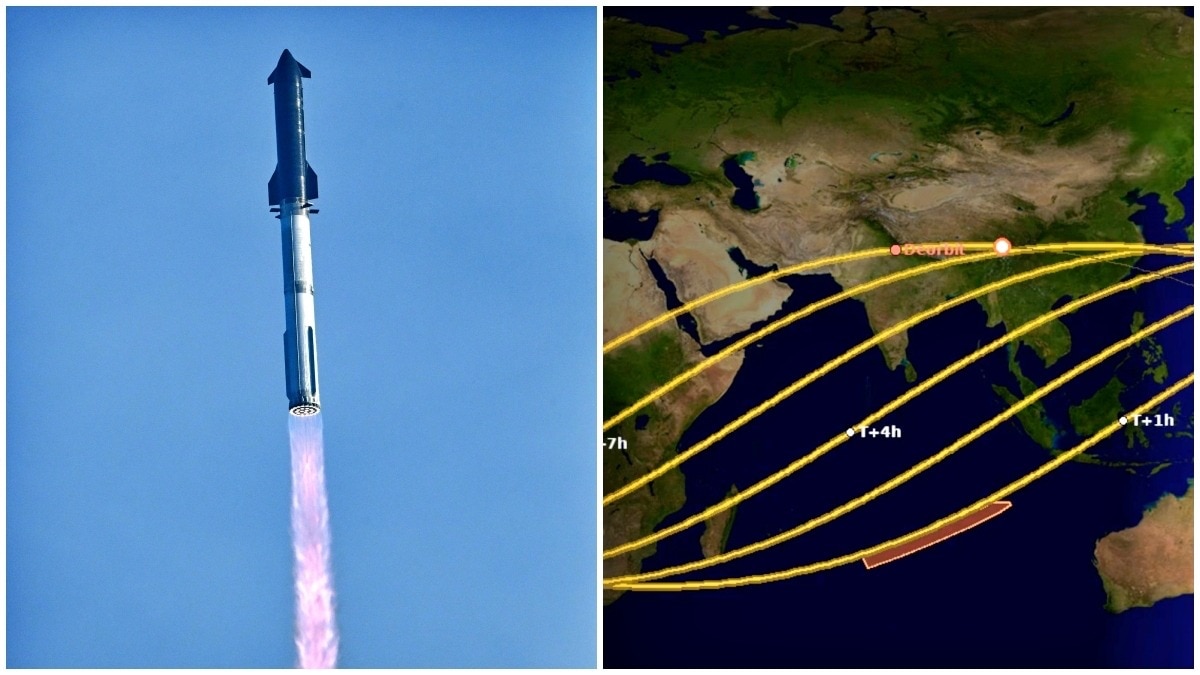
SpaceX is preparing for one of the most consequential tests of its Starship rocket yet, with the world's largest launch vehicle set to attempt its first orbital flight on Monday, September 28.
The mission could see Starship fly over India as it circles Earth approximately six times before splashing down in the Pacific Ocean.
The 75-minute launch window opens at 5:45 pm IST. However, it is dependent on weather in the region.
The nearly 10-hour mission marks a major milestone in Elon Musk's ambition to make Starship fully and rapidly reusable. Previous flights followed suborbital trajectories, but Flight 14 is designed to demonstrate orbital insertion, satellite deployment and a controlled return to Earth. So, based on the timeline published and the landing zones this is my rough approximation of the ground track for flight 14. Assuming it flies for all orbits there are opportunities to see it in many locations around the world. pic.twitter.com/LlORwFppos— Scott Manley (@DJSnM) September 27, 2026
Starship is expected to fly at an altitude of approximately 275 km above Earth, completing around six orbits before targeting a splashdown in the Pacific Ocean, west of Chile.WHY IS THIS STARSHIP'S MOST CRITICAL FLIGHT?
For the first time, SpaceX plans to deploy 26 Starlink V3 satellites from Starship, marking a significant step towards expanding its global satellite internet network.
Each Starlink V3 satellite is designed to add approximately 1 terabit per second of capacity to the constellation. Together, the 26 satellites could contribute 26 Tbps of capacity, around 10 times the capacity delivered by a single Falcon 9 launch carrying V2 Mini satellites.
The satellites will deploy their solar arrays and antennas before raising their orbits using onboard thrusters. SpaceX expects them to begin serving customers within weeks of launch, following initial testing.
Three satellites will also carry cameras to inspect Starship's heat shield, providing crucial data for future missions.TESTING STARSHIP'S RETURN TO EARTH
The flight will also test several improvements to Starship's heat shield, including better tile-retention mechanisms and redesigned curved tiles intended to reduce heating.
Two previously recovered heat-shield tiles are also expected to fly again, marking the first reuse of Starship heat-shield tiles.
The Super Heavy booster will attempt a controlled landing burn and offshore splashdown in the Gulf of America after stage separation.
Starship itself will perform an orbital insertion burn, deploy its satellites and execute a deorbit burn before re-entering Earth's atmosphere.
The mission will test whether Starship can move closer to becoming a fully reusable rocket capable of supporting future Moon and Mars missions.
SpaceX plans to livestream the flight beginning approximately 30 minutes before liftoff, with coverage continuing through splashdown.- Ends