Nasa tracking Earth's weight: Melting ice, oceans move planet's centre of mass
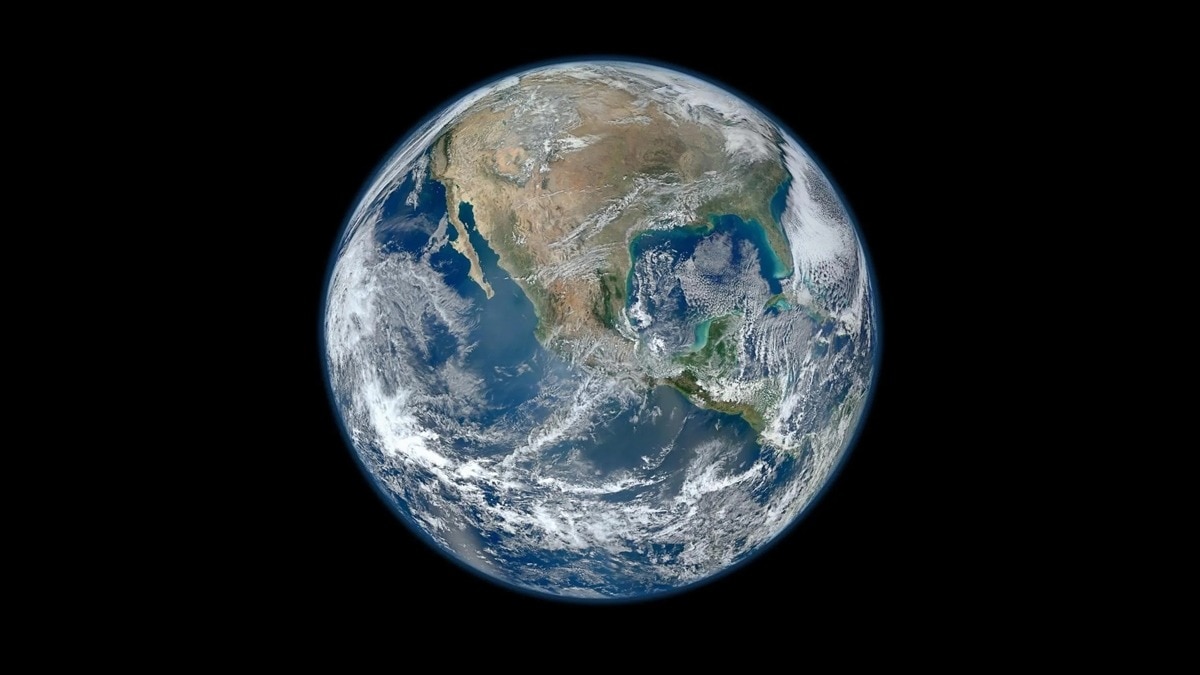
Earth may look like a solid, unchanging sphere, but its centre of mass is constantly on the move. As water, ice and air shift across the planet with the seasons, Earth’s centre of mass oscillates by a few millimetres relative to its geometric centre.
Now, Nasa scientists have developed a new technique to measure these tiny movements with greater precision. The method, led by geoscientist Donald Argus at Nasa’s Jet Propulsion Laboratory (JPL), is detailed in a new study published in Geophysical Journal International.
Earth’s centre of mass, also known as the geocentre, is crucial for defining reference systems used in satellite navigation, mapping and measurements of elevation. Even movements of a few millimetres matter when scientists and engineers need highly accurate positioning.
The latest estimates suggest the seasonal movement is smaller than previously thought. Earlier international estimates made in 2017 and 2023 differed by 7 millimetres, almost as large as the movement being measured.
The new technique combines GPS observations with orbital data from several low-Earth-orbit satellites. It also accounts for the way changing loads of water and ice physically deform Earth’s crust, improving the accuracy of measurements from ground stations.
Satellites naturally orbit around Earth’s centre of mass because of gravity. Scientists have also used dedicated satellites such as LAGEOS 1 and 2, which are covered with reflective prisms and tracked by laser stations around the world.
The researchers found that Earth’s seasonal geocentre movement is driven mainly by oceans, the atmosphere and water stored on land, including snow, glaciers, lakes, rivers, soil moisture and groundwater.
Snow accumulation across North America and Eurasia peaks around March and pushes the centre of mass about 3 millimetres towards the North Pole. In April, water stored in the Amazon basin reaches roughly 2,400 gigatons, shifting the centre about 2.2 millimetres towards South America.
By August to October, melting ice and increased rainfall add water to the oceans, with the vast Pacific producing the largest influence.
Seasonal atmospheric changes also contribute. Dense winter air over Arabia, Asia and northern Africa shifts the centre around December, while similar changes over South America and South Africa occur around June.
The findings are consistent with observations from Nasa and Germany’s GRACE-FO mission, which tracks changes in Earth’s gravitational field caused by moving water.
Nasa plans to continue this record with the GRACE-C mission, targeted for launch in late 2028.- EndsPublished By: Published On: Sep 17, 2026 12:00 IST