
Natal Indian Congress legacy project targets younger generation - IOL
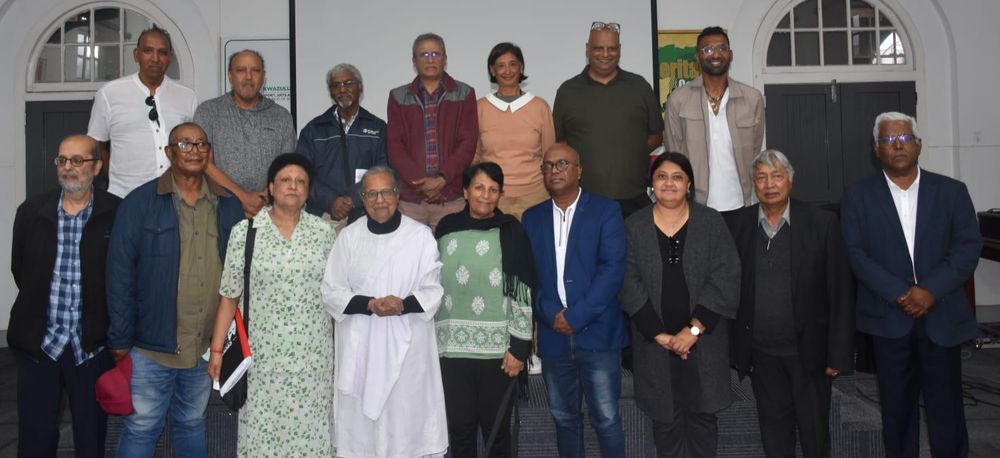
Members of the Natal Indian Congress Legacy Foundation.
A NEW generation is being called on to learn from the struggles of the past as the newly established Natal Indian Congress Legacy Foundation (NICLEF) seeks to ensure that the history and values of the liberation movement are not lost.
The foundation, which held its inaugural meeting at the 1860 Heritage Centre in Durban recently, aims to preserve the legacy of the Natal Indian Congress (NIC), while creating opportunities for young people to engage with the experiences of those who fought against apartheid.
Jeeven Padayachee, a Management Committee (Manco) member of the NICLEF, said the foundation's main objectives were to preserve the NIC's name, legacy and intellectual property, while collecting and archiving documents, artefacts and oral histories linked to the organisation.
“It also aims to promote the NIC's legacy through public programmes and co-operate with similar organisations to promote progressive history and nation-building.
“Its secondary objectives include promoting non-racialism, social cohesion, youth and leadership development, and democratic rights. The foundation hopes to become a permanent centre for education, research, public dialogue and community engagement,” he said.
Padayachee said the decision to establish NICLEF followed renewed public interest in the organisation during its 130th anniversary programme in 2024. This, he added, was also because much of the NIC's history was at risk of disappearing, particularly as many former activists were ageing.
“Our documents, minutes, photographs, banners and artefacts are sitting in garages and homes of ageing veterans and families. If we do not collect them now, they will be lost forever.”
Padayachee said the foundation was also concerned about preserving the oral histories of surviving NIC stalwarts, including their experiences of the Defiance Campaign, Congress Alliance and the struggle for non-racialism.
He said another important part of the project was ensuring that the NIC's broader role in the liberation struggle was not forgotten.
“The NIC is often reduced to an ethnic organisation. In fact, from 1894 it evolved to become a significant force in the broader non-racial struggle.”
Padayachee said the NICLEF planned to establish a digital archive accessible to pupils, researchers and the public, as well as a NIC Youth Fellowship linking young leaders with veterans through mentorship, leadership training and inter-generational dialogue.
It also plans to host heritage lectures, exhibitions, Freedom Charter dialogues and constitutional literacy workshops in schools and communities.
“Newsletters, short videos, social media storytelling and proposed school essay and debate competitions will form part of its youth engagement programme.
“The freedoms our youth enjoy today were won through courage, sacrifice and solidarity. We want them to appreciate that journey.”
Despite its political roots, Padayachee said the NICLEF would not become a political party or contest elections as per its Constitution.
“However, it would not be true to say NICLEF is non-political or apolitical. In the NIC tradition, we have always engaged in the political space. What we mean when we say we will not be drawn into contemporary party politics is that we will not become an appendage of any political party or contest elections.
“We are a civil society, heritage and educational foundation - not a political party. However, we will be political in the best NIC tradition; we will engage in the political space to defend and promote non-racialism, democracy, social cohesion, constitutional rights and social justice.”
Yeshelen Govender, a civil society and humanitarian activist, who is also part of Manco, said his motivation for joining was rooted in his family's connection to the NIC.
“A significant part of my childhood was spent in the presence of various NIC activists who were fighting against the apartheid regime in South Africa. I am well aware of the significant contribution the NIC made to the political struggle against apartheid and its role in helping to develop a more conscious society dedicated to the values outlined in the Freedom Charter and, eventually, our national Constitution.
“These values are now being eroded by reactionary elements in our society, and I believe that this is a danger to the very fabric of a non-racial, humane society that we are aspiring to achieve,” he said.
Govender said the NICLEF could play an important role in transferring the experiences of older activists to younger generations.
“The NICLEF, with its access to a base of seasoned, progressive activists, will play a vital role in ensuring that this experience is passed on to a younger generation of activists and humanitarians.
“For myself, I do not envisage any specific role other than to perhaps help bridge the gap between older activists and the younger generations of emerging activists.”
In terms of the NICLEF Constitution, two structures to oversee and manage the foundation were formally established: the Board and Manco.
The Board members includes veteran NIC stalwart Ela Gandhi (chairperson), Yunus Carrim, Don Gumede, Babu Baijoo, Spider Juggernath, Greta Apelgren, Eric Apelgren, Selvan Chetty, Professor Brij Maharaj, Alf Karrim, Dr Abba Omar, and Dr Reshma Badal.
The Manco comprises struggle and political veteran Maggie Govender (convenor), Ravi Pillay (secretary), Logie Naidoo (treasurer), Yeshelen Govender, Dr Lubna Nadvi, Jeeven Padayachee, Dr Hersheela Narsi, and Roshan Jainath.
The foundation will be formally and publicly launched next year.
