
NATO drafts plan to defeat Russian attack with drones and AI
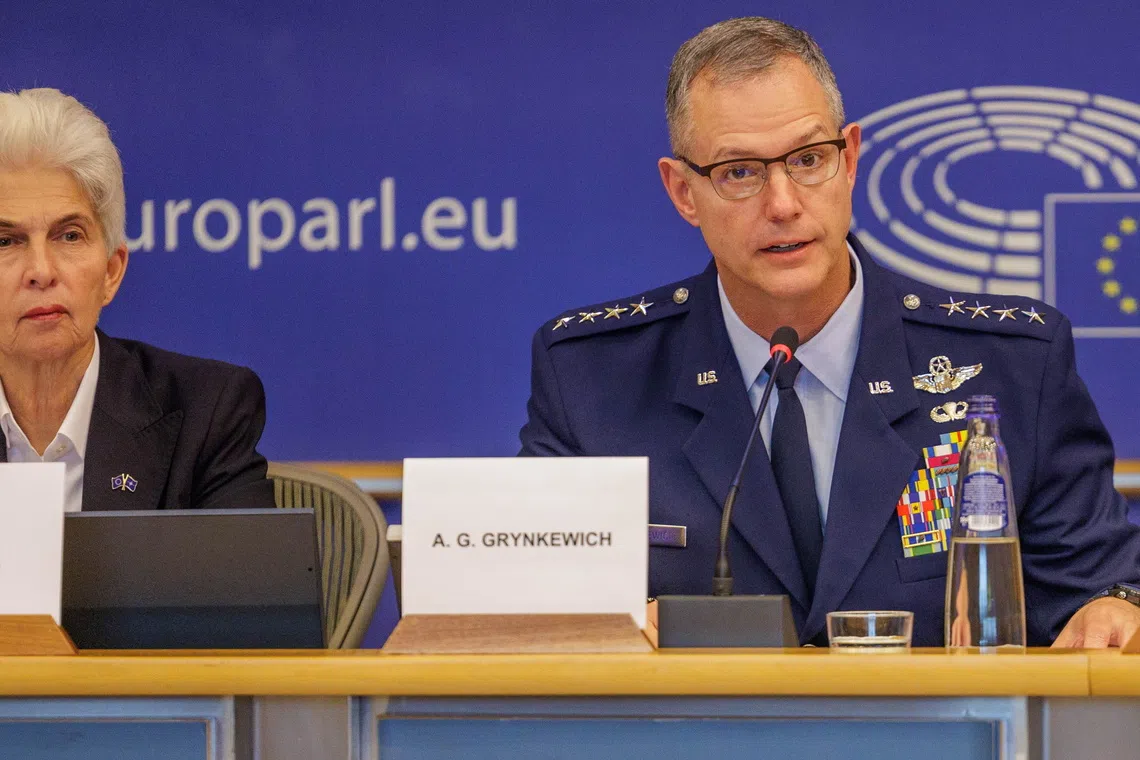
NATO Supreme Allied Commander Europe (SACEUR), US General Alexus G. Grynkewich (right), attending the European Parliament Committee on Security and Defence for an exchange of views in Brussels, Belgium, on Sept 28, 2026.
NATO’s top military commander is working on a strategy for achieving a quick victory against a Russian attack on its eastern flank, with a particular focus on integrating new defence technologies like drones and AI into traditional power.
The so-called theory of victory document, which Bloomberg has seen in an unclassified form, will be presented by Supreme Allied Commander Europe, General Alexus Grynkewich, in Poland on Oct 12 amid heightened tensions between NATO and Russia.
It is meant to clarify how the alliance would handle a possible incursion into NATO territory, according to senior officials and diplomats familiar with the matter. There have been numerous recent reports that Moscow is considering such action.
NATO Secretary-General Mark Rutte said recently that there were no indications that Russia was preparing for a conventional attack on the alliance but that Europe should be prepared for enduring hybrid attacks.
Grynkewich spokesman Colonel Martin O’Donnell declined to discuss details of the plan, but emphasised that the alliance was “purely defensive.”
“The Supreme Allied Commander Europe’s theory of victory is simple: maintain NATO’s advantage,” O’Donnell said.
“Given the unsettled and complex global security environment, we need to set conditions now to deter aggression and, if necessary, win if attacked.”
Although the broad strokes of NATO’s warfighting principles are known, open communication about them is rare.
The initiative is meant to reassure the public about NATO’s readiness while showing a more concrete picture of what is behind the heightened defence spending.
The document is also meant to illustrate to allies how NATO would integrate traditional weapons with the new capabilities that have emerged since Russia’s full-scale invasion of Ukraine in 2022, and to urge more defence investment and better preparations, the people said, asking for anonymity to discuss private matters.
The strategy insists on the defensive nature of NATO and on avoiding involuntary provocations, while explicitly mentioning the need to collectively counter hybrid threats – aggressive actions below the threshold of a conflict – as part of deterrence.
By demonstrating readiness, NATO wants the enemy to conclude that it cannot win, the strategy says.
But if NATO were attacked, it would block an incursion with a mix of land forces and other assets from NATO’s Eastern Flank Deterrence Initiative, a concept relying on low-cost drones, minimally crewed systems and AI-enabled targeting.
An artificial intelligence-enabled robot gun deployed by the Ukrainian Air Force to intercept the new Russian jet-powered drones shown in a handout photo.
After gaining freedom of manoeuvre, it would seek to destroy enemy command and control with the goal of defeating Russian forces quickly and overwhelmingly.
NATO allies, especially in Europe, have massively ramped up defence spending, with tensions emerging about how to prioritise between traditional weapons such as tanks, and alternative technology that has come to the forefront in the Ukraine conflict.
On Oct 5, Germany’s foreign intelligence chief warned lawmakers that Russian President Vladimir Putin has passed the point where he could end attacks on Ukraine “without jeopardising his power base at home,” increasing risk around the continent.
The US sent a questionnaire to NATO allies this summer gauging their defence spending and support for President Donald Trump’s policies to inform decisionmaking on planned cuts of US military assets committed to defending Europe.
As part of this questionnaire, the US asked whether allies had any more forces to commit to NATO for Grynkewich’s defence plans. BLOOMBERG
