Naturally colored cotton brings hope to Paraíba settlers - Valor International
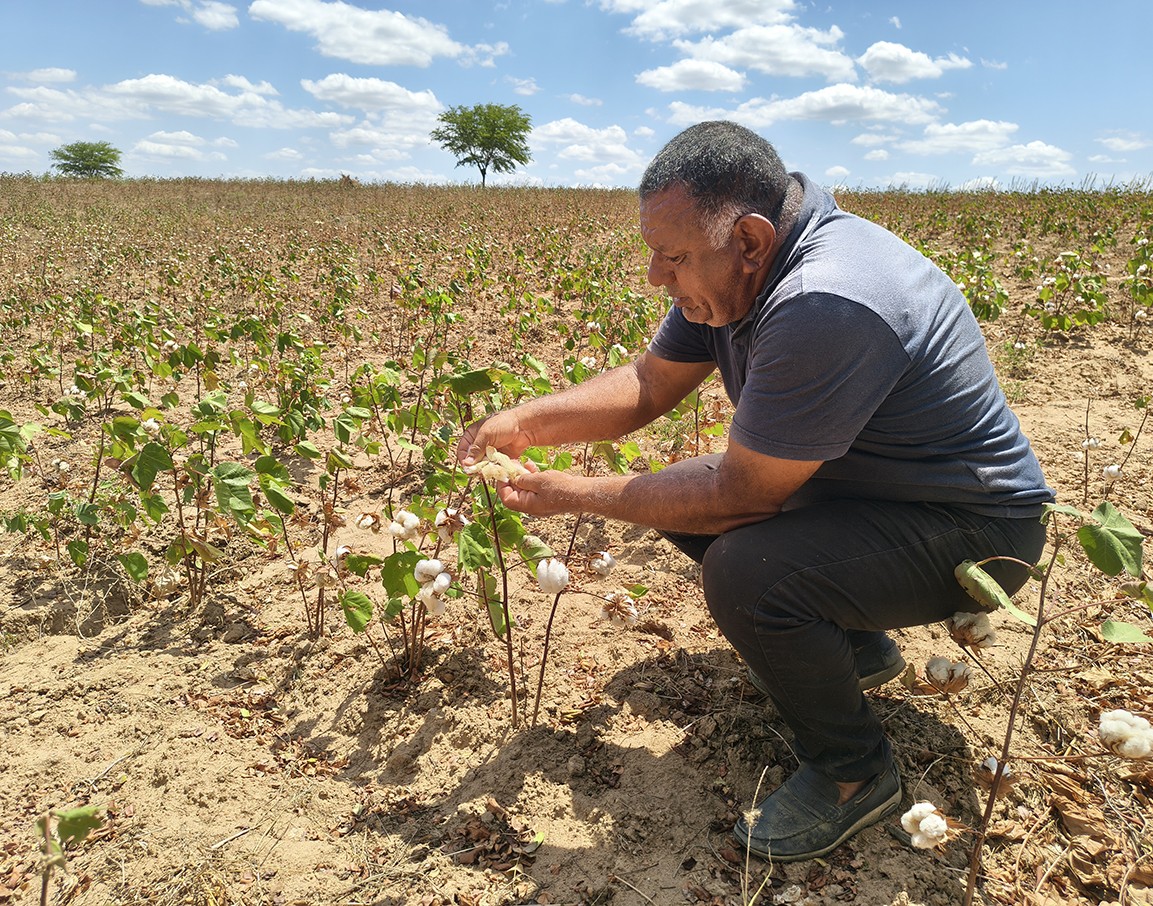
From the frustration of losing their land to the hope of securing a new place to farm and live—this is how smallholder farmers at the Agrovila Águas de Acauã resettlement community feel. Located in Itatuba, in Paraíba’s Agreste region, the community found an opportunity for a fresh start in naturally colored cotton.
On a hot Friday morning, Valor accompanied farmers as they harvested the last fields of naturally colored cotton on the property. It was 7 a.m., but the heat index in the fields was already approaching 30°C, a common springtime condition in Paraíba’s Agreste region. The heat helps the harvest by drying the moisture left by the previous night’s dew.
Under the intense sun, ten farmers began manually removing cotton from the bolls. From a distance, the fiber appeared white, but a closer look revealed the greenish hues of the BRS Verde variety, developed by the Brazilian Agricultural Research Corporation’s Embrapa Cotton unit in Paraíba.
This is the fourth year the settlement has harvested naturally colored cotton. The property spans 330 hectares—each hectare is an area of land equal to 10,000 square meters, or about two and a half acres—and 11 hectares were planted with cotton. Output fell to five tonnes in 2026 from eight tonnes last year because rainfall during the pre-planting period in May exceeded expectations.
The cotton grown there is organic, agroecological, and traceable. During the first few years, it was purchased by Santa Luzia, a textile manufacturer in Paraíba. This year’s crop already has a guaranteed buyer: Organic Cotton Colours (OCC), a textile manufacturer based in Girona, Spain. The transaction was brokered by the Paraíba Agricultural Research, Rural Extension, and Land Regularization Company (Empaer).
This season, the settlement’s farmers received R$10 per rama, or about one kilogram, of raw green cotton, including the seed and lint. Last year, brown cotton fetched R$8 per rama. The Spanish company selected the seed and also covered its purchase cost.
Osias Bezerra de Lima, known in the community as Dida, has been a farmer for 50 years. As a child, he grew up growing corn and beans on his father’s land. He has now found a stable income from cotton.
“Naturally colored cotton is a very good crop to work with because every year I know I will have income at the end of the harvest. With corn and beans, it takes a great deal of work to harvest a kilogram and secure a guaranteed buyer,” Lima explained.
After 40 minutes of harvesting, the heat prompted occasional complaints from some farmers. But between handfuls of cotton, the group’s good humor and conversations about weekend plans made the work feel lighter. More than a community, everyone there seems to be part of the same family.
Anyone watching such a close-knit group at work and in daily life would hardly imagine the years of struggle required to secure land and decent housing. In 2002, after heavy rainfall, the Acauã dam on the Paraíba River overflowed, flooding rural areas of Aroeiras, Itatuba, and Natuba. According to the Federal Prosecutor’s Office (MPF), 800 families were affected, including the 100 now living in the Itatuba settlement.
In the rural community of Pedro Velho, in Aroeiras, at least 500 families were forced to abandon their homes. Among them was the family of Osvaldo Bernardo, a farmer and community leader at the Agrovila Águas de Acauã resettlement.
“The [Paraíba] River was like a mother to us. We grew corn, beans, pumpkins, and sweet potatoes. But when a dam is built in Brazil, it automatically leaves someone landless. The force of the water drove us out, and we lost our income,” he recalled.
After the disaster, Bernardo met with state government officials to find a solution. When no immediate response came, he and other farmers organized a protest involving 500 people, who marched from Campina Grande to the state capital, João Pessoa.
The protest drew the attention of organizations such as the Movement of Dam-Affected People (MAB), where Bernardo now serves as a director, and agencies such as the MPF, which was already monitoring similar events in other parts of the Northeast.
Twenty years after the disaster, in 2022, the Paraíba state government purchased the land where the Agrovila Águas de Acauã resettlement now stands for R$11 million.
The site has 100 houses that are undergoing the final stages of renovation and are expected to be delivered later in 2026. Everyone in the settlement says they are eager to enjoy their new homes. Each lot covers 1.5 hectares, and with state subsidies, some farmers are already growing forage cactus and fruits such as cashews, acerola cherries, and soursop.
“Of the 100 families living here, 67 will have fruit trees in their backyards. Imagine how much acerola we will need to bring to market. The challenge now is to create an organization to sell fruit and vegetables, particularly through government purchasing programs for smallholder farmers,” Bernardo noted.