Navy ATC to manning cranes: Meet 3 women breaking barriers in male-dominated jobs
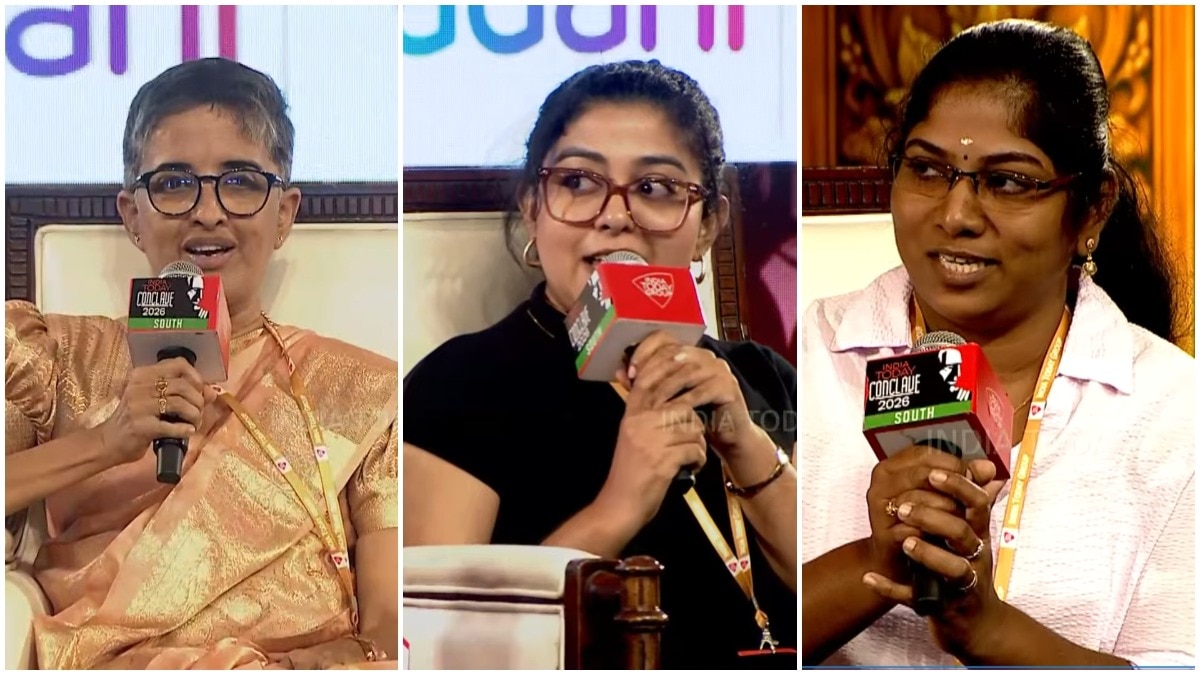
For women entering professions traditionally dominated by men, the biggest challenge is often not the job itself but the expectations surrounding it. At the India Today Conclave South, three women who have worked in unconventional and demanding roles spoke about overcoming resistance, proving themselves and finding confidence in careers that many once considered off-limits to women.
From serving as an Air Traffic Control (ATC) officer in the Indian Navy to operating massive ship-to-shore cranes at Vizhinjam International Seaport, Commander Prasanna Edayilliam (retd), Nathana Mary JD and Shiji U shared stories of persistence, institutional support and the importance of creating opportunities for women.
Their experiences, though from very different workplaces, reflected a common theme -- women often have to enter spaces that were not designed with them in mind and then prove that they belong there.PRASANNA'S FIGHT FOR EQUAL OPPORTUNITY
Commander Prasanna Edayilliam, a retired Indian Navy officer, fought a historic legal battle for permanent commissions and gender equality for women in the Indian Armed Forces.
Her entry into the armed forces took her into a profession where women were still a small minority. She eventually served as an Air Traffic Control officer in the Navy, a role that required precision, discipline and the ability to operate in a demanding environment.
But her career was also shaped by the institutional limitations women officers faced at the time.
"We completed 14 years. There was no pension, no medical benefits. We fought a case because it was an injustice," Prasanna remembered in her legal fight at the India Today Conclave South.
At the time, women officers were not permitted to continue in permanent service on the same terms as their male counterparts. Prasanna and other women officers challenged the policy in court, seeking greater career security and equal opportunities.
The legal battle eventually contributed to a wider change in the armed forces, with women being allowed to seek permanent commission. In March 2020, the Supreme Court ordered the removal of statutory restrictions on the entry of women into the Navy and directed that male and female officers be treated equally when considering Permanent Commission.
"In a couple of years, you will find an Army Chief who is a woman," Commander Prasanna, who started her journey as an NCC cadet and caused fundamental changes in the Indian Armed Forces, said.
For Prasanna, the significance of these changes extends far beyond her own career. She believes that the increasing presence of women in the armed forces could eventually transform the highest levels of military leadership.
According to her, the challenges for women in the armed forces were not limited to formal rules or career structures. She said women entering unconventional professions often have to challenge perceptions at every stage and repeatedly demonstrate their capabilities.
She agreed when asked if "there was resistance at every point" and whether she had to prove herself. "It is tough. We follow norms. If someone thinks out of the box, you are pointed out," she added.
Citing an example, she said, "When I joined the service, there was no washroom for women. There were only male officers." She also recalled how even routine language in the workplace changed as more women entered the armed forces. "Initially, it was 'Good morning, gentlemen' for briefing. Then it became 'ladies and gentlemen'," she recalled.
For Prasanna, these seemingly small changes represented a much larger transformation in the workplace.NATHANA TAKES ON GIANT CRANES
At Vizhinjam International Seaport, Nathana Mary JD has taken up another profession that has traditionally been associated with men -- operating massive cranes used to handle containers at the port.
A physics graduate, Nathana entered the port industry, which is male-dominated and women still remain a small minority in the field.
The job required technical training and the ability to operate heavy machinery in a demanding environment. Nathana said she gradually gained confidence through training and the support of her colleagues and managers.
"Eventually, through training and support from the managers, I became more confident in what I am doing," she said.
There are now nine women operating cranes at Vizhinjam, according to Nathana, signalling a gradual shift in an industry where women have historically had limited representation.
Operating the cranes comes with its own challenges, particularly when it involves handling massive containers. But Nathana said advances in technology have made the work more manageable.
"When people know about the career, they are shocked," she said.
"During my childhood, I would not have believed that I would become a crane operator at the Adani port," she added.
For Nathana, her presence in the profession is part of a broader change in the workplace.
"Women are doing more jobs in male-dominated fields. It is gradually changing and I am very proud of representing the change," she said.
She believes the key is not simply encouraging women to enter such professions but ensuring that they receive the training and opportunities needed to succeed.
"Women can enter into any field. With opportunity and proper training, it will give [them] a level playing field," Nathana said.
Importantly, she said confidence does not necessarily have to come before taking up an unconventional career. It can develop after a woman gets the opportunity to try.
"Sometimes ourselves will be our support systems. When you take that opportunity, the confidence will happen," she said.SOLE BREADWINNER WHO LEARNT TO OPERATE CRANE
Shiji U, another crane operator at Vizhinjam International Seaport, described a similar journey of entering a profession that she initially found intimidating.
A resident of Vizhinjam, Shiji said taking up the role of a crane operator was difficult in the beginning, particularly because she was entering a highly technical and traditionally male-dominated workplace.
"CRMG (Cantilever Rail-Mounted Gantry) operator, it was very difficult for me and I never thought I could continue," she said.
But she persisted and gradually acquired the confidence and skills required to handle the demanding job.
"It was difficult for me, but now I am able to do it. And I am proud of it," Shiji said.
For Shiji, the decision to continue working was also driven by circumstances at home. She is the sole breadwinner of her family and said she needed to earn an income.
"Yes, I am confident. But in my family, there is no other earning, so I had to earn," she said.
She also acknowledged the support she received from her family, which helped her persevere despite the initial difficulties.
Her experience, she said, demonstrates how opportunities and training can enable women to take up jobs that they may initially believe are beyond their reach.
The three women said breaking traditional barriers requires more than individual determination. Families, institutions and society also need to change the way they perceive women's careers.
Prasanna pointed to the dramatic change in access to information over the years. When she began her career, young women had far fewer avenues to learn about unconventional career opportunities.
"Those days there was no Google to help. There was no information source. Now everything is available," she said.
The availability of information, she said, has made it easier for young people to explore opportunities outside their immediate surroundings and consider careers that may not have been traditionally available to them.
The change, according to Prasanna, is not simply about women entering professions traditionally occupied by men. It is also about expanding the idea of what a woman can aspire to become.
The experiences of the three women -- one who worked as an Air Traffic Control officer in the Navy and fought for greater career rights for women officers and two who operate giant cranes at one of India's major ports -- illustrate how those boundaries can shift when women are given opportunities, training and institutional support.
For young women considering careers outside conventional choices, Prasanna offered a simple message. "You should have the passion. You will achieve it," she said.- Ends