Nearly $12bn project pipeline gives new weight to Seoul –Tashkent ties in minerals, AI and transport
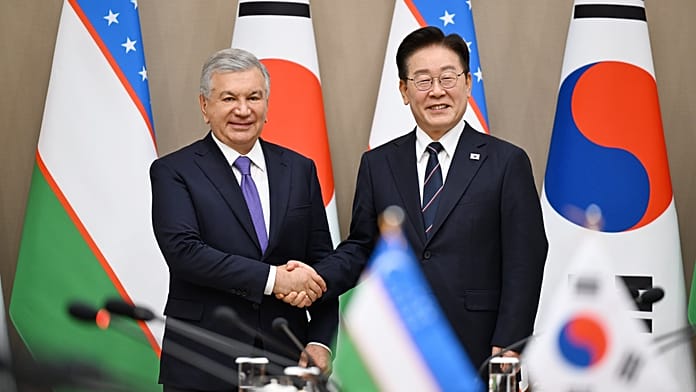
Nearly $12bn (€10.4bn) in prospective projects is giving new economic weight to ties between Uzbekistan and South Korea, a relationship Seoul already classifies as a Special Strategic Partnership, its only one with a Central Asian country.
Uzbek President Shavkat Mirziyoyev is in Seoul ahead of Wednesday’s first C5+Korea leaders’ summit, with bilateral talks focused on investment, technology and industrial cooperation.
The latest discussions have also produced a new $8bn (€6.9bn) cooperation programme with Korea Eximbank, while agreements signed or exchanged during the visit cover critical minerals, AI in manufacturing, transport, healthcare and other sectors.
The economic agreements were accompanied by a broader political push during Mirziyoyev’s summit with South Korean President Lee Jae Myung.
Lee called Uzbekistan a “precious friend and a key partner” while Mirziyoyev noted that the relationship had proved resilient over time.
“Our bilateral ties do not falter with political changes,” he said, while reaffirming Uzbekistan’s support for Seoul’s efforts to promote peace and stability on the Korean Peninsula.
The talks also covered deeper military-technical cooperation, including training and closer contacts between the two countries’ defence institutions.
Mirziyoyev also met Prime Minister Han Seong-sook on Tuesday, with talks covering trade, investment, the digital economy and cybersecurity. They also discussed processing critical minerals using Korean technology and Uzbekistan’s raw-material base, as well as cooperation on transport and railway infrastructure.
Critical minerals are one of the clearest strategic areas of cooperation.
Uzbekistan plans 120 projects worth more than $4bn (€3.5bn) in the sector in the coming years. But Tashkent’s pitch is not simply about giving Korean companies access to new deposits.
President Mirziyoyev said at a business forum that the priority was not simply to export raw materials, outlining plans to build full production chains inside Uzbekistan, from deep processing to finished high-tech products.
South Korea has its own strategic interest: its automotive, electronics and battery industries depend on secure supplies of critical materials.
The two countries now plan to expand cooperation through their existing Korea-Uzbekistan Rare Metals Center, a joint project developing technology for refining and processing high-purity metals. Seoul says cooperation will cover the full chain from exploration and development to processing.
A joint fund for strategic critical-mineral projects has also been launched, while the two sides are considering a centre to develop and test semiconductors and new materials.
For Uzbekistan, the aim is to keep more of the value generated from its resources at home. For South Korea, the partnership offers another route to diversify critical-mineral supply chains.
Uzbek President Mirziyoyev also met Korea Eximbank chairman Hwang Ki-yeon in Seoul, with financing for critical minerals, digital technologies, transport and healthcare among the projects discussed.
Under a financing framework agreed with Uzbekistan’s investment ministry, Korea Eximbank will help identify prospective projects and assess financing options in six priority areas, including critical minerals, AI and data centres, smart cities, an industrial zone for Korean companies, pharmaceuticals and biotechnology.
The mechanism is intended to help move projects from the planning stage towards financing and implementation.
Shavkat Mirziyoyev used a series of meetings with senior Korean executives to push for more production to move inside Uzbekistan.
He met Kim Seong, Hyundai Motor Group’s president for strategy, and Kia Motors senior vice-president Cho Sang-woon to discuss expanding the automotive cluster in Jizzakh, increasing local production of components, introducing new Kia models and exploring the assembly of electric and hybrid vehicles.
He described the broader objective at the business forum as a shift from assembly operations towards full-cycle industrial clusters.
Korean companies were also invited into copper processing, electrical equipment, robotics, automation, battery storage and grid modernisation.
Uzbekistan wants its electrical engineering industry to reach $11bn by 2030, with exports reaching $5bn.
Transport infrastructure was another focus of Mirziyoyev’s meetings with Korean companies.
He met Hyundai Rotem chairman Lee Yong-bae to discuss further rail cooperation, including a service centre in Uzbekistan, localisation of railway components and production of magnets for electric motors.
The two governments signed a memorandum for a South Korean-funded feasibility study on the possible acquisition of up to eight additional high-speed trainsets.
Possible Korean participation in a new Tashkent-Samarkand railway is also under discussion.
In aviation, Mirziyoyev met representatives of Incheon International Airport Corporation, which is involved in plans to modernise Urgench airport and develop a new international airport for Tashkent. The company also plans to establish a representative office in the Uzbek capital.
President Mirziyoyev also met members of the Uzbek community living and working in South Korea, including entrepreneurs, academics and specialists.
The visit also highlighted the cultural ties between the two countries. During his summit with South Korean President Lee Jae Myung, Mirziyoyev described Uzbekistan’s ethnic Korean community as a “spiritual bridge” between the two countries. The two leaders also agreed to designate 2027 as a Year of Culture and Exchanges.
The visit is also being accompanied by Days of Uzbek Culture in Seoul and other South Korean cities, adding a cultural dimension to the political and economic programme.