Nepal floods: Why information can't be casualty in Himalayan calamity
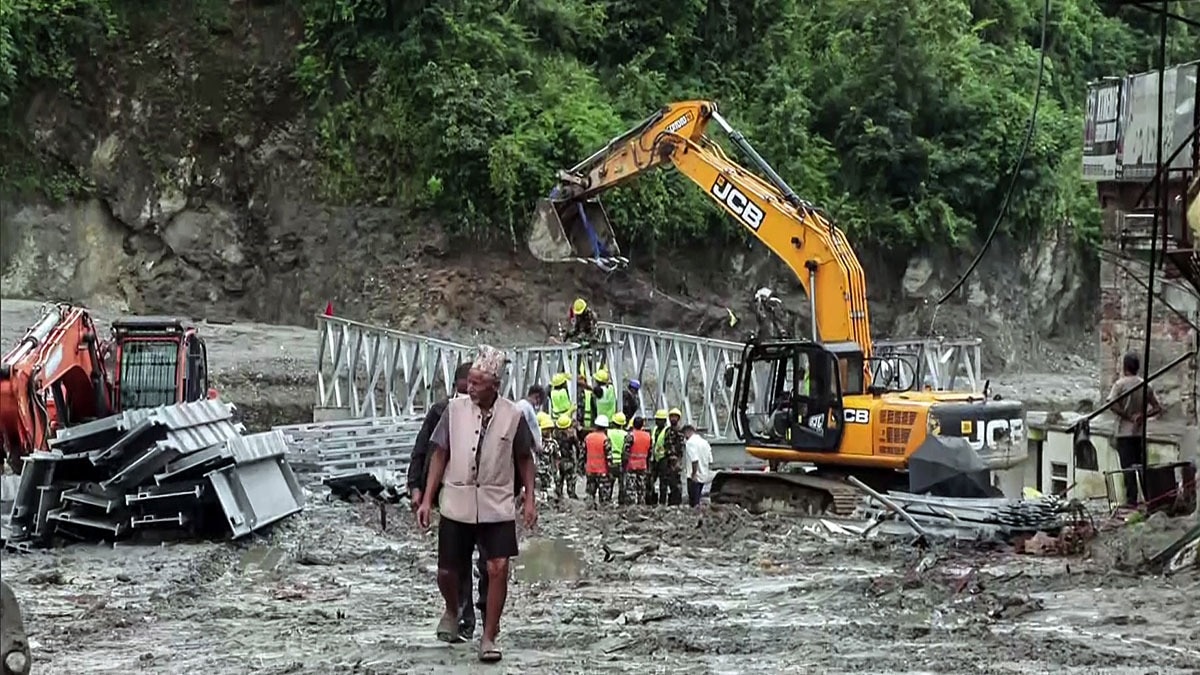
The devastating flash floods that struck the Nepal-Tibet border on August 26 exposed more than the Himalayas’ growing vulnerability to extreme weather and geological events. It also brought into focus a less visible but increasingly important challenge for India: when a disaster crosses borders, reliable information is critical. Knowing, as in this case, what happened upstream, how fast conditions are changing and who is at risk can determine whether communities downstream have minutes or hours to respond.
Last week, while addressing the 81st session of the UN General Assembly, Nepal prime minister Balendra Shah proposed a Himalayan Climate Resilience Mechanism led by his country as well as India and China, in the wake of the devastating flash floods. He also reminded world leaders that a warming climate was destabilising the fragile Himalayan ecology.
The Nepal-Tibet disaster had followed a high-altitude slope failure involving rock and glacier ice, sending a destructive surge through the Himalayan river system. Nepal suffered enormous losses while China reported deaths, missing people and extensive damage in Tibet’s Gyirong County.
A strategically important border crossing used for trade and by Kailash Mansarovar pilgrims was also disrupted. The full scale of the destruction has emerged gradually, with Nepal reporting more than 1,400 deaths and thousands still missing weeks after. China’s official figures have been considerably lower, although they too have been revised upwards.
What has drawn particular attention is Beijing’s handling of information coming out of Tibet. Chinese authorities said 10 people had been penalised for spreading what they called “false disaster information”, including claims that the number of casualties in Tibet was far higher than officially reported. The authorities did not identify those punished or disclose the precise penalties.
Beijing has defended the action as necessary to prevent misinformation and maintain public order. Critics, however, argue that restricting independent reporting during a disaster can make it harder to establish what is happening on the ground.
For India, the more important question is what this episode tells us about Himalayan disaster management. The floods crossed political boundaries. The river systems affected in the region are connected to India—the Trishuli-Narayani system eventually enters India as the Gandak. Indian authorities put downstream areas on alert even as rising water levels raised concerns in parts of Bihar and elsewhere. India also extended massive humanitarian assistance to Nepal.
Experts pointed out that the larger weakness is clear: real-time information about the Himalayas cannot remain fragmented between countries. Data on glacier movement, glacial lakes, rainfall, landslides, river levels and upstream water flows can determine how much warning downstream communities receive. Nepal had already been seeking greater cooperation with China on flood, weather and glacier monitoring, underlining the need for more institutionalised cross-border early-warning systems.
For India, this is no longer simply a disaster-relief issue. The Himalayas are one of Asia’s most sensitive geopolitical regions, involving India, China, Nepal and Bhutan. Climate and geological risks add another layer to an already complicated environment. A major event upstream can quickly become a problem for roads, bridges, hydropower projects, border infrastructure, trade routes, communications and communities downstream. The August 26 disaster showed how rapidly a seemingly local mountain event can turn into a regional crisis.
There is an equally important lesson about information. Governments have a legitimate responsibility to prevent dangerous misinformation during emergencies. But observers believe that suppressing unverified claims does not, by itself, produce reliable information. “When official updates are limited or slow, an information vacuum can be filled by rumours,” said an observer, adding that for India, the better solution was to communicate more, not less—provide timely official information, enable independent verification and make credible data available to the public and to neighbouring countries.
Technology can play a major role here. India has the opportunity to build a much stronger Himalayan early-warning architecture by bringing together satellite imagery, weather and hydrological sensors, glacier and glacial-lake monitoring, river-level data, artificial intelligence (AI) and secure communications. The objective should be straightforward: detect abnormal changes early, assess their likely downstream impact and get verified warnings to disaster-management agencies and vulnerable communities as quickly as possible. Such a system would be far more effective if relevant information could also be shared rapidly with Nepal and other Himalayan neighbours.
There is a direct humanitarian dimension as well. Indian nationals were among those reported missing on the Chinese side—thousands of Indians travel through Nepal for the Kailash Mansarovar pilgrimage. Chinese authorities subsequently reported that 49 Indian nationals were among the foreigners listed as missing in Tibet. For Indian authorities and families, this makes access to accurate information on casualties, identification, rescue operations and evacuation particularly important.
Observers believe that the real lesson from the disaster, therefore, is bigger than China’s decision to punish people accused of spreading rumours. It is about who controls information when a natural disaster crosses borders. In the Himalayas, rivers, glaciers, roads, trade routes and communities do not stop at political boundaries. Information cannot afford to do so either.
India needs a Himalayan disaster architecture built around better scientific-monitoring, stronger cooperation with Nepal and other neighbours, rapid information-sharing and independent verification. AI, satellites and real-time sensors can make that possible, but only if the underlying data is shared quickly and trusted by those who need it. In the Himalayas, the first few minutes of reliable information can be worth as much as the first few hours of rescue.
Deputy Editor with India Today magazine. Primarily reports on defence and strategic affairs. An old school journalist, who believes in plainspeak. A print journalist who has worked at several mainstream national newspapers and magazine. In over two decades of journalism journey, he has been breaking stories and shaking things up with his investigative reports. He enjoys tracking political upheavals in the country.