New UPI charges from October 15: What it means for you
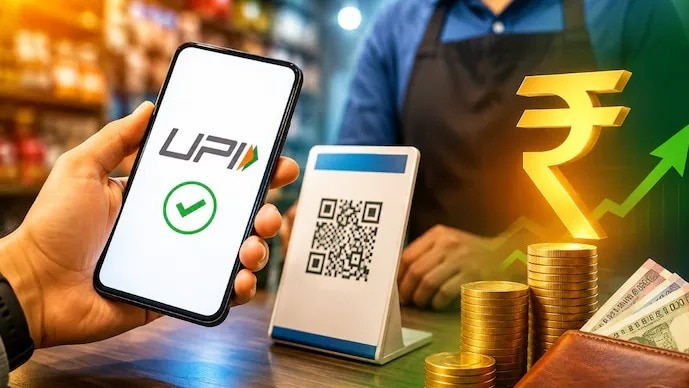
A new charge is coming to UPI payments from October 15, but there is an important catch. You, as the person making the payment, will not be charged.
The new Merchant Discount Rate framework will impose a 0.4% charge on direct UPI payments to merchants above Rs 2,000. The charge will be paid by the merchant to its acquiring bank and will be capped at Rs 300 for transactions of Rs 75,000 and above.
If you pay Rs 1,500 through UPI at a shop, nothing changes. If you pay Rs 3,000, the merchant will pay Rs 12 in MDR, but you will still pay Rs 3,000.
And that is where the more interesting question begins. If the customer does not pay the fee directly, who ultimately bears the cost?WHAT HAPPENS WHEN YOU PAY MORE THAN RS 2,000?
The simplest way to understand the new system is through the numbers.
A Rs 3,000 UPI payment will attract an MDR of Rs 12.
A Rs 50,000 payment will attract Rs 200.
A Rs 75,000 payment would work out to Rs 300, and that becomes the maximum charge. So even a Rs 1 lakh UPI payment will attract Rs 300 rather than Rs 400.
The charge applies to Person-to-Merchant, or P2M, transactions.
It does not mean your bank account will suddenly be debited for an extra Rs 12 when you buy something worth Rs 3,000.
The merchant bears the MDR.YOU WILL NOT SEE A SEPARATE UPI FEE
The framework is explicit on this point. Merchants cannot pass the MDR on to customers while accepting UPI payments.
So if your bill is Rs 3,000, a merchant cannot simply say that UPI costs Rs 12 extra and collect Rs 3,012 from you. The framework says merchants cannot pass the MDR on to buyers while accepting payments through UPI. Consumers are expected to pay the posted price.
UPI app providers also cannot impose a platform fee or any other charge on UPI payments.
For consumers, therefore, the transaction remains free.
There is also no charge for sending money to another person. Person-to-person transfers, whether to a friend, family member or another account belonging to you, remain free regardless of the amount transferred.MOST EVERYDAY UPI PAYMENTS WILL NOT BE AFFECTED
The new MDR does not apply to standard P2M UPI transactions of Rs 2,000 or less.
According to the FAQ, these transactions account for more than 95% of P2M UPI transaction volume.
So a Rs 100 payment at a tea stall, a Rs 700 grocery bill or a Rs 1,500 purchase will continue as before.
There is no MDR on these transactions.
The change becomes relevant when you make a direct UPI payment to a merchant above Rs 2,000.WHAT DOES THE CHARGE LOOK LIKE IN REAL LIFE?
Consider a restaurant bill of Rs 2,500.
If you pay by direct account-to-merchant UPI, the restaurant would incur an MDR of Rs 10.
Now consider a Rs 10,000 purchase. The merchant would pay Rs 40 in MDR.
At Rs 50,000, the charge rises to Rs 200.
The cap becomes important for larger purchases. At Rs 75,000, the 0.4% calculation reaches Rs 300, and that becomes the ceiling. A Rs 1 lakh transaction therefore attracts Rs 300 rather than Rs 400.
The government says the rate is still considerably lower than charges associated with traditional card payments. The FAQ puts typical credit card MDRs at 1.5% to 2.5% and debit card MDRs at up to 0.90%.SMALL SHOPKEEPERS HAVE A SEPARATE EXEMPTION
The Rs 2,000 threshold is not the only protection for small merchants.
Vendors classified under the P2PM framework and receiving up to Rs 1 lakh a month through UPI QR codes directly into their accounts will continue to enjoy zero MDR.
This means a small vendor does not automatically start paying MDR simply because one customer makes a payment of more than Rs 2,000.
For example, if a qualifying small vendor receives Rs 2,500 from a customer, that payment itself does not make the vendor liable for MDR.
The framework says eligibility depends on the merchant’s classification and monthly inward-payment threshold.
If a P2PM merchant receives more than Rs 1 lakh through UPI for three consecutive months, it will transition into the P2M category.
Existing QR codes will continue to work. Small merchants do not need to replace or re-register them because of the new MDR framework.SOME PAYMENTS WILL ATTRACT ONLY RS 5
The standard 0.4% MDR does not apply to every type of merchant payment.
Certain categories, including railways, telecom services, insurance and fuel, will have a flat MDR of Rs 5 for transactions above Rs 2,000.
That makes a big difference for larger payments.
A Rs 50,000 payment at a regular merchant would attract Rs 200.
A qualifying Rs 50,000 insurance payment would attract just Rs 5.
The same Rs 5 flat rate applies to qualifying fuel payments above Rs 2,000. Payments below Rs 2,000 remain at zero MDR.
Electricity, water and piped natural gas payments above Rs 2,000 will also attract a flat Rs 5 MDR rather than the standard 0.4% rate. Payments below that threshold will remain at zero MDR.
Capital-market payments have yet another rate. Payments involving mutual funds, securities, stockbrokers, dealers and investment platforms will attract an MDR of 0.02%, capped at Rs 300.WHAT ABOUT CREDIT CARDS ON UPI?
The new MDR framework is specifically for direct account-to-merchant UPI payments.
Credit-linked UPI transactions, such as RuPay credit cards linked to UPI and pre-sanctioned credit lines, are governed by separate credit-product rules.
So the new 0.4% framework should not be read as a new charge applicable to every transaction made through a UPI app.CAN MERCHANTS RAISE PRICES BECAUSE OF THIS?
This is where the answer is less straightforward.
The rules prevent a merchant from directly passing the MDR on to a customer as a UPI fee.
But that is different from saying that a business can never change its prices.
One merchant could absorb the Rs 12 MDR and continue selling it for Rs 3,000.
Another could decide that its overall costs have increased and raise the general price of the product to Rs 3,012 for everyone, regardless of how they pay.
That would not be the same as adding a separate UPI surcharge.
The FAQ argues that merchants have little economic incentive to inflate prices because digital payments can generate higher footfall, larger average transaction values and lower cash-handling risks. It says consumers will continue to pay the listed price.
But that is an economic argument, not a blanket legal guarantee that businesses can never change their prices.
Whether merchants absorb the cost, accept a slightly lower margin or adjust their broader pricing will depend on the individual business and the competitive environment.
So while you will not be charged the MDR directly, it is too simplistic to say that consumers can never feel the economic impact of the new cost.WHY IS THE GOVERNMENT INTRODUCING MDR NOW?
The government’s argument is that UPI has become too large to rely indefinitely on government subsidies to fund its infrastructure.
The FAQ estimates that payment operations, server bandwidth, fraud prevention systems and bank technology support cost the industry around Rs 20,000 crore a year.
UPI processed 2,451 crore transactions worth Rs 29.9 lakh crore in August 2026 alone, according to the FAQ.
The government says MDR revenue will remain within the UPI ecosystem and be used for infrastructure resilience, innovation, cybersecurity and customer service.
It has also proposed a dedicated fund to support digital-payment infrastructure and merchant onboarding in smaller towns and rural areas. The detailed framework for that fund is to be finalised in consultation with the Reserve Bank of India within three months.
The broader objective is therefore to move UPI towards a commercial model that can fund its own infrastructure rather than depend entirely on government support.SO WHAT DOES THIS MEAN FOR YOU?
For most people, the immediate answer is simple. Not much changes.
If you use UPI to make everyday payments below Rs 2,000, the new MDR does not affect you.
If you transfer money to another person, there is still no charge.
If you make a larger purchase, the merchant, not you, pays the MDR.
You also cannot be charged a separate UPI fee by the merchant under the new framework, and UPI apps cannot impose their own platform fee.
But there is a broader economic question that the new rules cannot completely settle.
The framework determines who pays the payment-processing fee directly. It does not determine how every business will respond to having that additional cost.
A merchant may absorb it. Another may accept a slightly lower margin. Another may find ways to cut costs. Some businesses could potentially adjust their general prices.
That does not mean prices will rise because of MDR. The FAQ itself argues that merchants have little economic incentive to do so.
But it is important to distinguish between a direct UPI charge, which the framework prohibits merchants from passing on, and the broader question of how businesses manage their costs.
So the most accurate way to look at the change is this.
UPI remains free for you at the point of payment. But the cost of processing some larger merchant transactions has now shifted into the merchant side of the ecosystem.
The new regime begins on October 15.
Who ultimately bears that cost will depend on what merchants do next.- EndsPublished By: Vivek Published On: Sep 15, 2026 20:53 IST